

476
10 Transport Processes
Metal plate
of area Ꮽ
Electrical
power
supply
Metal plate
of area Ꮽ
d
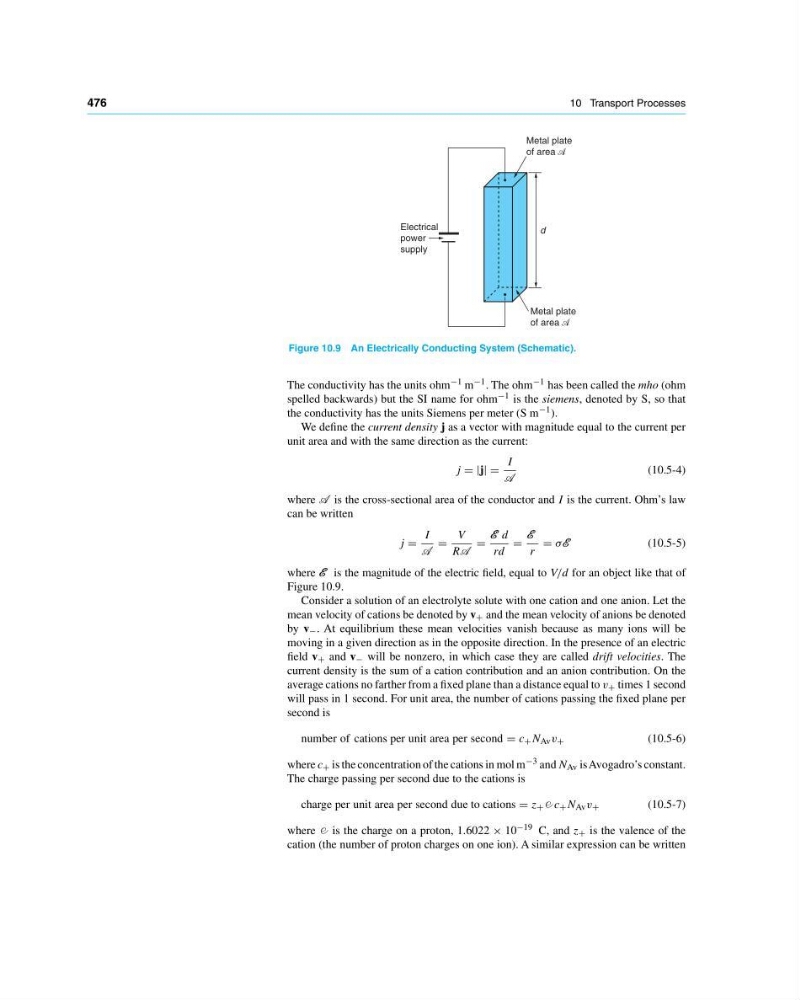
Figure 10.9 An Electrically Conducting System (Schematic).
The conductivity has the units ohm −1 m −1 . The ohm −1 has been called the mho (ohm
spelled backwards) but the SI name for ohm −1 is the siemens, denoted by S, so that
the conductivity has the units Siemens per meter (S m −1 ).
We define the current density j as a vector with magnitude equal to the current per
unit area and with the same direction as the current:
j |j|
I
A
(10.5-4)
where A is the cross-sectional area of the conductor and I is the current. Ohm’s law
can be written
j
I
A
V
RA
E E E d
rd
E E E
r
σE E E
(10.5-5)
where E E E is the magnitude of the electric field, equal to V/d for an object like that of
Figure 10.9.
Consider a solution of an electrolyte solute with one cation and one anion. Let the
mean velocity of cations be denoted by v + and the mean velocity of anions be denoted
by v − . At equilibrium these mean velocities vanish because as many ions will be
moving in a given direction as in the opposite direction. In the presence of an electric
field v + and v − will be nonzero, in which case they are called drift velocities. The
current density is the sum of a cation contribution and an anion contribution. On the
average cations no farther from a fixed plane than a distance equal to v + times 1 second
will pass in 1 second. For unit area, the number of cations passing the fixed plane per
second is
number of cations per unit area per second c + N Av v +
(10.5-6)
where c + is the concentration of the cations in mol m −3 and N Av is Avogadro’s constant.
The charge passing per second due to the cations is
charge per unit area per second due to cations z + e c + N Av v +
(10.5-7)
where e is the charge on a proton, 1.6022 × 10 −19 C, and z + is the valence of the
cation (the number of proton charges on one ion). A similar expression can be written
10 Transport Processes
Metal plate
of area Ꮽ
Electrical
power
supply
Metal plate
of area Ꮽ
d
Figure 10.9 An Electrically Conducting System (Schematic).
The conductivity has the units ohm −1 m −1 . The ohm −1 has been called the mho (ohm
spelled backwards) but the SI name for ohm −1 is the siemens, denoted by S, so that
the conductivity has the units Siemens per meter (S m −1 ).
We define the current density j as a vector with magnitude equal to the current per
unit area and with the same direction as the current:
j |j|
I
A
(10.5-4)
where A is the cross-sectional area of the conductor and I is the current. Ohm’s law
can be written
j
I
A
V
RA
E E E d
rd
E E E
r
σE E E
(10.5-5)
where E E E is the magnitude of the electric field, equal to V/d for an object like that of
Figure 10.9.
Consider a solution of an electrolyte solute with one cation and one anion. Let the
mean velocity of cations be denoted by v + and the mean velocity of anions be denoted
by v − . At equilibrium these mean velocities vanish because as many ions will be
moving in a given direction as in the opposite direction. In the presence of an electric
field v + and v − will be nonzero, in which case they are called drift velocities. The
current density is the sum of a cation contribution and an anion contribution. On the
average cations no farther from a fixed plane than a distance equal to v + times 1 second
will pass in 1 second. For unit area, the number of cations passing the fixed plane per
second is
number of cations per unit area per second c + N Av v +
(10.5-6)
where c + is the concentration of the cations in mol m −3 and N Av is Avogadro’s constant.
The charge passing per second due to the cations is
charge per unit area per second due to cations z + e c + N Av v +
(10.5-7)
where e is the charge on a proton, 1.6022 × 10 −19 C, and z + is the valence of the
cation (the number of proton charges on one ion). A similar expression can be written