

10.4 Transport Processes in Liquids
473
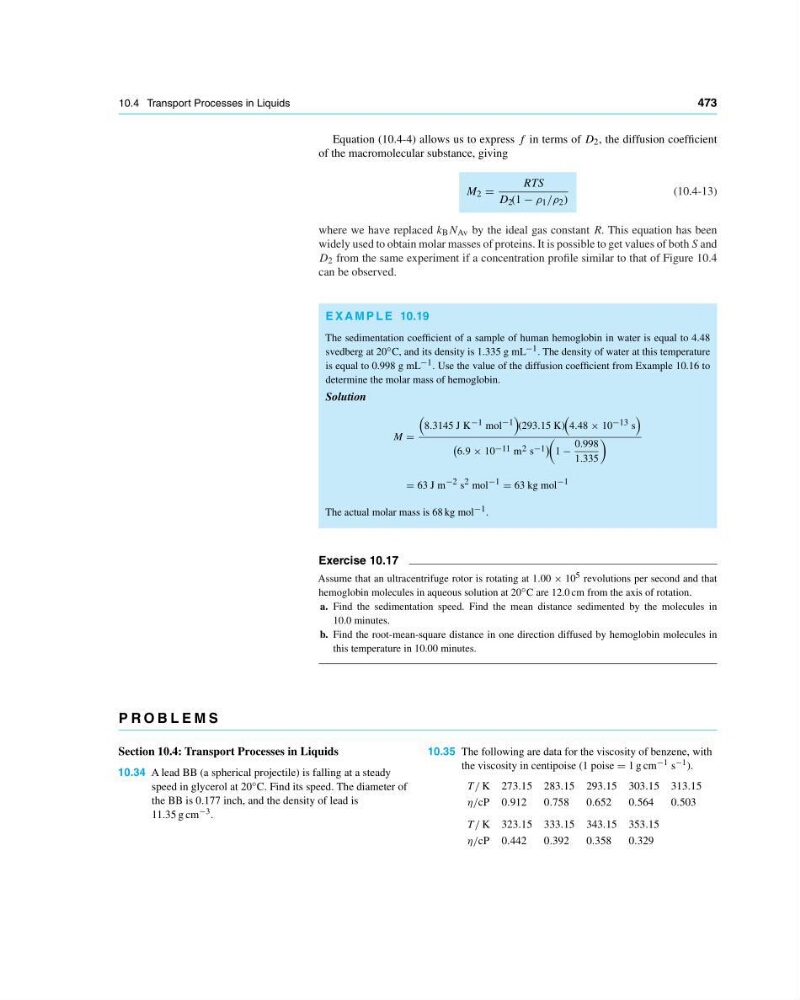
Equation (10.4-4) allows us to express f in terms of D 2 , the diffusion coefficient
of the macromolecular substance, giving
M 2
RTS
D 2 (1 − ρ 1 /ρ 2 )
(10.4-13)
where we have replaced k B N Av by the ideal gas constant R. This equation has been
widely used to obtain molar masses of proteins. It is possible to get values of both S and
D 2 from the same experiment if a concentration profile similar to that of Figure 10.4
can be observed.
E X A M P L E 10.19
The sedimentation coefficient of a sample of human hemoglobin in water is equal to 4.48
svedberg at 20 ◦ C, and its density is 1.335 g mL −1 . The density of water at this temperature
is equal to 0.998 g mL −1 . Use the value of the diffusion coefficient from Example 10.16 to
determine the molar mass of hemoglobin.
Solution
M
8.3145 J K −1 mol −1
(293.15 K)
4.48 × 10 −13 s
6.9 × 10 −11 m 2 s −1
1 −
0.998
1.335
63 J m −2 s 2 mol −1 63 kg mol −1
The actual molar mass is 68 kg mol −1 .
Exercise 10.17
Assume that an ultracentrifuge rotor is rotating at 1.00 × 10 5 revolutions per second and that
hemoglobin molecules in aqueous solution at 20 ◦ C are 12.0 cm from the axis of rotation.
a. Find the sedimentation speed. Find the mean distance sedimented by the molecules in
10.0 minutes.
b. Find the root-mean-square distance in one direction diffused by hemoglobin molecules in
this temperature in 10.00 minutes.
P R O B L E M S
Section 10.4: Transport Processes in Liquids
10.34 A lead BB (a spherical projectile) is falling at a steady
speed in glycerol at 20 ◦ C. Find its speed. The diameter of
the BB is 0.177 inch, and the density of lead is
11.35 g cm −3 .
10.35 The following are data for the viscosity of benzene, with
the viscosity in centipoise (1 poise 1 g cm −1 s −1 ).
T / K 273.15 283.15 293.15 303.15 313.15
η/cP 0.912
0.758
0.652
0.564
0.503
T / K 323.15 333.15 343.15 353.15
η/cP 0.442
0.392
0.358
0.329
473
Equation (10.4-4) allows us to express f in terms of D 2 , the diffusion coefficient
of the macromolecular substance, giving
M 2
RTS
D 2 (1 − ρ 1 /ρ 2 )
(10.4-13)
where we have replaced k B N Av by the ideal gas constant R. This equation has been
widely used to obtain molar masses of proteins. It is possible to get values of both S and
D 2 from the same experiment if a concentration profile similar to that of Figure 10.4
can be observed.
E X A M P L E 10.19
The sedimentation coefficient of a sample of human hemoglobin in water is equal to 4.48
svedberg at 20 ◦ C, and its density is 1.335 g mL −1 . The density of water at this temperature
is equal to 0.998 g mL −1 . Use the value of the diffusion coefficient from Example 10.16 to
determine the molar mass of hemoglobin.
Solution
M
8.3145 J K −1 mol −1
(293.15 K)
4.48 × 10 −13 s
6.9 × 10 −11 m 2 s −1
1 −
0.998
1.335
63 J m −2 s 2 mol −1 63 kg mol −1
The actual molar mass is 68 kg mol −1 .
Exercise 10.17
Assume that an ultracentrifuge rotor is rotating at 1.00 × 10 5 revolutions per second and that
hemoglobin molecules in aqueous solution at 20 ◦ C are 12.0 cm from the axis of rotation.
a. Find the sedimentation speed. Find the mean distance sedimented by the molecules in
10.0 minutes.
b. Find the root-mean-square distance in one direction diffused by hemoglobin molecules in
this temperature in 10.00 minutes.
P R O B L E M S
Section 10.4: Transport Processes in Liquids
10.34 A lead BB (a spherical projectile) is falling at a steady
speed in glycerol at 20 ◦ C. Find its speed. The diameter of
the BB is 0.177 inch, and the density of lead is
11.35 g cm −3 .
10.35 The following are data for the viscosity of benzene, with
the viscosity in centipoise (1 poise 1 g cm −1 s −1 ).
T / K 273.15 283.15 293.15 303.15 313.15
η/cP 0.912
0.758
0.652
0.564
0.503
T / K 323.15 333.15 343.15 353.15
η/cP 0.442
0.392
0.358
0.329