

470
10 Transport Processes
The Temperature Dependence of Diffusion and Viscosity
Coefficients in Liquids
Diffusion coefficients and viscosities in liquids depend more strongly on temperature
than on gases. It is found experimentally that diffusion coefficients in liquids are usually
well described by the formula
D D 0 e
−E a,d /RT
(10.4-5)
where R is the ideal gas constant and T is the absolute temperature. The quantity D 0
is a parameter that is nearly temperature-independent, and E a,d is called the molar
activation energy for diffusion. Liquid viscosities are usually well described by the
formula
η η 0 e
E a,η /RT
(10.4-6)
where E a,η is the molar activation energy for viscous flow.
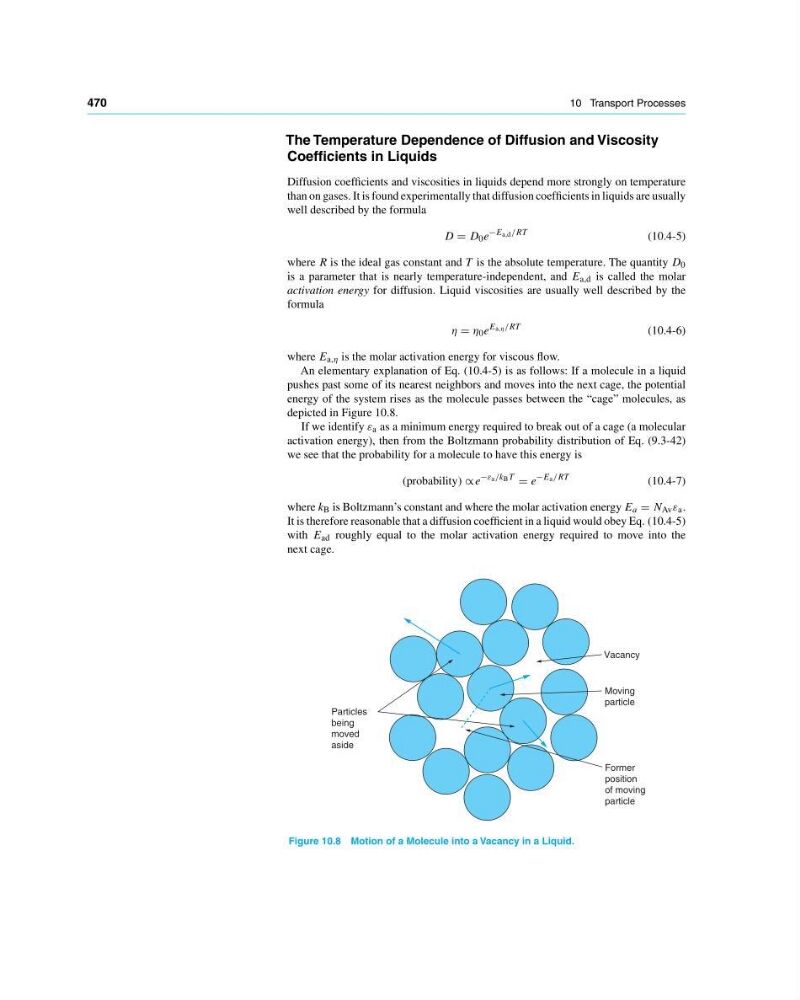
An elementary explanation of Eq. (10.4-5) is as follows: If a molecule in a liquid
pushes past some of its nearest neighbors and moves into the next cage, the potential
energy of the system rises as the molecule passes between the “cage” molecules, as
depicted in Figure 10.8.
If we identify ε a as a minimum energy required to break out of a cage (a molecular
activation energy), then from the Boltzmann probability distribution of Eq. (9.3-42)
we see that the probability for a molecule to have this energy is
(probability) ∝ e
−ε a /k B T
e
−E a /RT
(10.4-7)
where k B is Boltzmann’s constant and where the molar activation energy E a N Av ε a .
It is therefore reasonable that a diffusion coefficient in a liquid would obey Eq. (10.4-5)
with E ad roughly equal to the molar activation energy required to move into the
next cage.
Particles
being
moved
aside
Vacancy
Moving
particle
Former
position
of moving
particle
Figure 10.8 Motion of a Molecule into a Vacancy in a Liquid.
10 Transport Processes
The Temperature Dependence of Diffusion and Viscosity
Coefficients in Liquids
Diffusion coefficients and viscosities in liquids depend more strongly on temperature
than on gases. It is found experimentally that diffusion coefficients in liquids are usually
well described by the formula
D D 0 e
−E a,d /RT
(10.4-5)
where R is the ideal gas constant and T is the absolute temperature. The quantity D 0
is a parameter that is nearly temperature-independent, and E a,d is called the molar
activation energy for diffusion. Liquid viscosities are usually well described by the
formula
η η 0 e
E a,η /RT
(10.4-6)
where E a,η is the molar activation energy for viscous flow.
An elementary explanation of Eq. (10.4-5) is as follows: If a molecule in a liquid
pushes past some of its nearest neighbors and moves into the next cage, the potential
energy of the system rises as the molecule passes between the “cage” molecules, as
depicted in Figure 10.8.
If we identify ε a as a minimum energy required to break out of a cage (a molecular
activation energy), then from the Boltzmann probability distribution of Eq. (9.3-42)
we see that the probability for a molecule to have this energy is
(probability) ∝ e
−ε a /k B T
e
−E a /RT
(10.4-7)
where k B is Boltzmann’s constant and where the molar activation energy E a N Av ε a .
It is therefore reasonable that a diffusion coefficient in a liquid would obey Eq. (10.4-5)
with E ad roughly equal to the molar activation energy required to move into the
next cage.
Particles
being
moved
aside
Vacancy
Moving
particle
Former
position
of moving
particle
Figure 10.8 Motion of a Molecule into a Vacancy in a Liquid.