

464
10 Transport Processes
Exercise 10.10
Evaluate the self-diffusion coefficient of argon at 1.00 atm and 0 ◦ C from the value of the hardsphere diameter in Table A.15 in the appendix for this temperature. Compare your result with
the experimental value of the self-diffusion coefficient in Table A.19 in the appendix.
Exercise 10.11
Find the effective hard-sphere diameter of argon atoms from each of the self-diffusion coefficient values in Table A.19. Comment on your results. Compare your results with the values in
Table A.15 in the appendix.
Thermal Conduction in the Hard-Sphere Gas
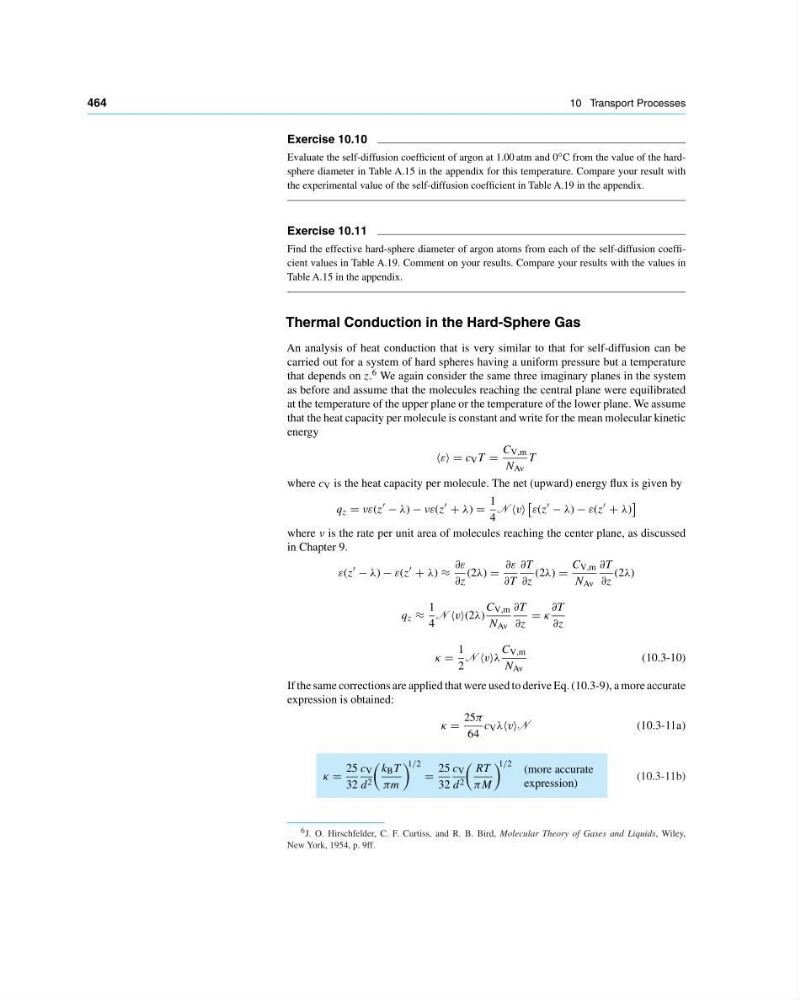
An analysis of heat conduction that is very similar to that for self-diffusion can be
carried out for a system of hard spheres having a uniform pressure but a temperature
that depends on z. 6 We again consider the same three imaginary planes in the system
as before and assume that the molecules reaching the central plane were equilibrated
at the temperature of the upper plane or the temperature of the lower plane. We assume
that the heat capacity per molecule is constant and write for the mean molecular kinetic
energy
ε c V T
C V,m
N Av
T
where c V is the heat capacity per molecule. The net (upward) energy flux is given by
q z νε(z
− λ) − νε(z
+ λ)
1
4
N v
ε(z
− λ) − ε(z
+ λ)
where ν is the rate per unit area of molecules reaching the center plane, as discussed
in Chapter 9.
ε(z
− λ) − ε(z
+ λ) ≈
∂ε
∂z
(2λ)
∂ε
∂T
∂T
∂z
(2λ)
C V,m
N Av
∂T
∂z
(2λ)
q z ≈
1
4
N v(2λ)
C V,m
N Av
∂T
∂z
κ
∂T
∂z
κ
1
2
N vλ
C V,m
N Av
(10.3-10)
If the same corrections are applied that were used to derive Eq. (10.3-9), a more accurate
expression is obtained:
κ
25π
64
c V λvN
(10.3-11a)
κ
25
32
c V
d 2
k B T
πm
1/2
25
32
c V
d 2
RT
πM
1/2 (more accurate
expression)
(10.3-11b)
6 J. O. Hirschfelder, C. F. Curtiss, and R. B. Bird, Molecular Theory of Gases and Liquids, Wiley,
New York, 1954, p. 9ff.
10 Transport Processes
Exercise 10.10
Evaluate the self-diffusion coefficient of argon at 1.00 atm and 0 ◦ C from the value of the hardsphere diameter in Table A.15 in the appendix for this temperature. Compare your result with
the experimental value of the self-diffusion coefficient in Table A.19 in the appendix.
Exercise 10.11
Find the effective hard-sphere diameter of argon atoms from each of the self-diffusion coefficient values in Table A.19. Comment on your results. Compare your results with the values in
Table A.15 in the appendix.
Thermal Conduction in the Hard-Sphere Gas
An analysis of heat conduction that is very similar to that for self-diffusion can be
carried out for a system of hard spheres having a uniform pressure but a temperature
that depends on z. 6 We again consider the same three imaginary planes in the system
as before and assume that the molecules reaching the central plane were equilibrated
at the temperature of the upper plane or the temperature of the lower plane. We assume
that the heat capacity per molecule is constant and write for the mean molecular kinetic
energy
ε c V T
C V,m
N Av
T
where c V is the heat capacity per molecule. The net (upward) energy flux is given by
q z νε(z
− λ) − νε(z
+ λ)
1
4
N v
ε(z
− λ) − ε(z
+ λ)
where ν is the rate per unit area of molecules reaching the center plane, as discussed
in Chapter 9.
ε(z
− λ) − ε(z
+ λ) ≈
∂ε
∂z
(2λ)
∂ε
∂T
∂T
∂z
(2λ)
C V,m
N Av
∂T
∂z
(2λ)
q z ≈
1
4
N v(2λ)
C V,m
N Av
∂T
∂z
κ
∂T
∂z
κ
1
2
N vλ
C V,m
N Av
(10.3-10)
If the same corrections are applied that were used to derive Eq. (10.3-9), a more accurate
expression is obtained:
κ
25π
64
c V λvN
(10.3-11a)
κ
25
32
c V
d 2
k B T
πm
1/2
25
32
c V
d 2
RT
πM
1/2 (more accurate
expression)
(10.3-11b)
6 J. O. Hirschfelder, C. F. Curtiss, and R. B. Bird, Molecular Theory of Gases and Liquids, Wiley,
New York, 1954, p. 9ff.