

456
10 Transport Processes
Exercise 10.6
The inside diameter of the buret in Example 10.6 is equal to 0.80 cm. Calculate the speed of the
meniscus when the meniscus is at the 0.00-mL mark.
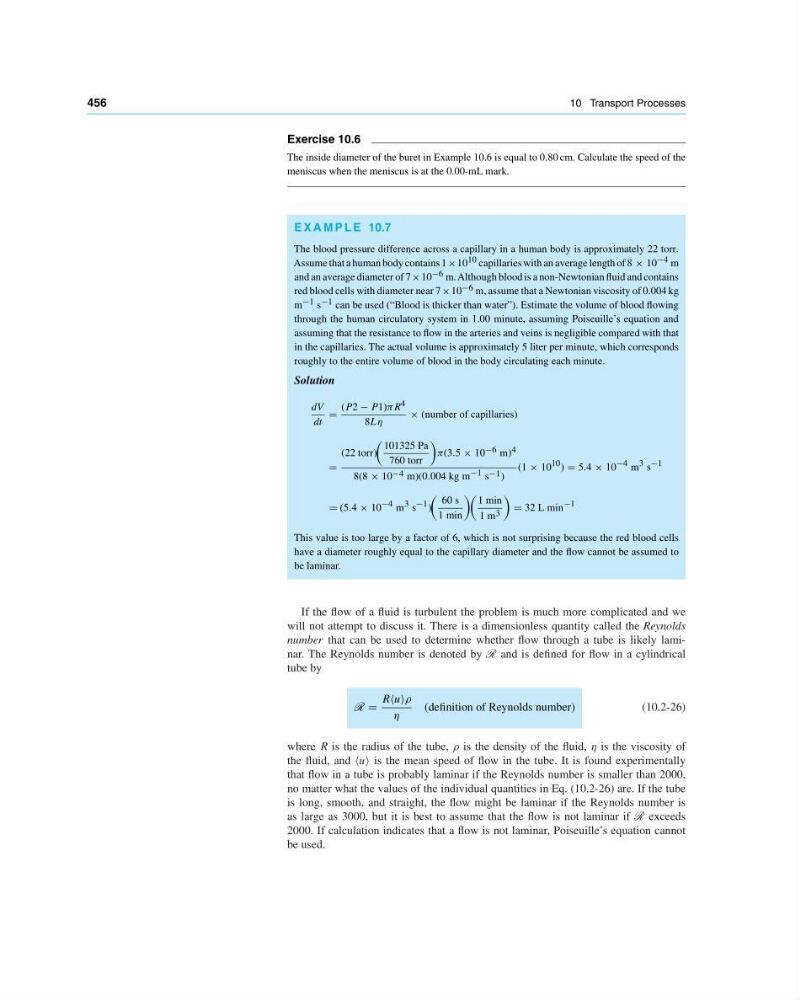
E X A M P L E 10.7
The blood pressure difference across a capillary in a human body is approximately 22 torr.
Assume that a human body contains 1 × 10 10 capillaries with an average length of 8 × 10 −4 m
and an average diameter of 7 × 10 −6 m. Although blood is a non-Newtonian fluid and contains
red blood cells with diameter near 7 × 10 −6 m, assume that a Newtonian viscosity of 0.004 kg
m −1 s −1 can be used (“Blood is thicker than water”). Estimate the volume of blood flowing
through the human circulatory system in 1.00 minute, assuming Poiseuille’s equation and
assuming that the resistance to flow in the arteries and veins is negligible compared with that
in the capillaries. The actual volume is approximately 5 liter per minute, which corresponds
roughly to the entire volume of blood in the body circulating each minute.
Solution
dV
dt
(P2 − P1)πR 4
8Lη
× (number of capillaries)
(22 torr)
101325 Pa
760 torr
π(3.5 × 10 −6 m) 4
8(8 × 10 −4 m)(0.004 kg m −1 s −1 )
(1 × 10 10 ) 5.4 × 10 −4 m 3 s −1
(5.4 × 10 −4 m 3 s −1 )
60 s
1 min
1 min
1 m 3
32 L min −1
This value is too large by a factor of 6, which is not surprising because the red blood cells
have a diameter roughly equal to the capillary diameter and the flow cannot be assumed to
be laminar.
If the flow of a fluid is turbulent the problem is much more complicated and we
will not attempt to discuss it. There is a dimensionless quantity called the Reynolds
number that can be used to determine whether flow through a tube is likely laminar. The Reynolds number is denoted by R and is defined for flow in a cylindrical
tube by
R
Ruρ
η
(definition of Reynolds number)
(10.2-26)
where R is the radius of the tube, ρ is the density of the fluid, η is the viscosity of
the fluid, and u is the mean speed of flow in the tube. It is found experimentally
that flow in a tube is probably laminar if the Reynolds number is smaller than 2000,
no matter what the values of the individual quantities in Eq. (10.2-26) are. If the tube
is long, smooth, and straight, the flow might be laminar if the Reynolds number is
as large as 3000, but it is best to assume that the flow is not laminar if R exceeds
2000. If calculation indicates that a flow is not laminar, Poiseuille’s equation cannot
be used.
10 Transport Processes
Exercise 10.6
The inside diameter of the buret in Example 10.6 is equal to 0.80 cm. Calculate the speed of the
meniscus when the meniscus is at the 0.00-mL mark.
E X A M P L E 10.7
The blood pressure difference across a capillary in a human body is approximately 22 torr.
Assume that a human body contains 1 × 10 10 capillaries with an average length of 8 × 10 −4 m
and an average diameter of 7 × 10 −6 m. Although blood is a non-Newtonian fluid and contains
red blood cells with diameter near 7 × 10 −6 m, assume that a Newtonian viscosity of 0.004 kg
m −1 s −1 can be used (“Blood is thicker than water”). Estimate the volume of blood flowing
through the human circulatory system in 1.00 minute, assuming Poiseuille’s equation and
assuming that the resistance to flow in the arteries and veins is negligible compared with that
in the capillaries. The actual volume is approximately 5 liter per minute, which corresponds
roughly to the entire volume of blood in the body circulating each minute.
Solution
dV
dt
(P2 − P1)πR 4
8Lη
× (number of capillaries)
(22 torr)
101325 Pa
760 torr
π(3.5 × 10 −6 m) 4
8(8 × 10 −4 m)(0.004 kg m −1 s −1 )
(1 × 10 10 ) 5.4 × 10 −4 m 3 s −1
(5.4 × 10 −4 m 3 s −1 )
60 s
1 min
1 min
1 m 3
32 L min −1
This value is too large by a factor of 6, which is not surprising because the red blood cells
have a diameter roughly equal to the capillary diameter and the flow cannot be assumed to
be laminar.
If the flow of a fluid is turbulent the problem is much more complicated and we
will not attempt to discuss it. There is a dimensionless quantity called the Reynolds
number that can be used to determine whether flow through a tube is likely laminar. The Reynolds number is denoted by R and is defined for flow in a cylindrical
tube by
R
Ruρ
η
(definition of Reynolds number)
(10.2-26)
where R is the radius of the tube, ρ is the density of the fluid, η is the viscosity of
the fluid, and u is the mean speed of flow in the tube. It is found experimentally
that flow in a tube is probably laminar if the Reynolds number is smaller than 2000,
no matter what the values of the individual quantities in Eq. (10.2-26) are. If the tube
is long, smooth, and straight, the flow might be laminar if the Reynolds number is
as large as 3000, but it is best to assume that the flow is not laminar if R exceeds
2000. If calculation indicates that a flow is not laminar, Poiseuille’s equation cannot
be used.