

436
9 Gas Kinetic Theory: The Molecular Theory of Dilute Gases at Equilibrium
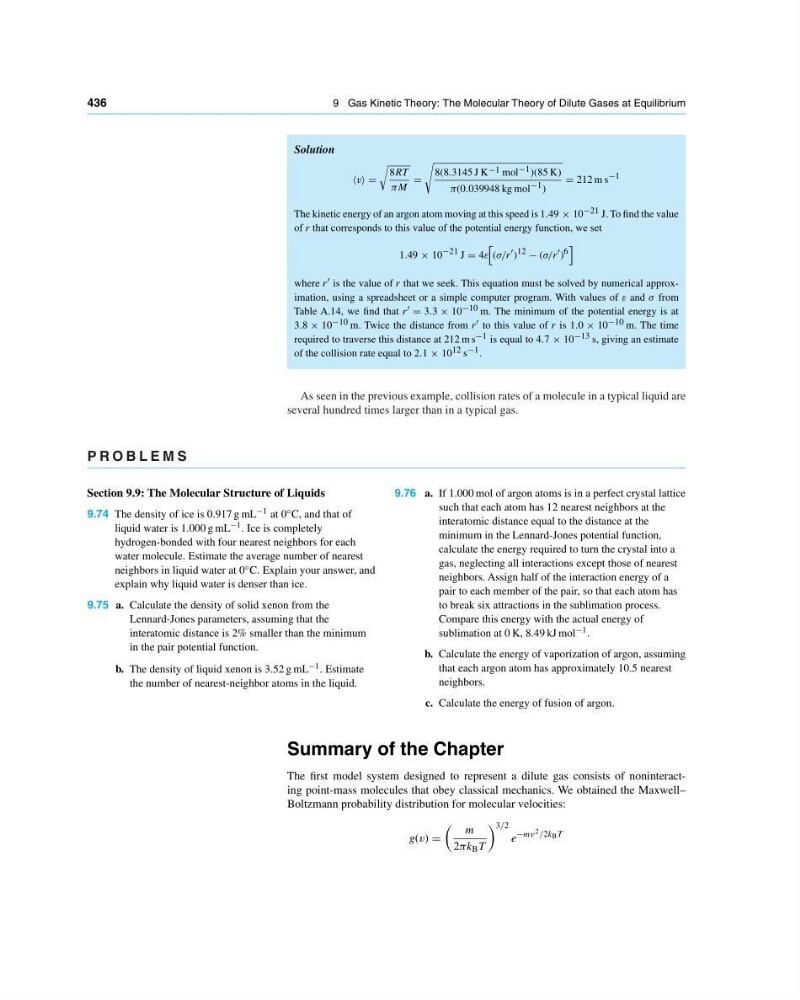
Solution
v
8RT
πM
8(8.3145 J K −1 mol −1 )(85 K)
π(0.039948 kg mol −1 )
212 m s −1
The kinetic energy of an argon atom moving at this speed is 1.49 × 10 −21 J. To find the value
of r that corresponds to this value of the potential energy function, we set
1.49 × 10 −21 J 4ε
(σ/r ) 12 − (σ/r ) 6
where r is the value of r that we seek. This equation must be solved by numerical approximation, using a spreadsheet or a simple computer program. With values of ε and σ from
Table A.14, we find that r 3.3 × 10 −10 m. The minimum of the potential energy is at
3.8 × 10 −10 m. Twice the distance from r to this value of r is 1.0 × 10 −10 m. The time
required to traverse this distance at 212 m s −1 is equal to 4.7 × 10 −13 s, giving an estimate
of the collision rate equal to 2.1 × 10 12 s −1 .
As seen in the previous example, collision rates of a molecule in a typical liquid are
several hundred times larger than in a typical gas.
P R O B L E M S
Section 9.9: The Molecular Structure of Liquids
9.74 The density of ice is 0.917 g mL −1 at 0 ◦ C, and that of
liquid water is 1.000 g mL −1 . Ice is completely
hydrogen-bonded with four nearest neighbors for each
water molecule. Estimate the average number of nearest
neighbors in liquid water at 0 ◦ C. Explain your answer, and
explain why liquid water is denser than ice.
9.75 a. Calculate the density of solid xenon from the
Lennard-Jones parameters, assuming that the
interatomic distance is 2% smaller than the minimum
in the pair potential function.
b. The density of liquid xenon is 3.52 g mL −1 . Estimate
the number of nearest-neighbor atoms in the liquid.
9.76 a. If 1.000 mol of argon atoms is in a perfect crystal lattice
such that each atom has 12 nearest neighbors at the
interatomic distance equal to the distance at the
minimum in the Lennard-Jones potential function,
calculate the energy required to turn the crystal into a
gas, neglecting all interactions except those of nearest
neighbors. Assign half of the interaction energy of a
pair to each member of the pair, so that each atom has
to break six attractions in the sublimation process.
Compare this energy with the actual energy of
sublimation at 0 K, 8.49 kJ mol −1 .
b. Calculate the energy of vaporization of argon, assuming
that each argon atom has approximately 10.5 nearest
neighbors.
c. Calculate the energy of fusion of argon.
Summary of the Chapter
The first model system designed to represent a dilute gas consists of noninteracting point-mass molecules that obey classical mechanics. We obtained the Maxwell–
Boltzmann probability distribution for molecular velocities:
g(v)
m
2πk B T
3/2
e
−mv 2 /2k B T
9 Gas Kinetic Theory: The Molecular Theory of Dilute Gases at Equilibrium
Solution
v
8RT
πM
8(8.3145 J K −1 mol −1 )(85 K)
π(0.039948 kg mol −1 )
212 m s −1
The kinetic energy of an argon atom moving at this speed is 1.49 × 10 −21 J. To find the value
of r that corresponds to this value of the potential energy function, we set
1.49 × 10 −21 J 4ε
(σ/r ) 12 − (σ/r ) 6
where r is the value of r that we seek. This equation must be solved by numerical approximation, using a spreadsheet or a simple computer program. With values of ε and σ from
Table A.14, we find that r 3.3 × 10 −10 m. The minimum of the potential energy is at
3.8 × 10 −10 m. Twice the distance from r to this value of r is 1.0 × 10 −10 m. The time
required to traverse this distance at 212 m s −1 is equal to 4.7 × 10 −13 s, giving an estimate
of the collision rate equal to 2.1 × 10 12 s −1 .
As seen in the previous example, collision rates of a molecule in a typical liquid are
several hundred times larger than in a typical gas.
P R O B L E M S
Section 9.9: The Molecular Structure of Liquids
9.74 The density of ice is 0.917 g mL −1 at 0 ◦ C, and that of
liquid water is 1.000 g mL −1 . Ice is completely
hydrogen-bonded with four nearest neighbors for each
water molecule. Estimate the average number of nearest
neighbors in liquid water at 0 ◦ C. Explain your answer, and
explain why liquid water is denser than ice.
9.75 a. Calculate the density of solid xenon from the
Lennard-Jones parameters, assuming that the
interatomic distance is 2% smaller than the minimum
in the pair potential function.
b. The density of liquid xenon is 3.52 g mL −1 . Estimate
the number of nearest-neighbor atoms in the liquid.
9.76 a. If 1.000 mol of argon atoms is in a perfect crystal lattice
such that each atom has 12 nearest neighbors at the
interatomic distance equal to the distance at the
minimum in the Lennard-Jones potential function,
calculate the energy required to turn the crystal into a
gas, neglecting all interactions except those of nearest
neighbors. Assign half of the interaction energy of a
pair to each member of the pair, so that each atom has
to break six attractions in the sublimation process.
Compare this energy with the actual energy of
sublimation at 0 K, 8.49 kJ mol −1 .
b. Calculate the energy of vaporization of argon, assuming
that each argon atom has approximately 10.5 nearest
neighbors.
c. Calculate the energy of fusion of argon.
Summary of the Chapter
The first model system designed to represent a dilute gas consists of noninteracting point-mass molecules that obey classical mechanics. We obtained the Maxwell–
Boltzmann probability distribution for molecular velocities:
g(v)
m
2πk B T
3/2
e
−mv 2 /2k B T