

432
9 Gas Kinetic Theory: The Molecular Theory of Dilute Gases at Equilibrium
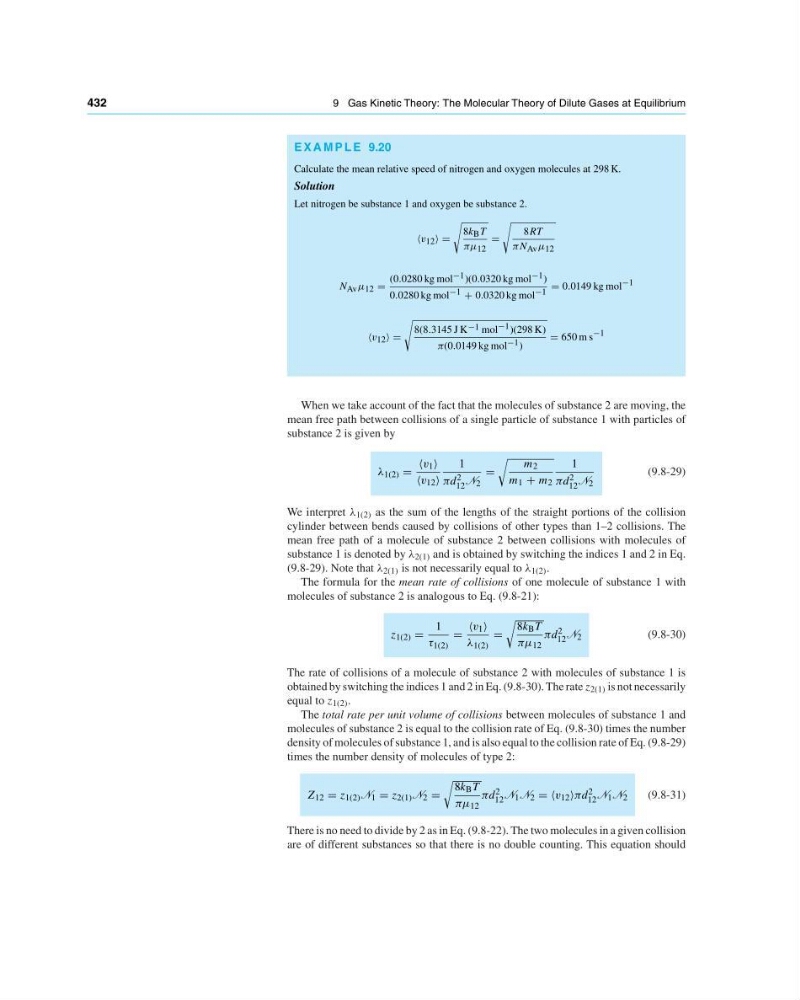
E X A M P L E 9.20
Calculate the mean relative speed of nitrogen and oxygen molecules at 298 K.
Solution
Let nitrogen be substance 1 and oxygen be substance 2.
v 12
8k B T
πµ 12
8RT
πN Av µ 12
N Av µ 12
(0.0280 kg mol −1 )(0.0320 kg mol −1 )
0.0280 kg mol −1 + 0.0320 kg mol −1 0.0149 kg mol −1
v 12
8(8.3145 J K −1 mol −1 )(298 K)
π(0.0149 kg mol −1 )
650 m s −1
When we take account of the fact that the molecules of substance 2 are moving, the
mean free path between collisions of a single particle of substance 1 with particles of
substance 2 is given by
λ 1(2)
v 1
v 12
1
πd 2
12 N 2
m 2
m 1 + m 2
1
πd 2
12 N 2
(9.8-29)
We interpret λ 1(2) as the sum of the lengths of the straight portions of the collision
cylinder between bends caused by collisions of other types than 1–2 collisions. The
mean free path of a molecule of substance 2 between collisions with molecules of
substance 1 is denoted by λ 2(1) and is obtained by switching the indices 1 and 2 in Eq.
(9.8-29). Note that λ 2(1) is not necessarily equal to λ 1(2) .
The formula for the mean rate of collisions of one molecule of substance 1 with
molecules of substance 2 is analogous to Eq. (9.8-21):
z 1(2)
1
τ 1(2)
v 1
λ 1(2)
8k B T
πµ 12
πd 2
12 N 2
(9.8-30)
The rate of collisions of a molecule of substance 2 with molecules of substance 1 is
obtained by switching the indices 1 and 2 in Eq. (9.8-30). The rate z 2(1) is not necessarily
equal to z 1(2) .
The total rate per unit volume of collisions between molecules of substance 1 and
molecules of substance 2 is equal to the collision rate of Eq. (9.8-30) times the number
density of molecules of substance 1, and is also equal to the collision rate of Eq. (9.8-29)
times the number density of molecules of type 2:
Z 12 z 1(2) N 1 z 2(1) N 2
8k B T
πµ 12
πd 2
12 N 1 N 2 v 12 πd 2
12 N 1 N 2
(9.8-31)
There is no need to divide by 2 as in Eq. (9.8-22). The two molecules in a given collision
are of different substances so that there is no double counting. This equation should
9 Gas Kinetic Theory: The Molecular Theory of Dilute Gases at Equilibrium
E X A M P L E 9.20
Calculate the mean relative speed of nitrogen and oxygen molecules at 298 K.
Solution
Let nitrogen be substance 1 and oxygen be substance 2.
v 12
8k B T
πµ 12
8RT
πN Av µ 12
N Av µ 12
(0.0280 kg mol −1 )(0.0320 kg mol −1 )
0.0280 kg mol −1 + 0.0320 kg mol −1 0.0149 kg mol −1
v 12
8(8.3145 J K −1 mol −1 )(298 K)
π(0.0149 kg mol −1 )
650 m s −1
When we take account of the fact that the molecules of substance 2 are moving, the
mean free path between collisions of a single particle of substance 1 with particles of
substance 2 is given by
λ 1(2)
v 1
v 12
1
πd 2
12 N 2
m 2
m 1 + m 2
1
πd 2
12 N 2
(9.8-29)
We interpret λ 1(2) as the sum of the lengths of the straight portions of the collision
cylinder between bends caused by collisions of other types than 1–2 collisions. The
mean free path of a molecule of substance 2 between collisions with molecules of
substance 1 is denoted by λ 2(1) and is obtained by switching the indices 1 and 2 in Eq.
(9.8-29). Note that λ 2(1) is not necessarily equal to λ 1(2) .
The formula for the mean rate of collisions of one molecule of substance 1 with
molecules of substance 2 is analogous to Eq. (9.8-21):
z 1(2)
1
τ 1(2)
v 1
λ 1(2)
8k B T
πµ 12
πd 2
12 N 2
(9.8-30)
The rate of collisions of a molecule of substance 2 with molecules of substance 1 is
obtained by switching the indices 1 and 2 in Eq. (9.8-30). The rate z 2(1) is not necessarily
equal to z 1(2) .
The total rate per unit volume of collisions between molecules of substance 1 and
molecules of substance 2 is equal to the collision rate of Eq. (9.8-30) times the number
density of molecules of substance 1, and is also equal to the collision rate of Eq. (9.8-29)
times the number density of molecules of type 2:
Z 12 z 1(2) N 1 z 2(1) N 2
8k B T
πµ 12
πd 2
12 N 1 N 2 v 12 πd 2
12 N 1 N 2
(9.8-31)
There is no need to divide by 2 as in Eq. (9.8-22). The two molecules in a given collision
are of different substances so that there is no double counting. This equation should