

9.8 The Hard-Sphere Gas
425
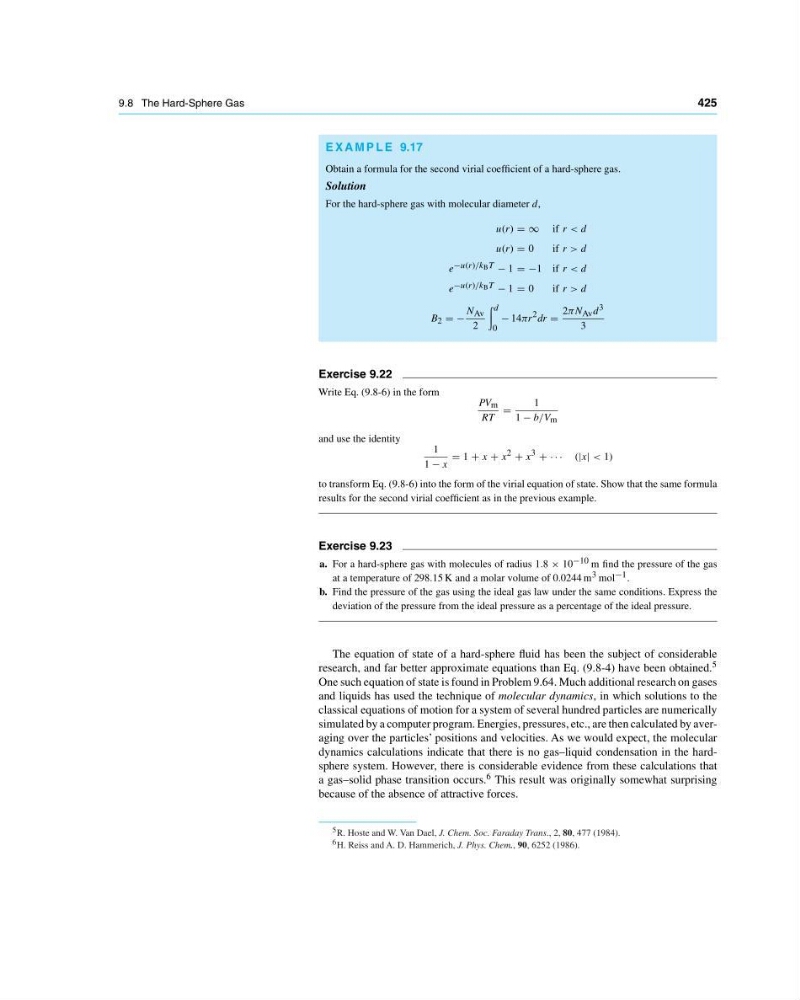
E X A M P L E 9.17
Obtain a formula for the second virial coefficient of a hard-sphere gas.
Solution
For the hard-sphere gas with molecular diameter d,
u(r) ∞ if r < d
u(r) 0
if r > d
e −u(r)/k B T − 1 −1 if r < d
e −u(r)/k B T − 1 0
if r > d
B 2 −
N Av
2
d
0
− 14πr 2 dr
2πN Av d 3
3
Exercise 9.22
Write Eq. (9.8-6) in the form
PV m
RT
1
1 − b/V m
and use the identity
1
1 − x
1 + x + x 2 + x 3 + · · · (|x| < 1)
to transform Eq. (9.8-6) into the form of the virial equation of state. Show that the same formula
results for the second virial coefficient as in the previous example.
Exercise 9.23
a. For a hard-sphere gas with molecules of radius 1.8 × 10 −10 m find the pressure of the gas
at a temperature of 298.15 K and a molar volume of 0.0244 m 3 mol −1 .
b. Find the pressure of the gas using the ideal gas law under the same conditions. Express the
deviation of the pressure from the ideal pressure as a percentage of the ideal pressure.
The equation of state of a hard-sphere fluid has been the subject of considerable
research, and far better approximate equations than Eq. (9.8-4) have been obtained. 5
One such equation of state is found in Problem 9.64. Much additional research on gases
and liquids has used the technique of molecular dynamics, in which solutions to the
classical equations of motion for a system of several hundred particles are numerically
simulated by a computer program. Energies, pressures, etc., are then calculated by averaging over the particles’ positions and velocities. As we would expect, the molecular
dynamics calculations indicate that there is no gas–liquid condensation in the hardsphere system. However, there is considerable evidence from these calculations that
a gas–solid phase transition occurs. 6 This result was originally somewhat surprising
because of the absence of attractive forces.
5 R. Hoste and W. Van Dael, J. Chem. Soc. Faraday Trans., 2, 80, 477 (1984).
6 H. Reiss and A. D. Hammerich, J. Phys. Chem., 90, 6252 (1986).
425
E X A M P L E 9.17
Obtain a formula for the second virial coefficient of a hard-sphere gas.
Solution
For the hard-sphere gas with molecular diameter d,
u(r) ∞ if r < d
u(r) 0
if r > d
e −u(r)/k B T − 1 −1 if r < d
e −u(r)/k B T − 1 0
if r > d
B 2 −
N Av
2
d
0
− 14πr 2 dr
2πN Av d 3
3
Exercise 9.22
Write Eq. (9.8-6) in the form
PV m
RT
1
1 − b/V m
and use the identity
1
1 − x
1 + x + x 2 + x 3 + · · · (|x| < 1)
to transform Eq. (9.8-6) into the form of the virial equation of state. Show that the same formula
results for the second virial coefficient as in the previous example.
Exercise 9.23
a. For a hard-sphere gas with molecules of radius 1.8 × 10 −10 m find the pressure of the gas
at a temperature of 298.15 K and a molar volume of 0.0244 m 3 mol −1 .
b. Find the pressure of the gas using the ideal gas law under the same conditions. Express the
deviation of the pressure from the ideal pressure as a percentage of the ideal pressure.
The equation of state of a hard-sphere fluid has been the subject of considerable
research, and far better approximate equations than Eq. (9.8-4) have been obtained. 5
One such equation of state is found in Problem 9.64. Much additional research on gases
and liquids has used the technique of molecular dynamics, in which solutions to the
classical equations of motion for a system of several hundred particles are numerically
simulated by a computer program. Energies, pressures, etc., are then calculated by averaging over the particles’ positions and velocities. As we would expect, the molecular
dynamics calculations indicate that there is no gas–liquid condensation in the hardsphere system. However, there is considerable evidence from these calculations that
a gas–solid phase transition occurs. 6 This result was originally somewhat surprising
because of the absence of attractive forces.
5 R. Hoste and W. Van Dael, J. Chem. Soc. Faraday Trans., 2, 80, 477 (1984).
6 H. Reiss and A. D. Hammerich, J. Phys. Chem., 90, 6252 (1986).