

9.8 The Hard-Sphere Gas
423
Table A.15 in the appendix gives the values of the effective hard-sphere diameters of
several substances.
u
r = d
r
0
`
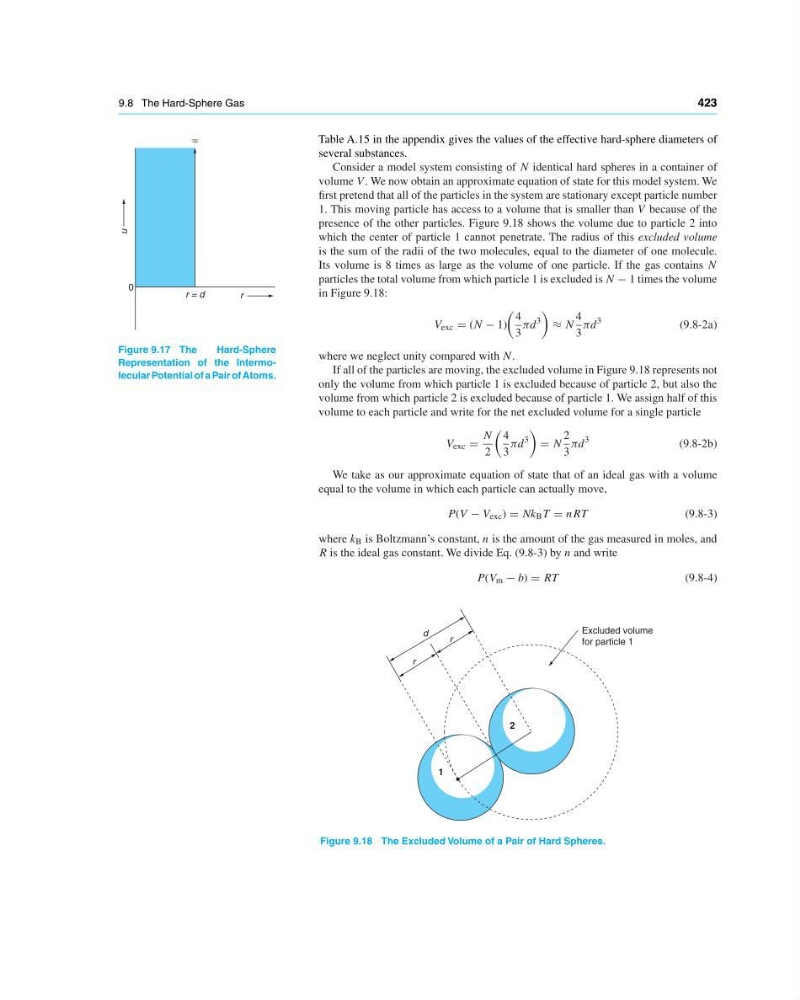
Figure 9.17 The
Hard-Sphere
Representation of the Intermolecular Potential of a Pair of Atoms.
Consider a model system consisting of N identical hard spheres in a container of
volume V . We now obtain an approximate equation of state for this model system. We
first pretend that all of the particles in the system are stationary except particle number
1. This moving particle has access to a volume that is smaller than V because of the
presence of the other particles. Figure 9.18 shows the volume due to particle 2 into
which the center of particle 1 cannot penetrate. The radius of this excluded volume
is the sum of the radii of the two molecules, equal to the diameter of one molecule.
Its volume is 8 times as large as the volume of one particle. If the gas contains N
particles the total volume from which particle 1 is excluded is N − 1 times the volume
in Figure 9.18:
V exc (N − 1)
4
3
πd
3
≈ N
4
3
πd
3
(9.8-2a)
where we neglect unity compared with N.
If all of the particles are moving, the excluded volume in Figure 9.18 represents not
only the volume from which particle 1 is excluded because of particle 2, but also the
volume from which particle 2 is excluded because of particle 1. We assign half of this
volume to each particle and write for the net excluded volume for a single particle
V exc
N
2
4
3
πd
3
N
2
3
πd
3
(9.8-2b)
We take as our approximate equation of state that of an ideal gas with a volume
equal to the volume in which each particle can actually move,
P(V − V exc ) Nk B T nRT
(9.8-3)
where k B is Boltzmann’s constant, n is the amount of the gas measured in moles, and
R is the ideal gas constant. We divide Eq. (9.8-3) by n and write
P(V m − b) RT
(9.8-4)
Excluded volume
for particle 1
d
r
r
1
2
Figure 9.18 The Excluded Volume of a Pair of Hard Spheres.
423
Table A.15 in the appendix gives the values of the effective hard-sphere diameters of
several substances.
u
r = d
r
0
`
Figure 9.17 The
Hard-Sphere
Representation of the Intermolecular Potential of a Pair of Atoms.
Consider a model system consisting of N identical hard spheres in a container of
volume V . We now obtain an approximate equation of state for this model system. We
first pretend that all of the particles in the system are stationary except particle number
1. This moving particle has access to a volume that is smaller than V because of the
presence of the other particles. Figure 9.18 shows the volume due to particle 2 into
which the center of particle 1 cannot penetrate. The radius of this excluded volume
is the sum of the radii of the two molecules, equal to the diameter of one molecule.
Its volume is 8 times as large as the volume of one particle. If the gas contains N
particles the total volume from which particle 1 is excluded is N − 1 times the volume
in Figure 9.18:
V exc (N − 1)
4
3
πd
3
≈ N
4
3
πd
3
(9.8-2a)
where we neglect unity compared with N.
If all of the particles are moving, the excluded volume in Figure 9.18 represents not
only the volume from which particle 1 is excluded because of particle 2, but also the
volume from which particle 2 is excluded because of particle 1. We assign half of this
volume to each particle and write for the net excluded volume for a single particle
V exc
N
2
4
3
πd
3
N
2
3
πd
3
(9.8-2b)
We take as our approximate equation of state that of an ideal gas with a volume
equal to the volume in which each particle can actually move,
P(V − V exc ) Nk B T nRT
(9.8-3)
where k B is Boltzmann’s constant, n is the amount of the gas measured in moles, and
R is the ideal gas constant. We divide Eq. (9.8-3) by n and write
P(V m − b) RT
(9.8-4)
Excluded volume
for particle 1
d
r
r
1
2
Figure 9.18 The Excluded Volume of a Pair of Hard Spheres.