

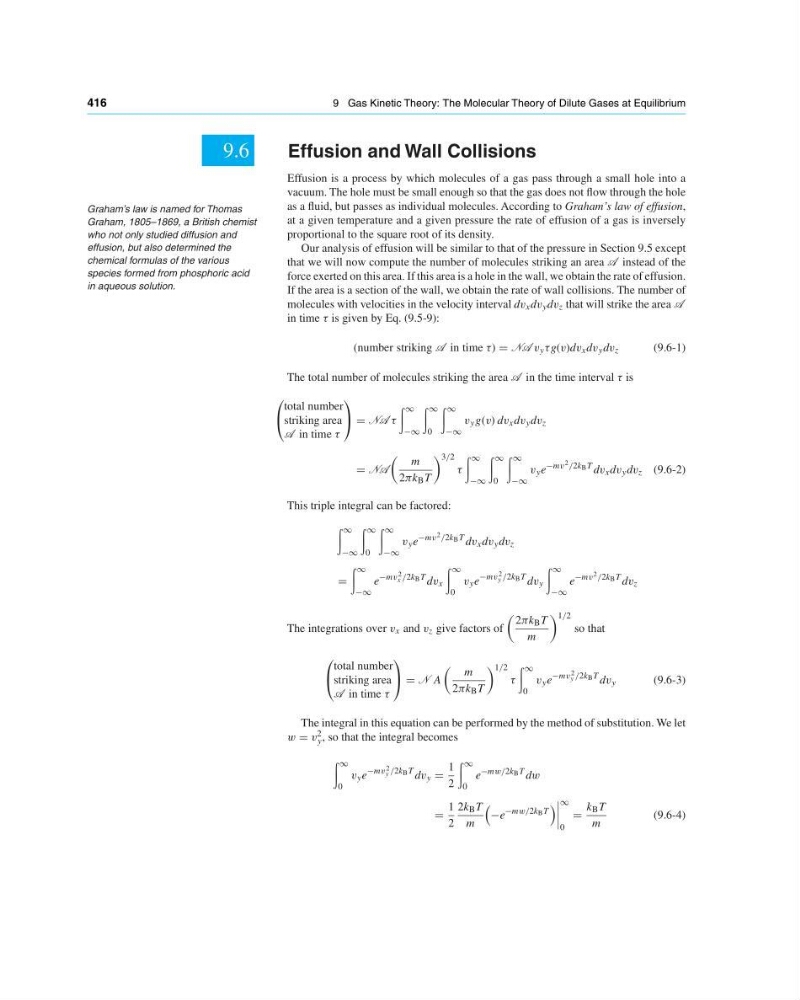
416
9 Gas Kinetic Theory: The Molecular Theory of Dilute Gases at Equilibrium
9.6
Effusion and Wall Collisions
Effusion is a process by which molecules of a gas pass through a small hole into a
vacuum. The hole must be small enough so that the gas does not flow through the hole
as a fluid, but passes as individual molecules. According to Graham’s law of effusion,
at a given temperature and a given pressure the rate of effusion of a gas is inversely
proportional to the square root of its density.
Graham’s law is named for Thomas
Graham, 1805–1869, a British chemist
who not only studied diffusion and
effusion, but also determined the
chemical formulas of the various
species formed from phosphoric acid
in aqueous solution.
Our analysis of effusion will be similar to that of the pressure in Section 9.5 except
that we will now compute the number of molecules striking an area A instead of the
force exerted on this area. If this area is a hole in the wall, we obtain the rate of effusion.
If the area is a section of the wall, we obtain the rate of wall collisions. The number of
molecules with velocities in the velocity interval dv x dv y dv z that will strike the area A
in time τ is given by Eq. (9.5-9):
(number striking A in time τ) NA v y τg(v)dv x dv y dv z
(9.6-1)
The total number of molecules striking the area A in the time interval τ is
⎛
⎝
total number
striking area
A in time τ
⎞
⎠ NA τ
∞
−∞
∞
0
∞
−∞
v y g(v) dv x dv y dv z
NA
m
2πk B T
3/2
τ
∞
−∞
∞
0
∞
−∞
v y e
−mv 2 /2k B T dv x dv y dv z (9.6-2)
This triple integral can be factored:
∞
−∞
∞
0
∞
−∞
v y e
−mv 2 /2k B T dv x dv y dv z
∞
−∞
e
−mv 2
x /2k B T dv x
∞
0
v y e
−mv 2
y /2k B T dv y
∞
−∞
e
−mv 2 /2k B T dv z
The integrations over v x and v z give factors of
2πk B T
m
1/2
so that
⎛
⎝
total number
striking area
A in time τ
⎞
⎠ N A
m
2πk B T
1/2
τ
∞
0
v y e
−mv 2
y /2k B T dv y
(9.6-3)
The integral in this equation can be performed by the method of substitution. We let
w v 2
y , so that the integral becomes
∞
0
v y e
−mv 2
y /2k B T dv y
1
2
∞
0
e
−mw/2k B T dw
1
2
2k B T
m
−e
−mw/2k B T
∞
0
k B T
m
(9.6-4)
9 Gas Kinetic Theory: The Molecular Theory of Dilute Gases at Equilibrium
9.6
Effusion and Wall Collisions
Effusion is a process by which molecules of a gas pass through a small hole into a
vacuum. The hole must be small enough so that the gas does not flow through the hole
as a fluid, but passes as individual molecules. According to Graham’s law of effusion,
at a given temperature and a given pressure the rate of effusion of a gas is inversely
proportional to the square root of its density.
Graham’s law is named for Thomas
Graham, 1805–1869, a British chemist
who not only studied diffusion and
effusion, but also determined the
chemical formulas of the various
species formed from phosphoric acid
in aqueous solution.
Our analysis of effusion will be similar to that of the pressure in Section 9.5 except
that we will now compute the number of molecules striking an area A instead of the
force exerted on this area. If this area is a hole in the wall, we obtain the rate of effusion.
If the area is a section of the wall, we obtain the rate of wall collisions. The number of
molecules with velocities in the velocity interval dv x dv y dv z that will strike the area A
in time τ is given by Eq. (9.5-9):
(number striking A in time τ) NA v y τg(v)dv x dv y dv z
(9.6-1)
The total number of molecules striking the area A in the time interval τ is
⎛
⎝
total number
striking area
A in time τ
⎞
⎠ NA τ
∞
−∞
∞
0
∞
−∞
v y g(v) dv x dv y dv z
NA
m
2πk B T
3/2
τ
∞
−∞
∞
0
∞
−∞
v y e
−mv 2 /2k B T dv x dv y dv z (9.6-2)
This triple integral can be factored:
∞
−∞
∞
0
∞
−∞
v y e
−mv 2 /2k B T dv x dv y dv z
∞
−∞
e
−mv 2
x /2k B T dv x
∞
0
v y e
−mv 2
y /2k B T dv y
∞
−∞
e
−mv 2 /2k B T dv z
The integrations over v x and v z give factors of
2πk B T
m
1/2
so that
⎛
⎝
total number
striking area
A in time τ
⎞
⎠ N A
m
2πk B T
1/2
τ
∞
0
v y e
−mv 2
y /2k B T dv y
(9.6-3)
The integral in this equation can be performed by the method of substitution. We let
w v 2
y , so that the integral becomes
∞
0
v y e
−mv 2
y /2k B T dv y
1
2
∞
0
e
−mw/2k B T dw
1
2
2k B T
m
−e
−mw/2k B T
∞
0
k B T
m
(9.6-4)