

406
9 Gas Kinetic Theory: The Molecular Theory of Dilute Gases at Equilibrium
is φ, the angle between the positive v x axis and the line segment in the v x –v y plane that
lies directly under the velocity vector.
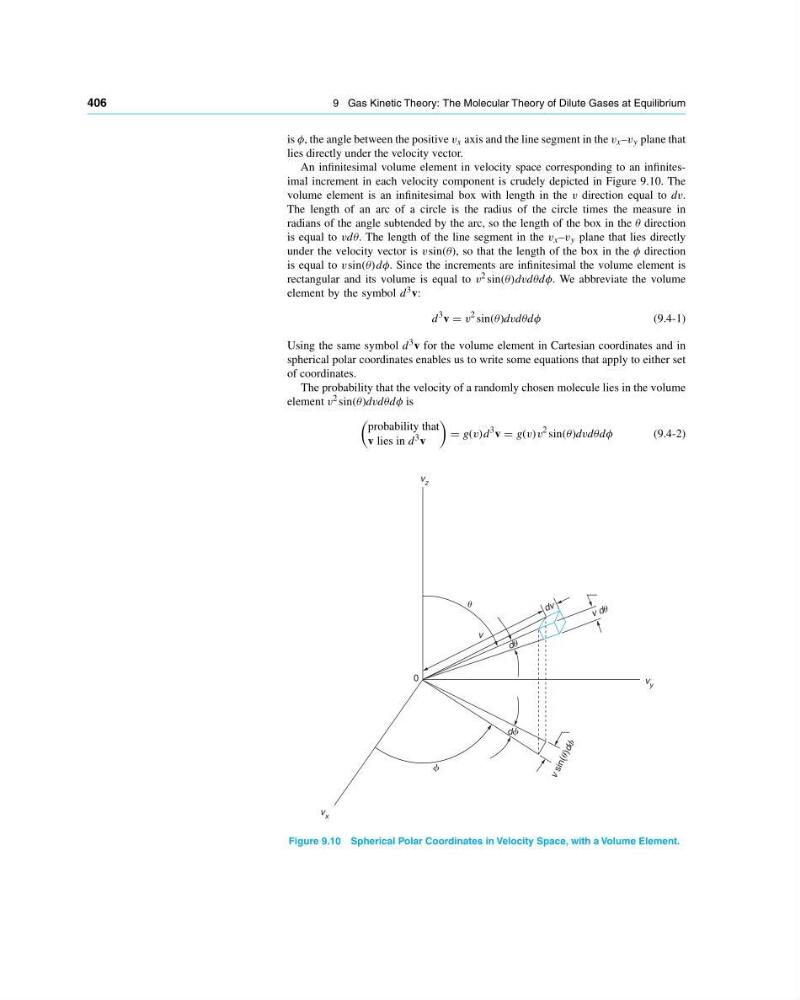
An infinitesimal volume element in velocity space corresponding to an infinitesimal increment in each velocity component is crudely depicted in Figure 9.10. The
volume element is an infinitesimal box with length in the v direction equal to dv.
The length of an arc of a circle is the radius of the circle times the measure in
radians of the angle subtended by the arc, so the length of the box in the θ direction
is equal to vdθ. The length of the line segment in the v x –v y plane that lies directly
under the velocity vector is vsin(θ), so that the length of the box in the φ direction
is equal to vsin(θ)dφ. Since the increments are infinitesimal the volume element is
rectangular and its volume is equal to v 2 sin(θ)dvdθdφ. We abbreviate the volume
element by the symbol d 3 v:
d
3 v v
2 sin(θ)dvdθdφ
(9.4-1)
Using the same symbol d 3 v for the volume element in Cartesian coordinates and in
spherical polar coordinates enables us to write some equations that apply to either set
of coordinates.
The probability that the velocity of a randomly chosen molecule lies in the volume
element v 2 sin(θ)dvdθdφ is
probability that
v lies in d 3 v
g(v)d
3 v g(v)v
2 sin(θ)dvdθdφ
(9.4-2)
v z
v x
v y
0
d v
v d
d
d
v
v s in (
) d
Figure 9.10 Spherical Polar Coordinates in Velocity Space, with a Volume Element.
9 Gas Kinetic Theory: The Molecular Theory of Dilute Gases at Equilibrium
is φ, the angle between the positive v x axis and the line segment in the v x –v y plane that
lies directly under the velocity vector.
An infinitesimal volume element in velocity space corresponding to an infinitesimal increment in each velocity component is crudely depicted in Figure 9.10. The
volume element is an infinitesimal box with length in the v direction equal to dv.
The length of an arc of a circle is the radius of the circle times the measure in
radians of the angle subtended by the arc, so the length of the box in the θ direction
is equal to vdθ. The length of the line segment in the v x –v y plane that lies directly
under the velocity vector is vsin(θ), so that the length of the box in the φ direction
is equal to vsin(θ)dφ. Since the increments are infinitesimal the volume element is
rectangular and its volume is equal to v 2 sin(θ)dvdθdφ. We abbreviate the volume
element by the symbol d 3 v:
d
3 v v
2 sin(θ)dvdθdφ
(9.4-1)
Using the same symbol d 3 v for the volume element in Cartesian coordinates and in
spherical polar coordinates enables us to write some equations that apply to either set
of coordinates.
The probability that the velocity of a randomly chosen molecule lies in the volume
element v 2 sin(θ)dvdθdφ is
probability that
v lies in d 3 v
g(v)d
3 v g(v)v
2 sin(θ)dvdθdφ
(9.4-2)
v z
v x
v y
0
d v
v d
d
d
v
v s in (
) d
Figure 9.10 Spherical Polar Coordinates in Velocity Space, with a Volume Element.