

9.3 The Velocity Probability Distribution
401
Solution
< κ x >
1
2
k B T
κ 2
x
m
2
2
v 4
x
m
2
2
m
2πk B T
1/2 ∞
−∞
v 4
x e −mv 2
x /2k B T dv x
2
m
2
2
m
2πk B T
1/2 ∞
0
v 4
x e −mv 2
x /2k B T dv x
2
m
2
2
m
2πk B T
1/2 3
8
√
π
2k B T
m
5/2
3
16
(2k B T ) 2
3
4
k 2
B T 2
σ κ x
3
4
k 2
B T 2 −
1
4
k 2
B T 2
1/2
k B T
√
2
Exercise 9.8
a. Evaluate σ κ x for oxygen molecules at 298 K.
b. Express this standard deviation as a fraction of the v x contribution to the kinetic energy.
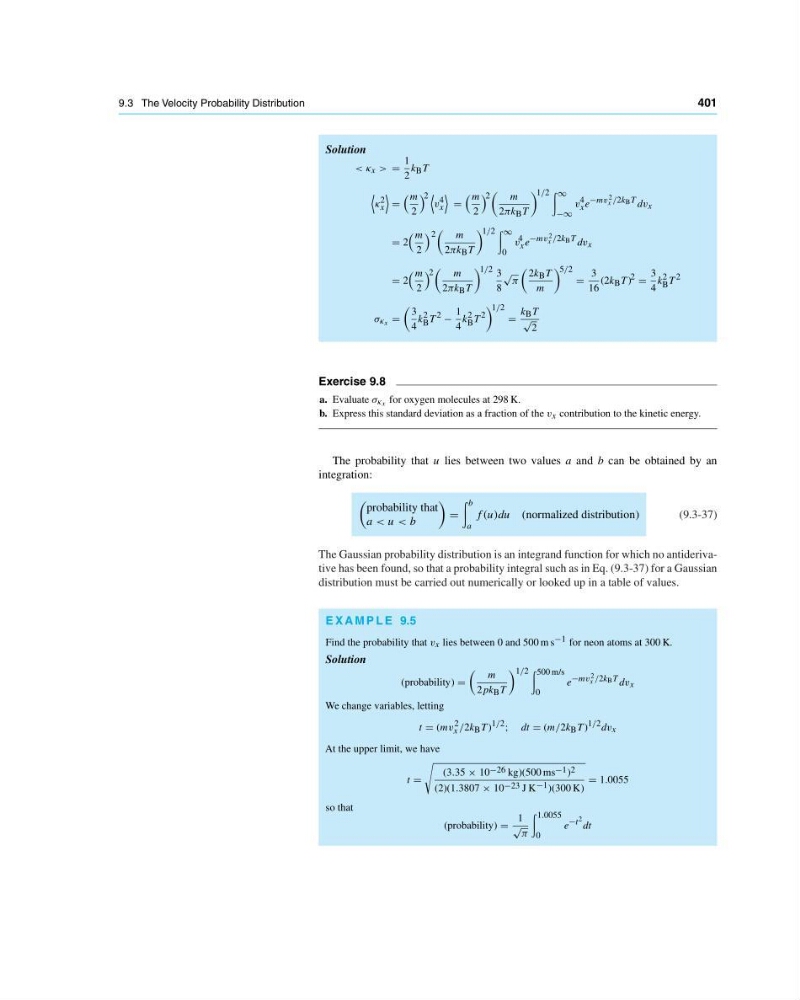
The probability that u lies between two values a and b can be obtained by an
integration:
probability that
a < u < b
b
a
f (u)du (normalized distribution)
(9.3-37)
The Gaussian probability distribution is an integrand function for which no antiderivative has been found, so that a probability integral such as in Eq. (9.3-37) for a Gaussian
distribution must be carried out numerically or looked up in a table of values.
E X A M P L E 9.5
Find the probability that v x lies between 0 and 500 m s −1 for neon atoms at 300 K.
Solution
(probability)
m
2pk B T
1/2 500 m/s
0
e −mv 2
x /2k B T dv x
We change variables, letting
t (mv 2
x /2k B T ) 1/2 ; dt (m/2k B T ) 1/2 dv x
At the upper limit, we have
t
(3.35 × 10 −26 kg)(500 ms −1 ) 2
(2)(1.3807 × 10 −23 J K −1 )(300 K)
1.0055
so that
(probability)
1
√
π
1.0055
0
e −t 2 dt
401
Solution
< κ x >
1
2
k B T
κ 2
x
m
2
2
v 4
x
m
2
2
m
2πk B T
1/2 ∞
−∞
v 4
x e −mv 2
x /2k B T dv x
2
m
2
2
m
2πk B T
1/2 ∞
0
v 4
x e −mv 2
x /2k B T dv x
2
m
2
2
m
2πk B T
1/2 3
8
√
π
2k B T
m
5/2
3
16
(2k B T ) 2
3
4
k 2
B T 2
σ κ x
3
4
k 2
B T 2 −
1
4
k 2
B T 2
1/2
k B T
√
2
Exercise 9.8
a. Evaluate σ κ x for oxygen molecules at 298 K.
b. Express this standard deviation as a fraction of the v x contribution to the kinetic energy.
The probability that u lies between two values a and b can be obtained by an
integration:
probability that
a < u < b
b
a
f (u)du (normalized distribution)
(9.3-37)
The Gaussian probability distribution is an integrand function for which no antiderivative has been found, so that a probability integral such as in Eq. (9.3-37) for a Gaussian
distribution must be carried out numerically or looked up in a table of values.
E X A M P L E 9.5
Find the probability that v x lies between 0 and 500 m s −1 for neon atoms at 300 K.
Solution
(probability)
m
2pk B T
1/2 500 m/s
0
e −mv 2
x /2k B T dv x
We change variables, letting
t (mv 2
x /2k B T ) 1/2 ; dt (m/2k B T ) 1/2 dv x
At the upper limit, we have
t
(3.35 × 10 −26 kg)(500 ms −1 ) 2
(2)(1.3807 × 10 −23 J K −1 )(300 K)
1.0055
so that
(probability)
1
√
π
1.0055
0
e −t 2 dt