

388
9 Gas Kinetic Theory: The Molecular Theory of Dilute Gases at Equilibrium
and is the second time derivative of the position vector. If a particle moves in three
dimensions, Newton’s second law is expressed by the vector equation
F ma m
dv
dt
m
d 2 r
dt 2 (Newton’s second law)
(9.2-4)
0
0
2.5
5.0
7.5
10.0
12.5
Velocity/m s
21
Position/m
0.5
1.0
Time/s
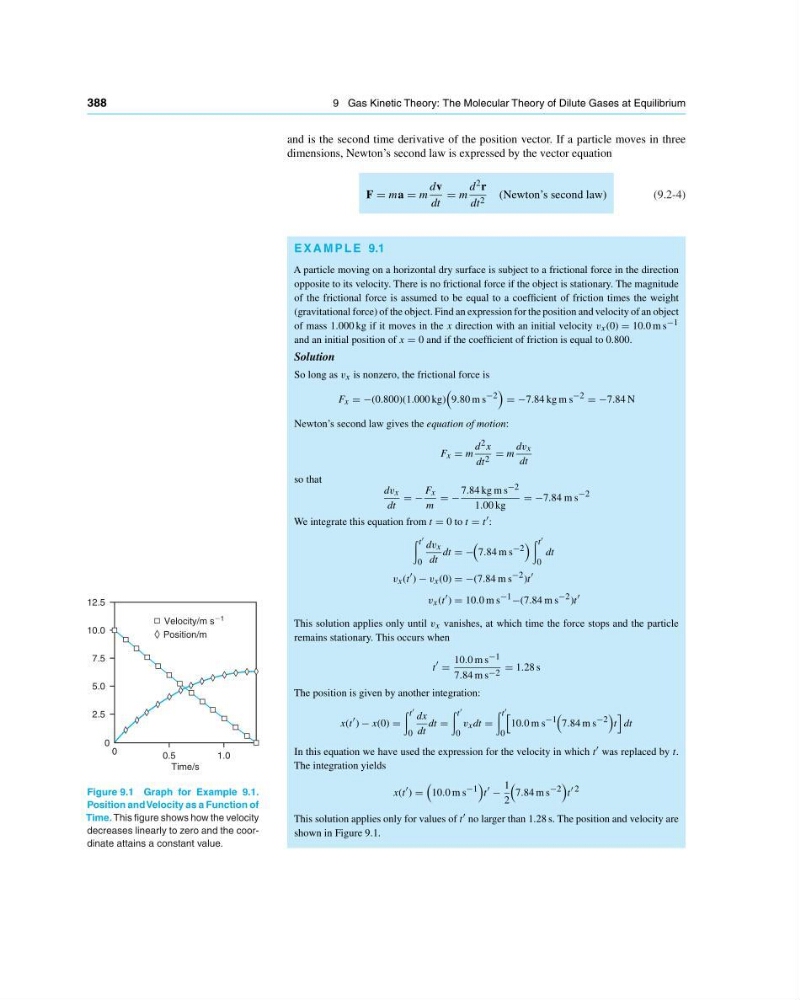
Figure 9.1 Graph for Example 9.1.
Position and Velocity as a Function of
Time. This figure shows how the velocity
decreases linearly to zero and the coordinate attains a constant value.
E X A M P L E 9.1
A particle moving on a horizontal dry surface is subject to a frictional force in the direction
opposite to its velocity. There is no frictional force if the object is stationary. The magnitude
of the frictional force is assumed to be equal to a coefficient of friction times the weight
(gravitational force) of the object. Find an expression for the position and velocity of an object
of mass 1.000 kg if it moves in the x direction with an initial velocity v x (0) 10.0 m s −1
and an initial position of x 0 and if the coefficient of friction is equal to 0.800.
Solution
So long as v x is nonzero, the frictional force is
F x −(0.800)(1.000 kg)
9.80 m s −2
−7.84 kg m s −2 −7.84 N
Newton’s second law gives the equation of motion:
F x m
d 2 x
dt 2 m
dv x
dt
so that
dv x
dt
−
F x
m
−
7.84 kg m s −2
1.00 kg
−7.84 m s −2
We integrate this equation from t 0 to t t :
t
0
dv x
dt
dt −
7.84 m s −2
t
0
dt
v x (t ) − v x (0) −(7.84 m s −2 )t
v x (t ) 10.0 m s −1 −(7.84 m s −2 )t
This solution applies only until v x vanishes, at which time the force stops and the particle
remains stationary. This occurs when
t
10.0 m s −1
7.84 m s −2 1.28 s
The position is given by another integration:
x(t ) − x(0)
t
0
dx
dt
dt
t
0
v x dt
t
0
10.0 m s −1
7.84 m s −2
t
dt
In this equation we have used the expression for the velocity in which t was replaced by t.
The integration yields
x(t )
10.0 m s −1
t −
1
2
7.84 m s −2
t 2
This solution applies only for values of t no larger than 1.28 s. The position and velocity are
shown in Figure 9.1.
9 Gas Kinetic Theory: The Molecular Theory of Dilute Gases at Equilibrium
and is the second time derivative of the position vector. If a particle moves in three
dimensions, Newton’s second law is expressed by the vector equation
F ma m
dv
dt
m
d 2 r
dt 2 (Newton’s second law)
(9.2-4)
0
0
2.5
5.0
7.5
10.0
12.5
Velocity/m s
21
Position/m
0.5
1.0
Time/s
Figure 9.1 Graph for Example 9.1.
Position and Velocity as a Function of
Time. This figure shows how the velocity
decreases linearly to zero and the coordinate attains a constant value.
E X A M P L E 9.1
A particle moving on a horizontal dry surface is subject to a frictional force in the direction
opposite to its velocity. There is no frictional force if the object is stationary. The magnitude
of the frictional force is assumed to be equal to a coefficient of friction times the weight
(gravitational force) of the object. Find an expression for the position and velocity of an object
of mass 1.000 kg if it moves in the x direction with an initial velocity v x (0) 10.0 m s −1
and an initial position of x 0 and if the coefficient of friction is equal to 0.800.
Solution
So long as v x is nonzero, the frictional force is
F x −(0.800)(1.000 kg)
9.80 m s −2
−7.84 kg m s −2 −7.84 N
Newton’s second law gives the equation of motion:
F x m
d 2 x
dt 2 m
dv x
dt
so that
dv x
dt
−
F x
m
−
7.84 kg m s −2
1.00 kg
−7.84 m s −2
We integrate this equation from t 0 to t t :
t
0
dv x
dt
dt −
7.84 m s −2
t
0
dt
v x (t ) − v x (0) −(7.84 m s −2 )t
v x (t ) 10.0 m s −1 −(7.84 m s −2 )t
This solution applies only until v x vanishes, at which time the force stops and the particle
remains stationary. This occurs when
t
10.0 m s −1
7.84 m s −2 1.28 s
The position is given by another integration:
x(t ) − x(0)
t
0
dx
dt
dt
t
0
v x dt
t
0
10.0 m s −1
7.84 m s −2
t
dt
In this equation we have used the expression for the velocity in which t was replaced by t.
The integration yields
x(t )
10.0 m s −1
t −
1
2
7.84 m s −2
t 2
This solution applies only for values of t no larger than 1.28 s. The position and velocity are
shown in Figure 9.1.