

8.3 Half-Cell Potentials and Cell Potentials
365
Cells with Liquid Junctions
Some pairs of half-cells cannot be combined to make a cell with a single liquid solution
because a single solution in contact with both electrodes would allow undesired chemical reactions at the electrode surfaces or in the solution. Consider the cell with the
half-reactions
Zn(s) − → Zn
2+
+ 2e
−
Cu
2+
+ 2e
−
− → Cu(s)
If the Cu 2+ ions were in the solution that contacts the zinc electrode the oxidation and
reduction half-reactions would both take place at the zinc electrode without transferring
electrons through an external circuit. Two separate solutions are needed. A cell with
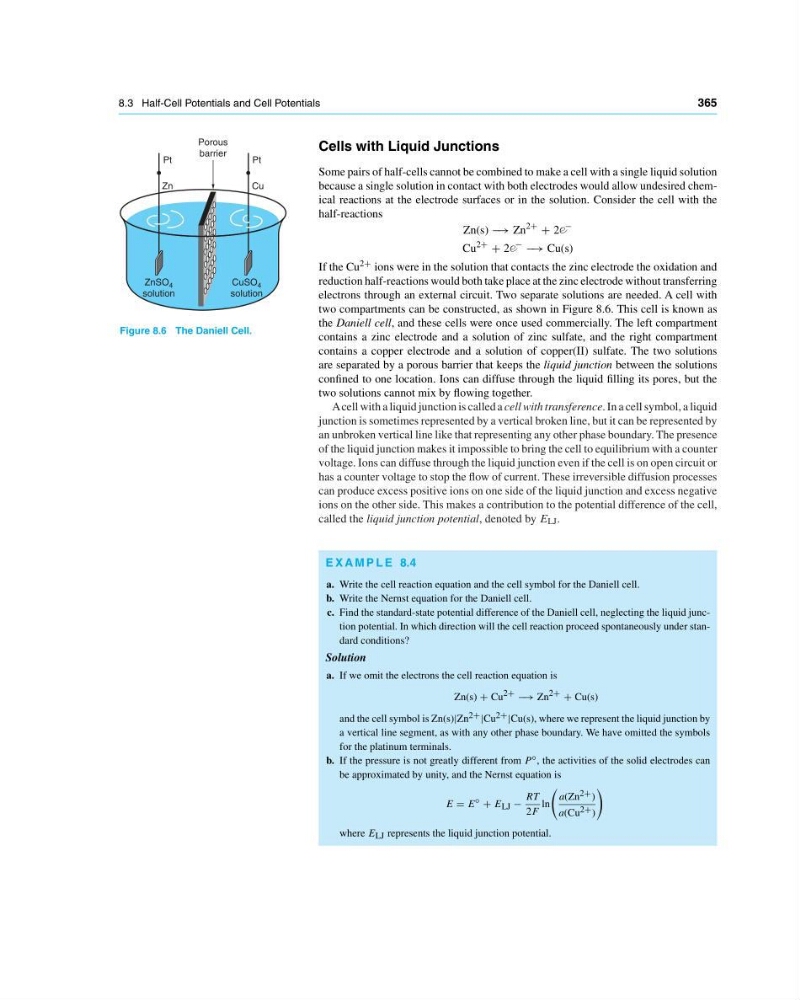
two compartments can be constructed, as shown in Figure 8.6. This cell is known as
the Daniell cell, and these cells were once used commercially. The left compartment
contains a zinc electrode and a solution of zinc sulfate, and the right compartment
contains a copper electrode and a solution of copper(II) sulfate. The two solutions
are separated by a porous barrier that keeps the liquid junction between the solutions
confined to one location. Ions can diffuse through the liquid filling its pores, but the
two solutions cannot mix by flowing together.
Pt
Porous
barrier
Zn
ZnSO 4
solution
CuSO 4
solution
Cu
Pt
Figure 8.6 The Daniell Cell.
Acell with a liquid junction is called a cell with transference. In a cell symbol, a liquid
junction is sometimes represented by a vertical broken line, but it can be represented by
an unbroken vertical line like that representing any other phase boundary. The presence
of the liquid junction makes it impossible to bring the cell to equilibrium with a counter
voltage. Ions can diffuse through the liquid junction even if the cell is on open circuit or
has a counter voltage to stop the flow of current. These irreversible diffusion processes
can produce excess positive ions on one side of the liquid junction and excess negative
ions on the other side. This makes a contribution to the potential difference of the cell,
called the liquid junction potential, denoted by E LJ .
E X A M P L E 8.4
a. Write the cell reaction equation and the cell symbol for the Daniell cell.
b. Write the Nernst equation for the Daniell cell.
c. Find the standard-state potential difference of the Daniell cell, neglecting the liquid junction potential. In which direction will the cell reaction proceed spontaneously under standard conditions?
Solution
a. If we omit the electrons the cell reaction equation is
Zn(s) + Cu 2+ − → Zn 2+ + Cu(s)
and the cell symbol is Zn(s)|Zn 2+ |Cu 2+ |Cu(s), where we represent the liquid junction by
a vertical line segment, as with any other phase boundary. We have omitted the symbols
for the platinum terminals.
b. If the pressure is not greatly different from P ◦ , the activities of the solid electrodes can
be approximated by unity, and the Nernst equation is
E E ◦ + E LJ −
RT
2F
ln
a(Zn 2+ )
a(Cu 2+ )
where E LJ represents the liquid junction potential.
365
Cells with Liquid Junctions
Some pairs of half-cells cannot be combined to make a cell with a single liquid solution
because a single solution in contact with both electrodes would allow undesired chemical reactions at the electrode surfaces or in the solution. Consider the cell with the
half-reactions
Zn(s) − → Zn
2+
+ 2e
−
Cu
2+
+ 2e
−
− → Cu(s)
If the Cu 2+ ions were in the solution that contacts the zinc electrode the oxidation and
reduction half-reactions would both take place at the zinc electrode without transferring
electrons through an external circuit. Two separate solutions are needed. A cell with
two compartments can be constructed, as shown in Figure 8.6. This cell is known as
the Daniell cell, and these cells were once used commercially. The left compartment
contains a zinc electrode and a solution of zinc sulfate, and the right compartment
contains a copper electrode and a solution of copper(II) sulfate. The two solutions
are separated by a porous barrier that keeps the liquid junction between the solutions
confined to one location. Ions can diffuse through the liquid filling its pores, but the
two solutions cannot mix by flowing together.
Pt
Porous
barrier
Zn
ZnSO 4
solution
CuSO 4
solution
Cu
Pt
Figure 8.6 The Daniell Cell.
Acell with a liquid junction is called a cell with transference. In a cell symbol, a liquid
junction is sometimes represented by a vertical broken line, but it can be represented by
an unbroken vertical line like that representing any other phase boundary. The presence
of the liquid junction makes it impossible to bring the cell to equilibrium with a counter
voltage. Ions can diffuse through the liquid junction even if the cell is on open circuit or
has a counter voltage to stop the flow of current. These irreversible diffusion processes
can produce excess positive ions on one side of the liquid junction and excess negative
ions on the other side. This makes a contribution to the potential difference of the cell,
called the liquid junction potential, denoted by E LJ .
E X A M P L E 8.4
a. Write the cell reaction equation and the cell symbol for the Daniell cell.
b. Write the Nernst equation for the Daniell cell.
c. Find the standard-state potential difference of the Daniell cell, neglecting the liquid junction potential. In which direction will the cell reaction proceed spontaneously under standard conditions?
Solution
a. If we omit the electrons the cell reaction equation is
Zn(s) + Cu 2+ − → Zn 2+ + Cu(s)
and the cell symbol is Zn(s)|Zn 2+ |Cu 2+ |Cu(s), where we represent the liquid junction by
a vertical line segment, as with any other phase boundary. We have omitted the symbols
for the platinum terminals.
b. If the pressure is not greatly different from P ◦ , the activities of the solid electrodes can
be approximated by unity, and the Nernst equation is
E E ◦ + E LJ −
RT
2F
ln
a(Zn 2+ )
a(Cu 2+ )
where E LJ represents the liquid junction potential.