

360
8 The Thermodynamics of Electrochemical Systems
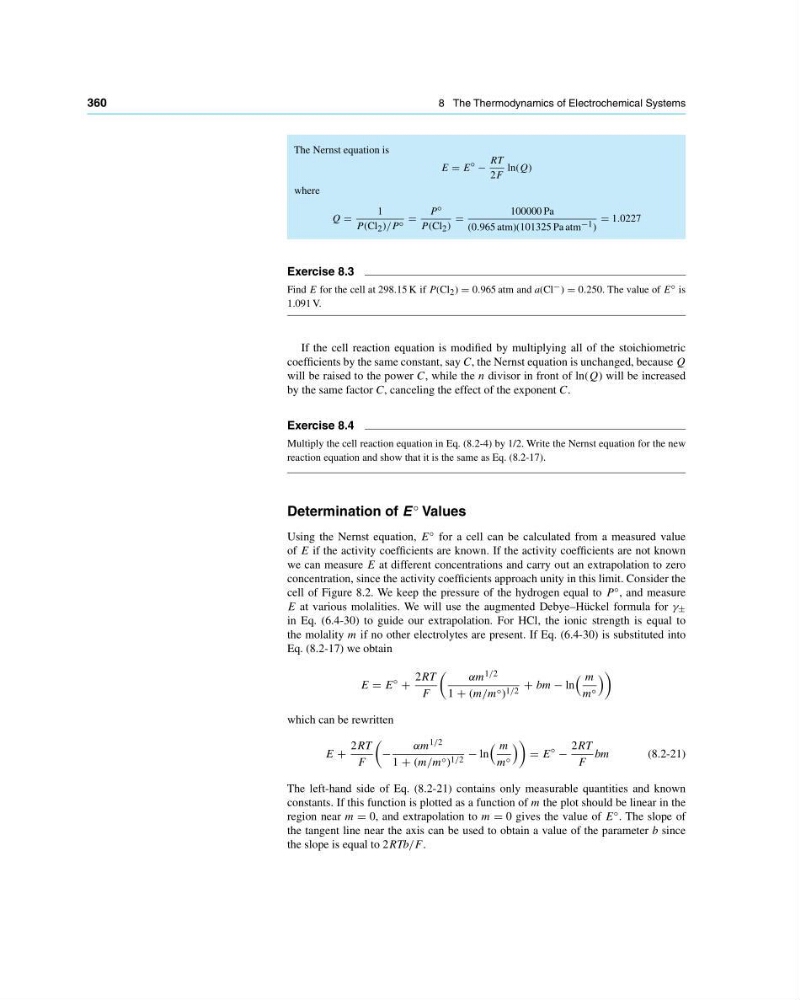
The Nernst equation is
E E ◦ −
RT
2F
ln(Q)
where
Q
1
P(Cl 2 )/P ◦
P ◦
P(Cl 2 )
100000 Pa
(0.965 atm)(101325 Pa atm −1 )
1.0227
Exercise 8.3
Find E for the cell at 298.15 K if P(Cl 2 ) 0.965 atm and a(Cl − ) 0.250. The value of E ◦ is
1.091 V.
If the cell reaction equation is modified by multiplying all of the stoichiometric
coefficients by the same constant, say C, the Nernst equation is unchanged, because Q
will be raised to the power C, while the n divisor in front of ln(Q) will be increased
by the same factor C, canceling the effect of the exponent C.
Exercise 8.4
Multiply the cell reaction equation in Eq. (8.2-4) by 1/2. Write the Nernst equation for the new
reaction equation and show that it is the same as Eq. (8.2-17).
Determination of E ◦ Values
Using the Nernst equation, E ◦ for a cell can be calculated from a measured value
of E if the activity coefficients are known. If the activity coefficients are not known
we can measure E at different concentrations and carry out an extrapolation to zero
concentration, since the activity coefficients approach unity in this limit. Consider the
cell of Figure 8.2. We keep the pressure of the hydrogen equal to P ◦ , and measure
E at various molalities. We will use the augmented Debye–Hückel formula for γ ±
in Eq. (6.4-30) to guide our extrapolation. For HCl, the ionic strength is equal to
the molality m if no other electrolytes are present. If Eq. (6.4-30) is substituted into
Eq. (8.2-17) we obtain
E E
◦
+
2RT
F
αm 1/2
1 + (m/m ◦ ) 1/2 + bm − ln
m
m ◦
which can be rewritten
E +
2RT
F
−
αm 1/2
1 + (m/m ◦ ) 1/2 − ln
m
m ◦
E
◦
−
2RT
F
bm
(8.2-21)
The left-hand side of Eq. (8.2-21) contains only measurable quantities and known
constants. If this function is plotted as a function of m the plot should be linear in the
region near m 0, and extrapolation to m 0 gives the value of E ◦ . The slope of
the tangent line near the axis can be used to obtain a value of the parameter b since
the slope is equal to 2RTb/F .
8 The Thermodynamics of Electrochemical Systems
The Nernst equation is
E E ◦ −
RT
2F
ln(Q)
where
Q
1
P(Cl 2 )/P ◦
P ◦
P(Cl 2 )
100000 Pa
(0.965 atm)(101325 Pa atm −1 )
1.0227
Exercise 8.3
Find E for the cell at 298.15 K if P(Cl 2 ) 0.965 atm and a(Cl − ) 0.250. The value of E ◦ is
1.091 V.
If the cell reaction equation is modified by multiplying all of the stoichiometric
coefficients by the same constant, say C, the Nernst equation is unchanged, because Q
will be raised to the power C, while the n divisor in front of ln(Q) will be increased
by the same factor C, canceling the effect of the exponent C.
Exercise 8.4
Multiply the cell reaction equation in Eq. (8.2-4) by 1/2. Write the Nernst equation for the new
reaction equation and show that it is the same as Eq. (8.2-17).
Determination of E ◦ Values
Using the Nernst equation, E ◦ for a cell can be calculated from a measured value
of E if the activity coefficients are known. If the activity coefficients are not known
we can measure E at different concentrations and carry out an extrapolation to zero
concentration, since the activity coefficients approach unity in this limit. Consider the
cell of Figure 8.2. We keep the pressure of the hydrogen equal to P ◦ , and measure
E at various molalities. We will use the augmented Debye–Hückel formula for γ ±
in Eq. (6.4-30) to guide our extrapolation. For HCl, the ionic strength is equal to
the molality m if no other electrolytes are present. If Eq. (6.4-30) is substituted into
Eq. (8.2-17) we obtain
E E
◦
+
2RT
F
αm 1/2
1 + (m/m ◦ ) 1/2 + bm − ln
m
m ◦
which can be rewritten
E +
2RT
F
−
αm 1/2
1 + (m/m ◦ ) 1/2 − ln
m
m ◦
E
◦
−
2RT
F
bm
(8.2-21)
The left-hand side of Eq. (8.2-21) contains only measurable quantities and known
constants. If this function is plotted as a function of m the plot should be linear in the
region near m 0, and extrapolation to m 0 gives the value of E ◦ . The slope of
the tangent line near the axis can be used to obtain a value of the parameter b since
the slope is equal to 2RTb/F .