

358
8 The Thermodynamics of Electrochemical Systems
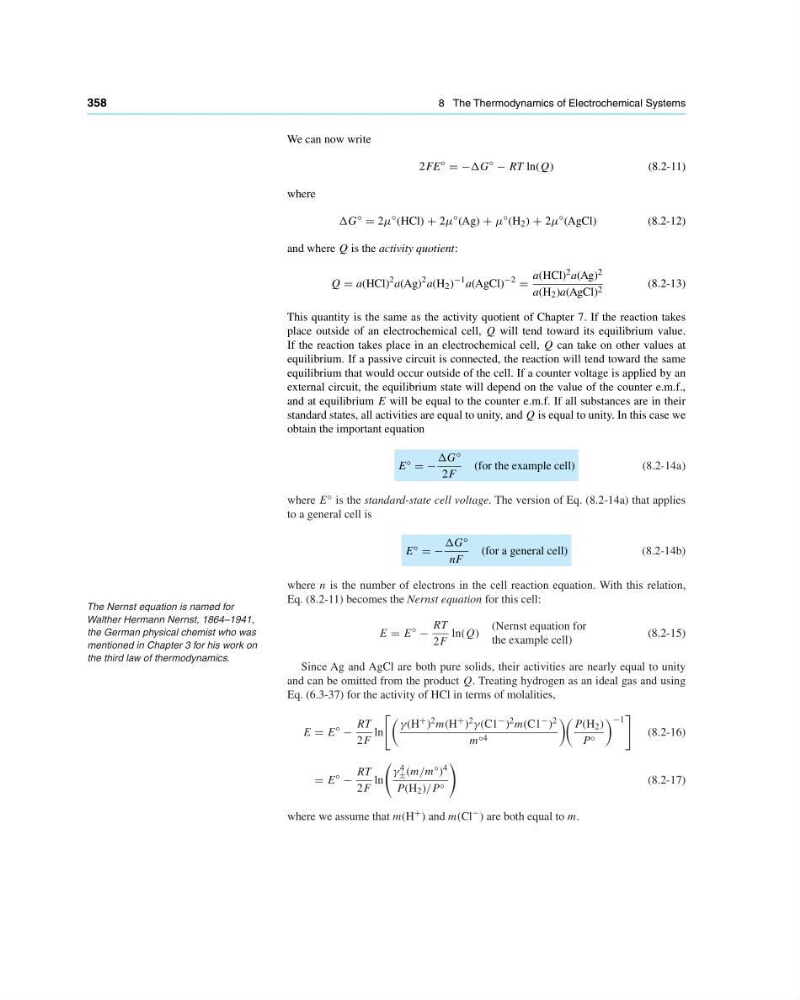
We can now write
2FE
◦
−∆G
◦
− RT ln(Q)
(8.2-11)
where
∆G
◦
2µ
◦ (HCl) + 2µ
◦ (Ag) + µ
◦ (H 2 ) + 2µ
◦ (AgCl)
(8.2-12)
and where Q is the activity quotient:
Q a(HCl)
2 a(Ag)
2 a(H 2 )
−1 a(AgCl)
−2
a(HCl) 2 a(Ag) 2
a(H 2 )a(AgCl) 2
(8.2-13)
This quantity is the same as the activity quotient of Chapter 7. If the reaction takes
place outside of an electrochemical cell, Q will tend toward its equilibrium value.
If the reaction takes place in an electrochemical cell, Q can take on other values at
equilibrium. If a passive circuit is connected, the reaction will tend toward the same
equilibrium that would occur outside of the cell. If a counter voltage is applied by an
external circuit, the equilibrium state will depend on the value of the counter e.m.f.,
and at equilibrium E will be equal to the counter e.m.f. If all substances are in their
standard states, all activities are equal to unity, and Q is equal to unity. In this case we
obtain the important equation
E ◦ −
∆G ◦
2F
(for the example cell)
(8.2-14a)
where E ◦ is the standard-state cell voltage. The version of Eq. (8.2-14a) that applies
to a general cell is
E ◦ −
∆G ◦
nF
(for a general cell)
(8.2-14b)
where n is the number of electrons in the cell reaction equation. With this relation,
Eq. (8.2-11) becomes the Nernst equation for this cell:
E E
◦
−
RT
2F
ln(Q)
(Nernst equation for
the example cell)
(8.2-15)
The Nernst equation is named for
Walther Hermann Nernst, 1864–1941,
the German physical chemist who was
mentioned in Chapter 3 for his work on
the third law of thermodynamics.
Since Ag and AgCl are both pure solids, their activities are nearly equal to unity
and can be omitted from the product Q. Treating hydrogen as an ideal gas and using
Eq. (6.3-37) for the activity of HCl in terms of molalities,
E E
◦
−
RT
2F
ln
γ(H + ) 2 m(H + ) 2 γ(C1 − ) 2 m(C1 − ) 2
m ◦4
P(H 2 )
P ◦
−1
(8.2-16)
E
◦
−
RT
2F
ln
γ 4
± (m/m ◦ ) 4
P(H 2 )/P ◦
(8.2-17)
where we assume that m(H + ) and m(Cl
− ) are both equal to m.
8 The Thermodynamics of Electrochemical Systems
We can now write
2FE
◦
−∆G
◦
− RT ln(Q)
(8.2-11)
where
∆G
◦
2µ
◦ (HCl) + 2µ
◦ (Ag) + µ
◦ (H 2 ) + 2µ
◦ (AgCl)
(8.2-12)
and where Q is the activity quotient:
Q a(HCl)
2 a(Ag)
2 a(H 2 )
−1 a(AgCl)
−2
a(HCl) 2 a(Ag) 2
a(H 2 )a(AgCl) 2
(8.2-13)
This quantity is the same as the activity quotient of Chapter 7. If the reaction takes
place outside of an electrochemical cell, Q will tend toward its equilibrium value.
If the reaction takes place in an electrochemical cell, Q can take on other values at
equilibrium. If a passive circuit is connected, the reaction will tend toward the same
equilibrium that would occur outside of the cell. If a counter voltage is applied by an
external circuit, the equilibrium state will depend on the value of the counter e.m.f.,
and at equilibrium E will be equal to the counter e.m.f. If all substances are in their
standard states, all activities are equal to unity, and Q is equal to unity. In this case we
obtain the important equation
E ◦ −
∆G ◦
2F
(for the example cell)
(8.2-14a)
where E ◦ is the standard-state cell voltage. The version of Eq. (8.2-14a) that applies
to a general cell is
E ◦ −
∆G ◦
nF
(for a general cell)
(8.2-14b)
where n is the number of electrons in the cell reaction equation. With this relation,
Eq. (8.2-11) becomes the Nernst equation for this cell:
E E
◦
−
RT
2F
ln(Q)
(Nernst equation for
the example cell)
(8.2-15)
The Nernst equation is named for
Walther Hermann Nernst, 1864–1941,
the German physical chemist who was
mentioned in Chapter 3 for his work on
the third law of thermodynamics.
Since Ag and AgCl are both pure solids, their activities are nearly equal to unity
and can be omitted from the product Q. Treating hydrogen as an ideal gas and using
Eq. (6.3-37) for the activity of HCl in terms of molalities,
E E
◦
−
RT
2F
ln
γ(H + ) 2 m(H + ) 2 γ(C1 − ) 2 m(C1 − ) 2
m ◦4
P(H 2 )
P ◦
−1
(8.2-16)
E
◦
−
RT
2F
ln
γ 4
± (m/m ◦ ) 4
P(H 2 )/P ◦
(8.2-17)
where we assume that m(H + ) and m(Cl
− ) are both equal to m.