

344
7 Chemical Equilibrium
Solution
a.
K exp
⎡
⎣
2.93 × 10 4 J mol −1
8.3145 J K −1 mol −1
(298.15 K)
⎤
⎦
1.36 × 10 5
b. Let x c eq (ATP)/c ◦
1.36 × 10 5
(0.0100 − x) 2
x
x
(0.0100 − x) 2
1.36 × 10 5 ≈
(0.0100) 2
1.36 × 10 5
≈ 7.35 × 10 −10
Exercise 7.22
Find the value of (∂G/∂ξ) T ,P at 298.15 K for the case that c(ATP) 0.0100 mol L −1 and
c(ADP) c(P i ) 0.0200 mol L −1 at pH 7.00 and pMg 4.00. Approximate all activity
coefficients by unity.
The hydrolysis of ATP is “coupled” to various other reactions that would otherwise
not be spontaneous. For example, the reaction
P i + glucose glucose 6-phosphate + H 2 O
(7.7-3)
is driven by the reaction of Eq. (7.7-1). We illustrate the coupling of reactions with the
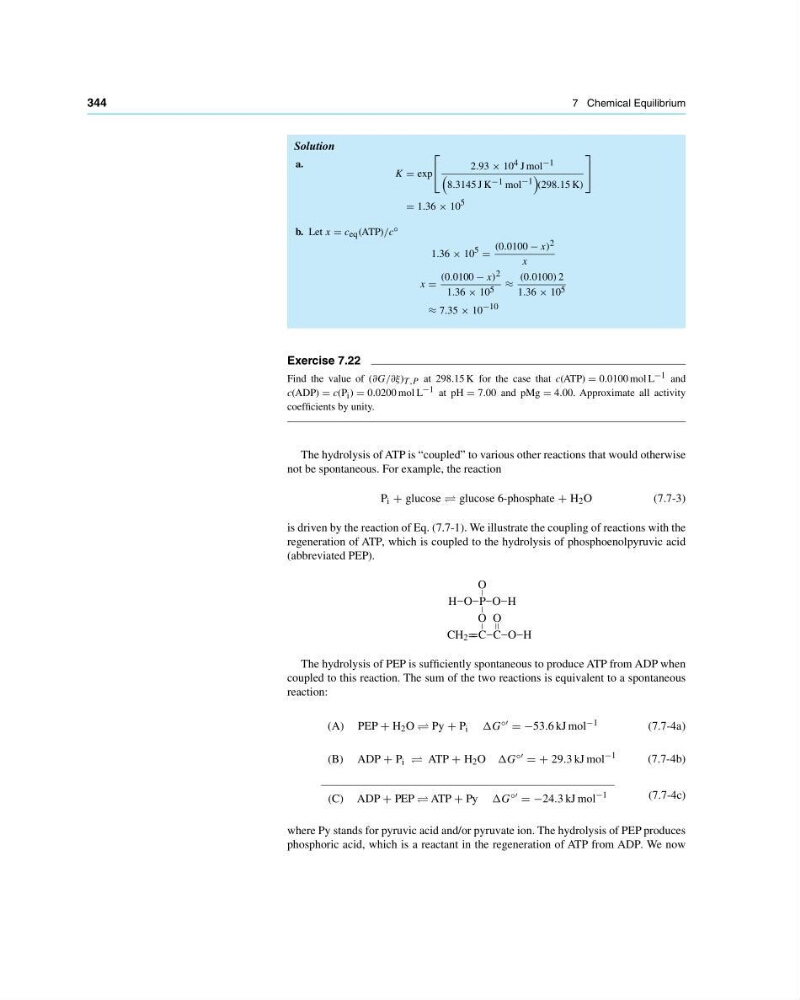
regeneration of ATP, which is coupled to the hydrolysis of phosphoenolpyruvic acid
(abbreviated PEP).
O
H–O–P–O–H
O O
CH 2 = =C–C–O–H
The hydrolysis of PEP is sufficiently spontaneous to produce ATP from ADP when
coupled to this reaction. The sum of the two reactions is equivalent to a spontaneous
reaction:
(A) PEP + H 2 O Py + P i ∆G ◦◦ −53.6 kJ mol −1
(7.7-4a)
(B) ADP + P i ATP + H 2 O ∆G ◦◦ + 29.3 kJ mol
−1
(7.7-4b)
(C) ADP + PEP ATP + Py ∆G ◦◦ −24.3 kJ mol
−1
(7.7-4c)
where Py stands for pyruvic acid and/or pyruvate ion. The hydrolysis of PEP produces
phosphoric acid, which is a reactant in the regeneration of ATP from ADP. We now
7 Chemical Equilibrium
Solution
a.
K exp
⎡
⎣
2.93 × 10 4 J mol −1
8.3145 J K −1 mol −1
(298.15 K)
⎤
⎦
1.36 × 10 5
b. Let x c eq (ATP)/c ◦
1.36 × 10 5
(0.0100 − x) 2
x
x
(0.0100 − x) 2
1.36 × 10 5 ≈
(0.0100) 2
1.36 × 10 5
≈ 7.35 × 10 −10
Exercise 7.22
Find the value of (∂G/∂ξ) T ,P at 298.15 K for the case that c(ATP) 0.0100 mol L −1 and
c(ADP) c(P i ) 0.0200 mol L −1 at pH 7.00 and pMg 4.00. Approximate all activity
coefficients by unity.
The hydrolysis of ATP is “coupled” to various other reactions that would otherwise
not be spontaneous. For example, the reaction
P i + glucose glucose 6-phosphate + H 2 O
(7.7-3)
is driven by the reaction of Eq. (7.7-1). We illustrate the coupling of reactions with the
regeneration of ATP, which is coupled to the hydrolysis of phosphoenolpyruvic acid
(abbreviated PEP).
O
H–O–P–O–H
O O
CH 2 = =C–C–O–H
The hydrolysis of PEP is sufficiently spontaneous to produce ATP from ADP when
coupled to this reaction. The sum of the two reactions is equivalent to a spontaneous
reaction:
(A) PEP + H 2 O Py + P i ∆G ◦◦ −53.6 kJ mol −1
(7.7-4a)
(B) ADP + P i ATP + H 2 O ∆G ◦◦ + 29.3 kJ mol
−1
(7.7-4b)
(C) ADP + PEP ATP + Py ∆G ◦◦ −24.3 kJ mol
−1
(7.7-4c)
where Py stands for pyruvic acid and/or pyruvate ion. The hydrolysis of PEP produces
phosphoric acid, which is a reactant in the regeneration of ATP from ADP. We now