

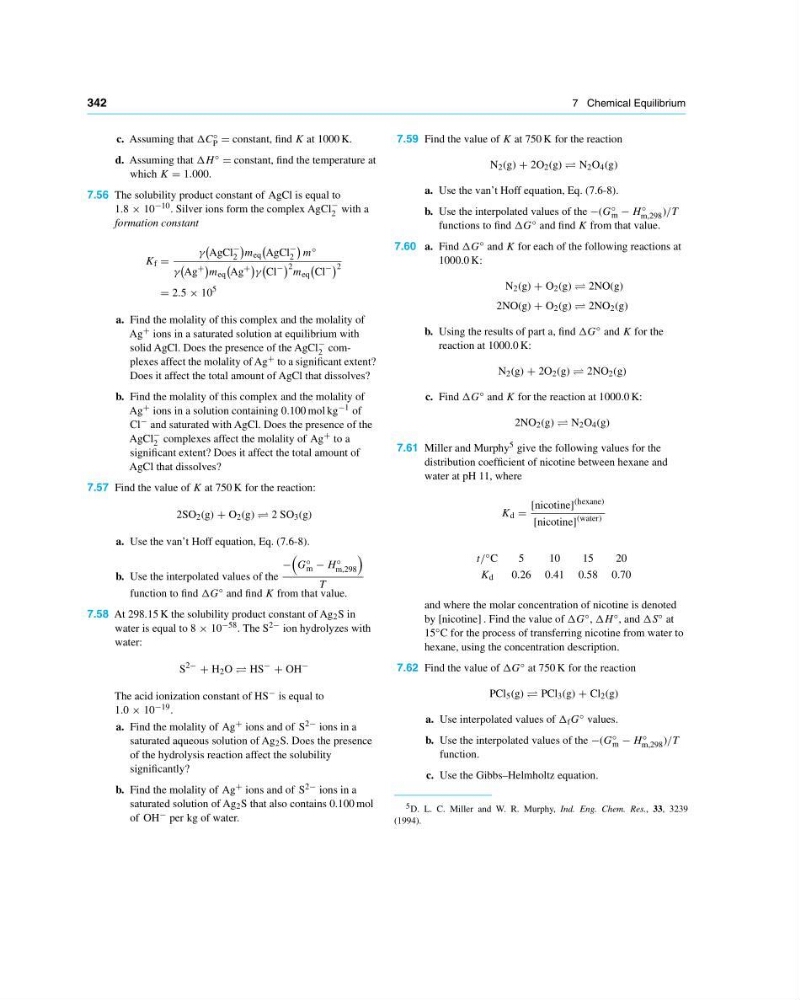
342
7 Chemical Equilibrium
c. Assuming that ∆C ◦
P constant, find K at 1000 K.
d. Assuming that ∆H ◦ constant, find the temperature at
which K 1.000.
7.56 The solubility product constant of AgCl is equal to
1.8 × 10 −10 . Silver ions form the complex AgCl
−
2 with a
formation constant
K f
γ
AgCl
−
2
m eq
AgCl
−
2
m ◦
γ
Ag
+
m eq
Ag
+
γ
Cl
−
2 m eq
Cl
−
2
2.5 × 10
5
a. Find the molality of this complex and the molality of
Ag + ions in a saturated solution at equilibrium with
solid AgCl. Does the presence of the AgCl
−
2 complexes affect the molality of Ag + to a significant extent?
Does it affect the total amount of AgCl that dissolves?
b. Find the molality of this complex and the molality of
Ag + ions in a solution containing 0.100 mol kg −1 of
Cl − and saturated with AgCl. Does the presence of the
AgCl
−
2 complexes affect the molality of Ag + to a
significant extent? Does it affect the total amount of
AgCl that dissolves?
7.57 Find the value of K at 750 K for the reaction:
2SO 2 (g) + O 2 (g) 2 SO 3 (g)
a. Use the van’t Hoff equation, Eq. (7.6-8).
b. Use the interpolated values of the
−
G ◦
m − H ◦
m,298
T
function to find ∆G ◦ and find K from that value.
7.58 At 298.15 K the solubility product constant of Ag 2 S in
water is equal to 8 × 10 −58 . The S 2− ion hydrolyzes with
water:
S
2−
+ H 2 O HS
−
+ OH
−
The acid ionization constant of HS − is equal to
1.0 × 10 −19 .
a. Find the molality of Ag + ions and of S 2− ions in a
saturated aqueous solution of Ag 2 S. Does the presence
of the hydrolysis reaction affect the solubility
significantly?
b. Find the molality of Ag + ions and of S 2− ions in a
saturated solution of Ag 2 S that also contains 0.100 mol
of OH − per kg of water.
7.59 Find the value of K at 750 K for the reaction
N 2 (g) + 2O 2 (g) N 2 O 4 (g)
a. Use the van’t Hoff equation, Eq. (7.6-8).
b. Use the interpolated values of the −(G ◦
m − H ◦
m,298 )/T
functions to find ∆G ◦ and find K from that value.
7.60 a. Find ∆G ◦ and K for each of the following reactions at
1000.0 K:
N 2 (g) + O 2 (g) 2NO(g)
2NO(g) + O 2 (g) 2NO 2 (g)
b. Using the results of part a, find ∆G ◦ and K for the
reaction at 1000.0 K:
N 2 (g) + 2O 2 (g) 2NO 2 (g)
c. Find ∆G ◦ and K for the reaction at 1000.0 K:
2NO 2 (g) N 2 O 4 (g)
7.61 Miller and Murphy 5 give the following values for the
distribution coefficient of nicotine between hexane and
water at pH 11, where
K d
[nicotine]
(hexane)
[nicotine]
(water)
t/ ◦ C
5
10
15
20
K d
0.26 0.41 0.58 0.70
and where the molar concentration of nicotine is denoted
by [nicotine] . Find the value of ∆G ◦ , ∆H ◦ , and ∆S ◦ at
15 ◦ C for the process of transferring nicotine from water to
hexane, using the concentration description.
7.62 Find the value of ∆G ◦ at 750 K for the reaction
PCl 5 (g) PCl 3 (g) + Cl 2 (g)
a. Use interpolated values of ∆ f G ◦ values.
b. Use the interpolated values of the −(G ◦
m − H ◦
m,298 )/T
function.
c. Use the Gibbs–Helmholtz equation.
5 D. L. C. Miller and W. R. Murphy, Ind. Eng. Chem. Res., 33, 3239
(1994).
7 Chemical Equilibrium
c. Assuming that ∆C ◦
P constant, find K at 1000 K.
d. Assuming that ∆H ◦ constant, find the temperature at
which K 1.000.
7.56 The solubility product constant of AgCl is equal to
1.8 × 10 −10 . Silver ions form the complex AgCl
−
2 with a
formation constant
K f
γ
AgCl
−
2
m eq
AgCl
−
2
m ◦
γ
Ag
+
m eq
Ag
+
γ
Cl
−
2 m eq
Cl
−
2
2.5 × 10
5
a. Find the molality of this complex and the molality of
Ag + ions in a saturated solution at equilibrium with
solid AgCl. Does the presence of the AgCl
−
2 complexes affect the molality of Ag + to a significant extent?
Does it affect the total amount of AgCl that dissolves?
b. Find the molality of this complex and the molality of
Ag + ions in a solution containing 0.100 mol kg −1 of
Cl − and saturated with AgCl. Does the presence of the
AgCl
−
2 complexes affect the molality of Ag + to a
significant extent? Does it affect the total amount of
AgCl that dissolves?
7.57 Find the value of K at 750 K for the reaction:
2SO 2 (g) + O 2 (g) 2 SO 3 (g)
a. Use the van’t Hoff equation, Eq. (7.6-8).
b. Use the interpolated values of the
−
G ◦
m − H ◦
m,298
T
function to find ∆G ◦ and find K from that value.
7.58 At 298.15 K the solubility product constant of Ag 2 S in
water is equal to 8 × 10 −58 . The S 2− ion hydrolyzes with
water:
S
2−
+ H 2 O HS
−
+ OH
−
The acid ionization constant of HS − is equal to
1.0 × 10 −19 .
a. Find the molality of Ag + ions and of S 2− ions in a
saturated aqueous solution of Ag 2 S. Does the presence
of the hydrolysis reaction affect the solubility
significantly?
b. Find the molality of Ag + ions and of S 2− ions in a
saturated solution of Ag 2 S that also contains 0.100 mol
of OH − per kg of water.
7.59 Find the value of K at 750 K for the reaction
N 2 (g) + 2O 2 (g) N 2 O 4 (g)
a. Use the van’t Hoff equation, Eq. (7.6-8).
b. Use the interpolated values of the −(G ◦
m − H ◦
m,298 )/T
functions to find ∆G ◦ and find K from that value.
7.60 a. Find ∆G ◦ and K for each of the following reactions at
1000.0 K:
N 2 (g) + O 2 (g) 2NO(g)
2NO(g) + O 2 (g) 2NO 2 (g)
b. Using the results of part a, find ∆G ◦ and K for the
reaction at 1000.0 K:
N 2 (g) + 2O 2 (g) 2NO 2 (g)
c. Find ∆G ◦ and K for the reaction at 1000.0 K:
2NO 2 (g) N 2 O 4 (g)
7.61 Miller and Murphy 5 give the following values for the
distribution coefficient of nicotine between hexane and
water at pH 11, where
K d
[nicotine]
(hexane)
[nicotine]
(water)
t/ ◦ C
5
10
15
20
K d
0.26 0.41 0.58 0.70
and where the molar concentration of nicotine is denoted
by [nicotine] . Find the value of ∆G ◦ , ∆H ◦ , and ∆S ◦ at
15 ◦ C for the process of transferring nicotine from water to
hexane, using the concentration description.
7.62 Find the value of ∆G ◦ at 750 K for the reaction
PCl 5 (g) PCl 3 (g) + Cl 2 (g)
a. Use interpolated values of ∆ f G ◦ values.
b. Use the interpolated values of the −(G ◦
m − H ◦
m,298 )/T
function.
c. Use the Gibbs–Helmholtz equation.
5 D. L. C. Miller and W. R. Murphy, Ind. Eng. Chem. Res., 33, 3239
(1994).