

326
7 Chemical Equilibrium
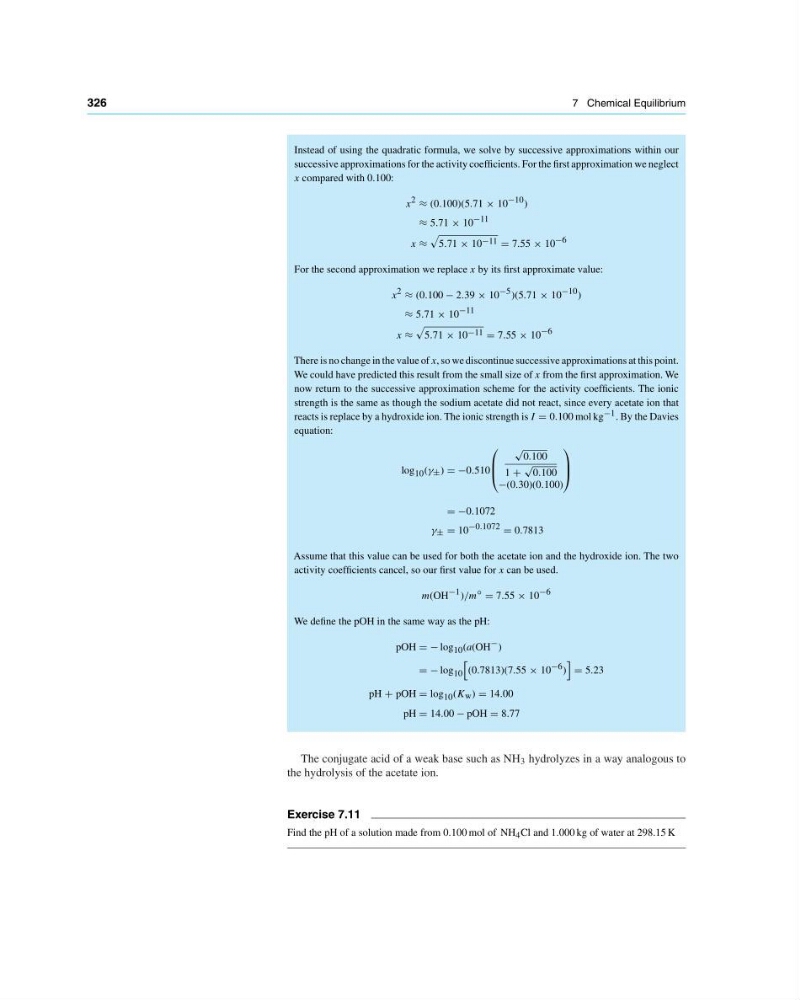
Instead of using the quadratic formula, we solve by successive approximations within our
successive approximations for the activity coefficients. For the first approximation we neglect
x compared with 0.100:
x 2 ≈ (0.100)(5.71 × 10 −10 )
≈ 5.71 × 10 −11
x ≈
5.71 × 10 −11 7.55 × 10 −6
For the second approximation we replace x by its first approximate value:
x 2 ≈ (0.100 − 2.39 × 10 −5 )(5.71 × 10 −10 )
≈ 5.71 × 10 −11
x ≈
5.71 × 10 −11 7.55 × 10 −6
There is no change in the value of x, so we discontinue successive approximations at this point.
We could have predicted this result from the small size of x from the first approximation. We
now return to the successive approximation scheme for the activity coefficients. The ionic
strength is the same as though the sodium acetate did not react, since every acetate ion that
reacts is replace by a hydroxide ion. The ionic strength is I 0.100 mol kg −1 . By the Davies
equation:
log 10 (γ ± ) −0.510
⎛
⎜
⎝
√
0.100
1 +
√
0.100
−(0.30)(0.100)
⎞
⎟
⎠
−0.1072
γ ± 10 −0.1072 0.7813
Assume that this value can be used for both the acetate ion and the hydroxide ion. The two
activity coefficients cancel, so our first value for x can be used.
m(OH −1 )/m ◦ 7.55 × 10 −6
We define the pOH in the same way as the pH:
pOH − log 10 (a(OH − )
− log 10
(0.7813)(7.55 × 10 −6 )
5.23
pH + pOH log 10 (K w ) 14.00
pH 14.00 − pOH 8.77
The conjugate acid of a weak base such as NH 3 hydrolyzes in a way analogous to
the hydrolysis of the acetate ion.
Exercise 7.11
Find the pH of a solution made from 0.100 mol of NH 4 Cl and 1.000 kg of water at 298.15 K
7 Chemical Equilibrium
Instead of using the quadratic formula, we solve by successive approximations within our
successive approximations for the activity coefficients. For the first approximation we neglect
x compared with 0.100:
x 2 ≈ (0.100)(5.71 × 10 −10 )
≈ 5.71 × 10 −11
x ≈
5.71 × 10 −11 7.55 × 10 −6
For the second approximation we replace x by its first approximate value:
x 2 ≈ (0.100 − 2.39 × 10 −5 )(5.71 × 10 −10 )
≈ 5.71 × 10 −11
x ≈
5.71 × 10 −11 7.55 × 10 −6
There is no change in the value of x, so we discontinue successive approximations at this point.
We could have predicted this result from the small size of x from the first approximation. We
now return to the successive approximation scheme for the activity coefficients. The ionic
strength is the same as though the sodium acetate did not react, since every acetate ion that
reacts is replace by a hydroxide ion. The ionic strength is I 0.100 mol kg −1 . By the Davies
equation:
log 10 (γ ± ) −0.510
⎛
⎜
⎝
√
0.100
1 +
√
0.100
−(0.30)(0.100)
⎞
⎟
⎠
−0.1072
γ ± 10 −0.1072 0.7813
Assume that this value can be used for both the acetate ion and the hydroxide ion. The two
activity coefficients cancel, so our first value for x can be used.
m(OH −1 )/m ◦ 7.55 × 10 −6
We define the pOH in the same way as the pH:
pOH − log 10 (a(OH − )
− log 10
(0.7813)(7.55 × 10 −6 )
5.23
pH + pOH log 10 (K w ) 14.00
pH 14.00 − pOH 8.77
The conjugate acid of a weak base such as NH 3 hydrolyzes in a way analogous to
the hydrolysis of the acetate ion.
Exercise 7.11
Find the pH of a solution made from 0.100 mol of NH 4 Cl and 1.000 kg of water at 298.15 K