

1.2 Systems and States in Physical Chemistry
15
df
∂f
∂x
y,z
dx +
∂f
∂y
x,z
dy +
∂f
∂z
x,y
dz
(1.2-5)
where (∂f /∂x) y,z , (∂f /∂y) x,z , and (∂f /∂z) x,y are partial derivatives. If the function is
represented by a formula, a partial derivative with respect to one independent variable
is obtained by the ordinary procedures of differentiation, treating the other independent variables as though they were constants. The independent variables that are held
constant are usually specified by subscripts.
We assume that our macroscopic equilibrium state functions are differentiable except
possibly at isolated points. For an equilibrium gas or liquid system of one phase and
one substance, we can write
dV
∂V
∂T
P,n
dT +
∂V
∂P
T ,n
dP +
∂V
∂n
T ,P
dn
(1.2-6)
This equation represents the value of an infinitesimal change in volume that is produced
when we impose arbitrary infinitesimal changes dT , dP, and dn on the system, making
sure that the system is at equilibrium after we make the changes. For an ideal gas
dV
nR
P
dT −
nRT
P 2 dP +
RT
P
dn (ideal gas)
(1.2-7)
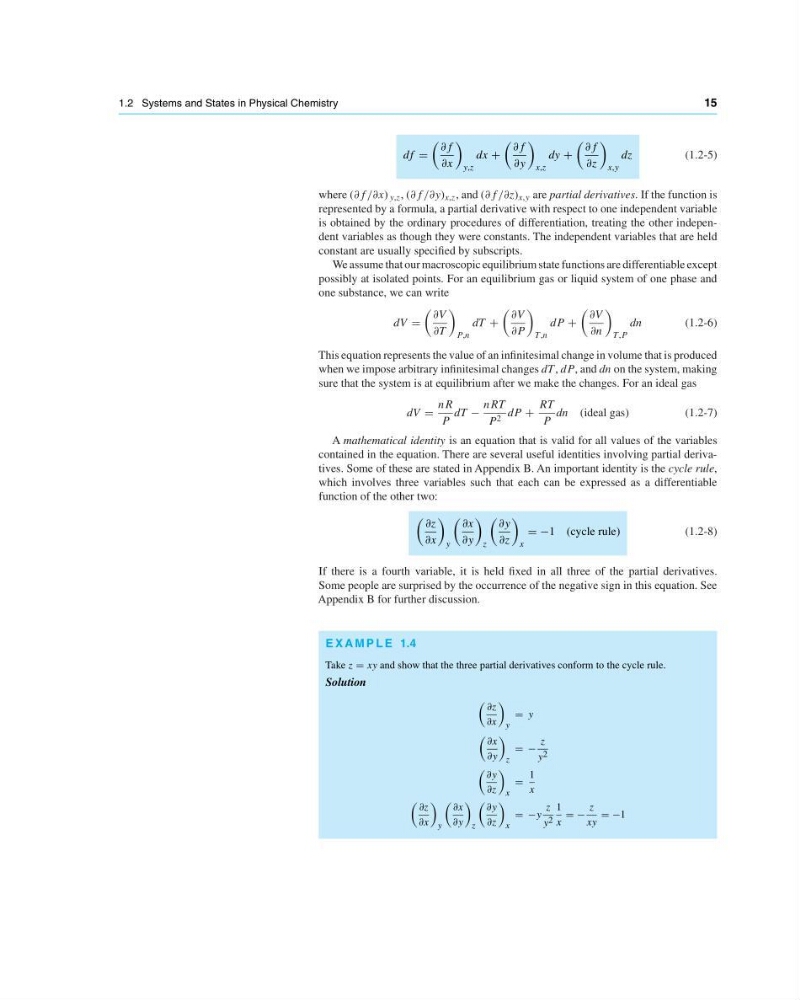
A mathematical identity is an equation that is valid for all values of the variables
contained in the equation. There are several useful identities involving partial derivatives. Some of these are stated in Appendix B. An important identity is the cycle rule,
which involves three variables such that each can be expressed as a differentiable
function of the other two:
∂z
∂x
y
∂x
∂y
z
∂y
∂z
x
−1 (cycle rule)
(1.2-8)
If there is a fourth variable, it is held fixed in all three of the partial derivatives.
Some people are surprised by the occurrence of the negative sign in this equation. See
Appendix B for further discussion.
E X A M P L E 1.4
Take z xy and show that the three partial derivatives conform to the cycle rule.
Solution
∂z
∂x
y
y
∂x
∂y
z
−
z
y 2
∂y
∂z
x
1
x
∂z
∂x
y
∂x
∂y
z
∂y
∂z
x
−y
z
y 2
1
x
−
z
xy
−1
15
df
∂f
∂x
y,z
dx +
∂f
∂y
x,z
dy +
∂f
∂z
x,y
dz
(1.2-5)
where (∂f /∂x) y,z , (∂f /∂y) x,z , and (∂f /∂z) x,y are partial derivatives. If the function is
represented by a formula, a partial derivative with respect to one independent variable
is obtained by the ordinary procedures of differentiation, treating the other independent variables as though they were constants. The independent variables that are held
constant are usually specified by subscripts.
We assume that our macroscopic equilibrium state functions are differentiable except
possibly at isolated points. For an equilibrium gas or liquid system of one phase and
one substance, we can write
dV
∂V
∂T
P,n
dT +
∂V
∂P
T ,n
dP +
∂V
∂n
T ,P
dn
(1.2-6)
This equation represents the value of an infinitesimal change in volume that is produced
when we impose arbitrary infinitesimal changes dT , dP, and dn on the system, making
sure that the system is at equilibrium after we make the changes. For an ideal gas
dV
nR
P
dT −
nRT
P 2 dP +
RT
P
dn (ideal gas)
(1.2-7)
A mathematical identity is an equation that is valid for all values of the variables
contained in the equation. There are several useful identities involving partial derivatives. Some of these are stated in Appendix B. An important identity is the cycle rule,
which involves three variables such that each can be expressed as a differentiable
function of the other two:
∂z
∂x
y
∂x
∂y
z
∂y
∂z
x
−1 (cycle rule)
(1.2-8)
If there is a fourth variable, it is held fixed in all three of the partial derivatives.
Some people are surprised by the occurrence of the negative sign in this equation. See
Appendix B for further discussion.
E X A M P L E 1.4
Take z xy and show that the three partial derivatives conform to the cycle rule.
Solution
∂z
∂x
y
y
∂x
∂y
z
−
z
y 2
∂y
∂z
x
1
x
∂z
∂x
y
∂x
∂y
z
∂y
∂z
x
−y
z
y 2
1
x
−
z
xy
−1