

320
7 Chemical Equilibrium
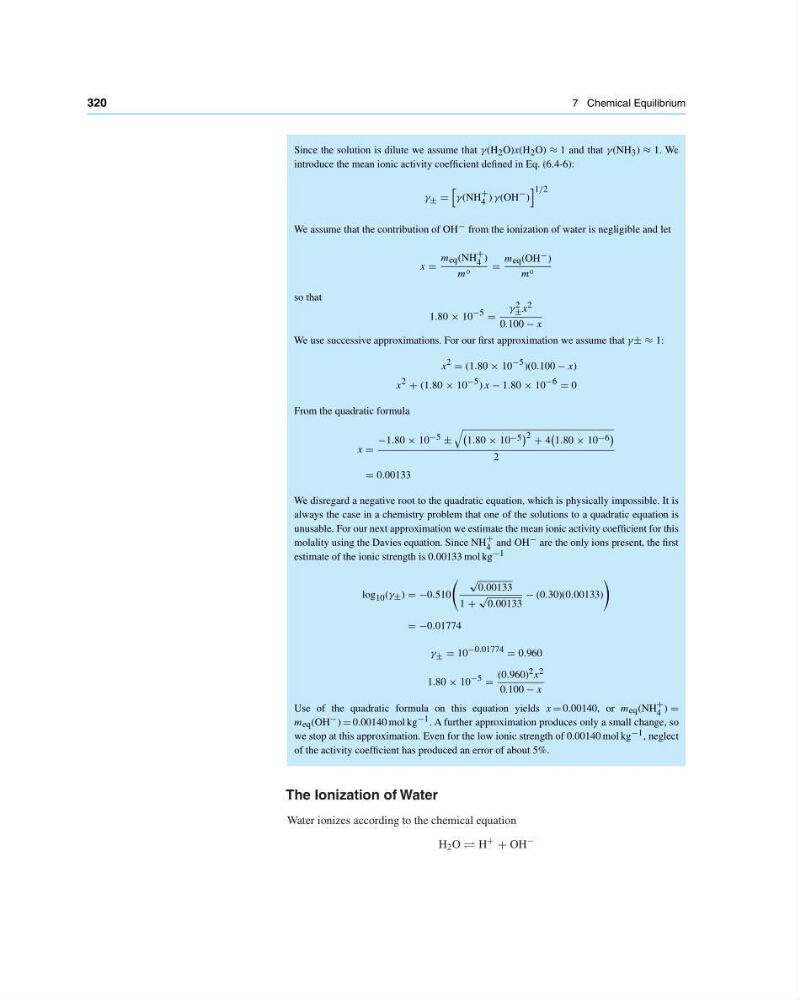
Since the solution is dilute we assume that γ(H 2 O)x(H 2 O) ≈ 1 and that γ(NH 3 ) ≈ 1. We
introduce the mean ionic activity coefficient defined in Eq. (6.4-6):
γ ±
γ(NH
+
4 ) γ(OH − )
1/2
We assume that the contribution of OH − from the ionization of water is negligible and let
x
m eq (NH
+
4 )
m ◦
m eq (OH − )
m ◦
so that
1.80 × 10 −5
γ 2
± x 2
0.100 − x
We use successive approximations. For our first approximation we assume that γ± ≈ 1:
x 2 (1.80 × 10 −5 )(0.100 − x)
x 2 + (1.80 × 10 −5 ) x − 1.80 × 10 −6 0
From the quadratic formula
x
−1.80 × 10 −5 ±
1.80 × 10 −5
2 + 4
1.80 × 10 −6
2
0.00133
We disregard a negative root to the quadratic equation, which is physically impossible. It is
always the case in a chemistry problem that one of the solutions to a quadratic equation is
unusable. For our next approximation we estimate the mean ionic activity coefficient for this
molality using the Davies equation. Since NH
+
4 and OH − are the only ions present, the first
estimate of the ionic strength is 0.00133 mol kg −1
log 10 (γ ± ) −0.510
√
0.00133
1 +
√
0.00133
− (0.30)(0.00133)
−0.01774
γ ± 10 −0.01774 0.960
1.80 × 10 −5
(0.960) 2 x 2
0.100 − x
Use of the quadratic formula on this equation yields x 0.00140, or m eq (NH
+
4 )
m eq (OH − ) 0.00140 mol kg −1 . A further approximation produces only a small change, so
we stop at this approximation. Even for the low ionic strength of 0.00140 mol kg −1 , neglect
of the activity coefficient has produced an error of about 5%.
The Ionization of Water
Water ionizes according to the chemical equation
H 2 O H
+
+ OH
−
7 Chemical Equilibrium
Since the solution is dilute we assume that γ(H 2 O)x(H 2 O) ≈ 1 and that γ(NH 3 ) ≈ 1. We
introduce the mean ionic activity coefficient defined in Eq. (6.4-6):
γ ±
γ(NH
+
4 ) γ(OH − )
1/2
We assume that the contribution of OH − from the ionization of water is negligible and let
x
m eq (NH
+
4 )
m ◦
m eq (OH − )
m ◦
so that
1.80 × 10 −5
γ 2
± x 2
0.100 − x
We use successive approximations. For our first approximation we assume that γ± ≈ 1:
x 2 (1.80 × 10 −5 )(0.100 − x)
x 2 + (1.80 × 10 −5 ) x − 1.80 × 10 −6 0
From the quadratic formula
x
−1.80 × 10 −5 ±
1.80 × 10 −5
2 + 4
1.80 × 10 −6
2
0.00133
We disregard a negative root to the quadratic equation, which is physically impossible. It is
always the case in a chemistry problem that one of the solutions to a quadratic equation is
unusable. For our next approximation we estimate the mean ionic activity coefficient for this
molality using the Davies equation. Since NH
+
4 and OH − are the only ions present, the first
estimate of the ionic strength is 0.00133 mol kg −1
log 10 (γ ± ) −0.510
√
0.00133
1 +
√
0.00133
− (0.30)(0.00133)
−0.01774
γ ± 10 −0.01774 0.960
1.80 × 10 −5
(0.960) 2 x 2
0.100 − x
Use of the quadratic formula on this equation yields x 0.00140, or m eq (NH
+
4 )
m eq (OH − ) 0.00140 mol kg −1 . A further approximation produces only a small change, so
we stop at this approximation. Even for the low ionic strength of 0.00140 mol kg −1 , neglect
of the activity coefficient has produced an error of about 5%.
The Ionization of Water
Water ionizes according to the chemical equation
H 2 O H
+
+ OH
−