

7.3 Chemical Equilibrium in Solutions
317
and the reactant molecules are uncharged, we can often assume that activity coefficients
are nearly equal to unity.
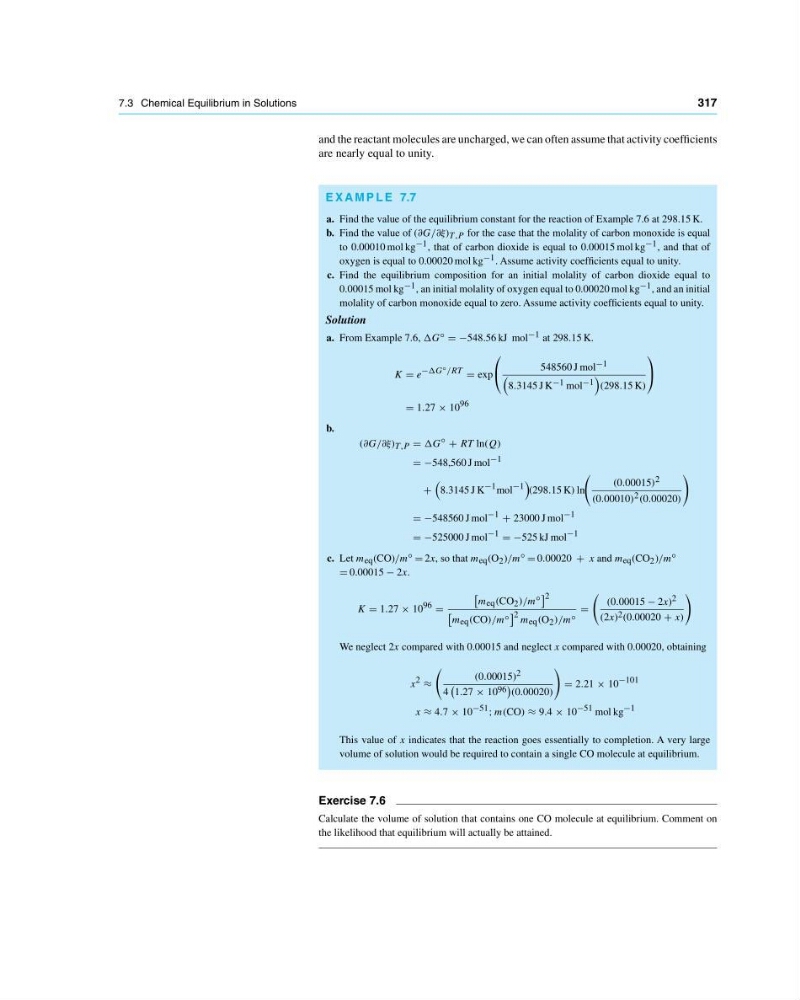
E X A M P L E 7.7
a. Find the value of the equilibrium constant for the reaction of Example 7.6 at 298.15 K.
b. Find the value of (∂G/∂ξ) T ,P for the case that the molality of carbon monoxide is equal
to 0.00010 mol kg −1 , that of carbon dioxide is equal to 0.00015 mol kg −1 , and that of
oxygen is equal to 0.00020 mol kg −1 . Assume activity coefficients equal to unity.
c. Find the equilibrium composition for an initial molality of carbon dioxide equal to
0.00015 mol kg −1 , an initial molality of oxygen equal to 0.00020 mol kg −1 , and an initial
molality of carbon monoxide equal to zero. Assume activity coefficients equal to unity.
Solution
a. From Example 7.6, ∆G ◦ −548.56 kJ mol −1 at 298.15 K.
K e −∆G ◦ /RT exp
⎛
⎝
548560 J mol −1
8.3145 J K −1 mol −1
(298.15 K)
⎞
⎠
1.27 × 10 96
b.
(∂G/∂ξ) T ,P ∆G ◦ + RT ln(Q)
−548,560 J mol −1
+
8.3145 J K −1 mol −1
(298.15 K) ln
(0.00015) 2
(0.00010) 2 (0.00020)
−548560 J mol −1 + 23000 J mol −1
−525000 J mol −1 −525 kJ mol −1
c. Let m eq (CO)/m ◦ 2x, so that m eq (O 2 )/m ◦ 0.00020 + x and m eq (CO 2 )/m ◦
0.00015 − 2x.
K 1.27 × 10 96
m eq (CO 2 )/m ◦ 2
m eq (CO)/m ◦
2 m eq (O 2 )/m ◦
(0.00015 − 2x) 2
(2x) 2 (0.00020 + x)
We neglect 2x compared with 0.00015 and neglect x compared with 0.00020, obtaining
x 2 ≈
(0.00015) 2
4
1.27 × 10 96
(0.00020)
2.21 × 10 −101
x ≈ 4.7 × 10 −51 ; m(CO) ≈ 9.4 × 10 −51 mol kg −1
This value of x indicates that the reaction goes essentially to completion. A very large
volume of solution would be required to contain a single CO molecule at equilibrium.
Exercise 7.6
Calculate the volume of solution that contains one CO molecule at equilibrium. Comment on
the likelihood that equilibrium will actually be attained.
317
and the reactant molecules are uncharged, we can often assume that activity coefficients
are nearly equal to unity.
E X A M P L E 7.7
a. Find the value of the equilibrium constant for the reaction of Example 7.6 at 298.15 K.
b. Find the value of (∂G/∂ξ) T ,P for the case that the molality of carbon monoxide is equal
to 0.00010 mol kg −1 , that of carbon dioxide is equal to 0.00015 mol kg −1 , and that of
oxygen is equal to 0.00020 mol kg −1 . Assume activity coefficients equal to unity.
c. Find the equilibrium composition for an initial molality of carbon dioxide equal to
0.00015 mol kg −1 , an initial molality of oxygen equal to 0.00020 mol kg −1 , and an initial
molality of carbon monoxide equal to zero. Assume activity coefficients equal to unity.
Solution
a. From Example 7.6, ∆G ◦ −548.56 kJ mol −1 at 298.15 K.
K e −∆G ◦ /RT exp
⎛
⎝
548560 J mol −1
8.3145 J K −1 mol −1
(298.15 K)
⎞
⎠
1.27 × 10 96
b.
(∂G/∂ξ) T ,P ∆G ◦ + RT ln(Q)
−548,560 J mol −1
+
8.3145 J K −1 mol −1
(298.15 K) ln
(0.00015) 2
(0.00010) 2 (0.00020)
−548560 J mol −1 + 23000 J mol −1
−525000 J mol −1 −525 kJ mol −1
c. Let m eq (CO)/m ◦ 2x, so that m eq (O 2 )/m ◦ 0.00020 + x and m eq (CO 2 )/m ◦
0.00015 − 2x.
K 1.27 × 10 96
m eq (CO 2 )/m ◦ 2
m eq (CO)/m ◦
2 m eq (O 2 )/m ◦
(0.00015 − 2x) 2
(2x) 2 (0.00020 + x)
We neglect 2x compared with 0.00015 and neglect x compared with 0.00020, obtaining
x 2 ≈
(0.00015) 2
4
1.27 × 10 96
(0.00020)
2.21 × 10 −101
x ≈ 4.7 × 10 −51 ; m(CO) ≈ 9.4 × 10 −51 mol kg −1
This value of x indicates that the reaction goes essentially to completion. A very large
volume of solution would be required to contain a single CO molecule at equilibrium.
Exercise 7.6
Calculate the volume of solution that contains one CO molecule at equilibrium. Comment on
the likelihood that equilibrium will actually be attained.