

314
7 Chemical Equilibrium
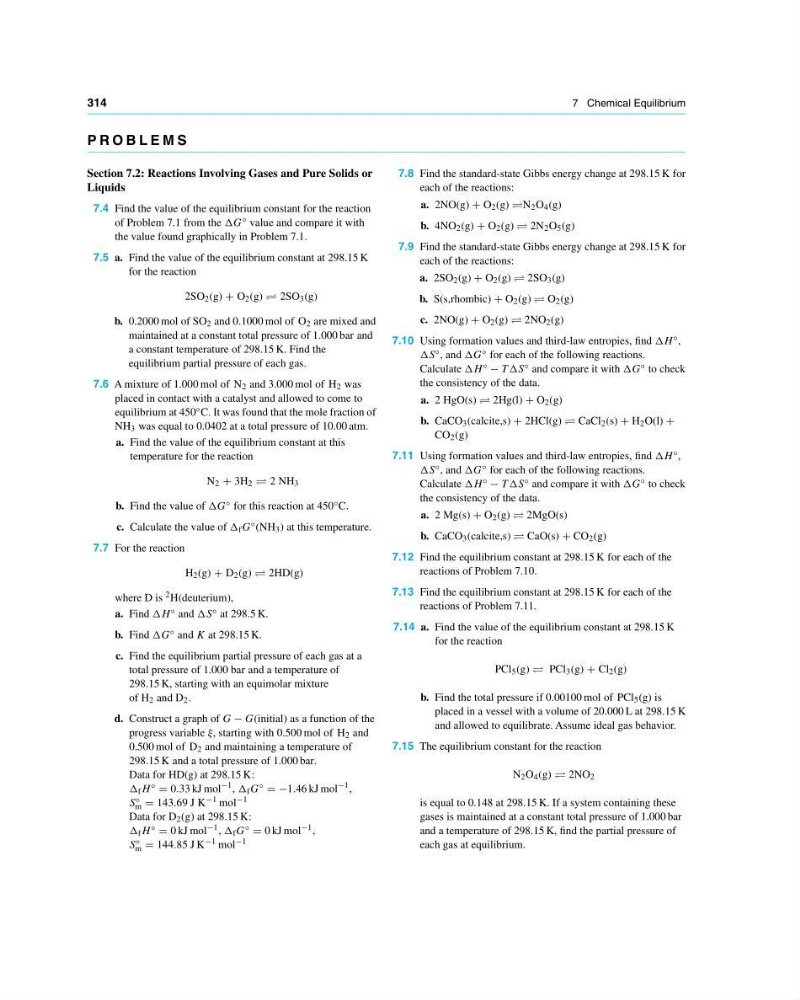
P R O B L E M S
Section 7.2: Reactions Involving Gases and Pure Solids or
Liquids
7.4 Find the value of the equilibrium constant for the reaction
of Problem 7.1 from the ∆G ◦ value and compare it with
the value found graphically in Problem 7.1.
7.5 a. Find the value of the equilibrium constant at 298.15 K
for the reaction
2SO 2 (g) + O 2 (g) 2SO 3 (g)
b. 0.2000 mol of SO 2 and 0.1000 mol of O 2 are mixed and
maintained at a constant total pressure of 1.000 bar and
a constant temperature of 298.15 K. Find the
equilibrium partial pressure of each gas.
7.6 A mixture of 1.000 mol of N 2 and 3.000 mol of H 2 was
placed in contact with a catalyst and allowed to come to
equilibrium at 450 ◦ C. It was found that the mole fraction of
NH 3 was equal to 0.0402 at a total pressure of 10.00 atm.
a. Find the value of the equilibrium constant at this
temperature for the reaction
N 2 + 3H 2 2 NH 3
b. Find the value of ∆G ◦ for this reaction at 450 ◦ C.
c. Calculate the value of ∆ f G ◦ (NH 3 ) at this temperature.
7.7 For the reaction
H 2 (g) + D 2 (g) 2HD(g)
where D is 2 H(deuterium),
a. Find ∆H ◦ and ∆S ◦ at 298.5 K.
b. Find ∆G ◦ and K at 298.15 K.
c. Find the equilibrium partial pressure of each gas at a
total pressure of 1.000 bar and a temperature of
298.15 K, starting with an equimolar mixture
of H 2 and D 2 .
d. Construct a graph of G − G(initial) as a function of the
progress variable ξ, starting with 0.500 mol of H 2 and
0.500 mol of D 2 and maintaining a temperature of
298.15 K and a total pressure of 1.000 bar.
Data for HD(g) at 298.15 K:
∆ f H ◦ 0.33 kJ mol
−1 , ∆ f G ◦ −1.46 kJ mol
−1 ,
S ◦
m 143.69 J K −1 mol −1
Data for D 2 (g) at 298.15 K:
∆ f H ◦ 0 kJ mol −1 , ∆ f G ◦ 0 kJ mol −1 ,
S ◦
m 144.85 J K −1 mol −1
7.8 Find the standard-state Gibbs energy change at 298.15 K for
each of the reactions:
a. 2NO(g) + O 2 (g) N 2 O 4 (g)
b. 4NO 2 (g) + O 2 (g) 2N 2 O 5 (g)
7.9 Find the standard-state Gibbs energy change at 298.15 K for
each of the reactions:
a. 2SO 2 (g) + O 2 (g) 2SO 3 (g)
b. S(s,rhombic) + O 2 (g) O 2 (g)
c. 2NO(g) + O 2 (g) 2NO 2 (g)
7.10 Using formation values and third-law entropies, find ∆H ◦ ,
∆S ◦ , and ∆G ◦ for each of the following reactions.
Calculate ∆H ◦ − T ∆S ◦ and compare it with ∆G ◦ to check
the consistency of the data.
a. 2 HgO(s) 2Hg(l) + O 2 (g)
b. CaCO 3 (calcite,s) + 2HCl(g) CaCl 2 (s) + H 2 O(l) +
CO 2 (g)
7.11 Using formation values and third-law entropies, find ∆H ◦ ,
∆S ◦ , and ∆G ◦ for each of the following reactions.
Calculate ∆H ◦ − T ∆S ◦ and compare it with ∆G ◦ to check
the consistency of the data.
a. 2 Mg(s) + O 2 (g) 2MgO(s)
b. CaCO 3 (calcite,s) CaO(s) + CO 2 (g)
7.12 Find the equilibrium constant at 298.15 K for each of the
reactions of Problem 7.10.
7.13 Find the equilibrium constant at 298.15 K for each of the
reactions of Problem 7.11.
7.14 a. Find the value of the equilibrium constant at 298.15 K
for the reaction
PCl 5 (g) PCl 3 (g) + Cl 2 (g)
b. Find the total pressure if 0.00100 mol of PCl 5 (g) is
placed in a vessel with a volume of 20.000 L at 298.15 K
and allowed to equilibrate. Assume ideal gas behavior.
7.15 The equilibrium constant for the reaction
N 2 O 4 (g) 2NO 2
is equal to 0.148 at 298.15 K. If a system containing these
gases is maintained at a constant total pressure of 1.000 bar
and a temperature of 298.15 K, find the partial pressure of
each gas at equilibrium.
7 Chemical Equilibrium
P R O B L E M S
Section 7.2: Reactions Involving Gases and Pure Solids or
Liquids
7.4 Find the value of the equilibrium constant for the reaction
of Problem 7.1 from the ∆G ◦ value and compare it with
the value found graphically in Problem 7.1.
7.5 a. Find the value of the equilibrium constant at 298.15 K
for the reaction
2SO 2 (g) + O 2 (g) 2SO 3 (g)
b. 0.2000 mol of SO 2 and 0.1000 mol of O 2 are mixed and
maintained at a constant total pressure of 1.000 bar and
a constant temperature of 298.15 K. Find the
equilibrium partial pressure of each gas.
7.6 A mixture of 1.000 mol of N 2 and 3.000 mol of H 2 was
placed in contact with a catalyst and allowed to come to
equilibrium at 450 ◦ C. It was found that the mole fraction of
NH 3 was equal to 0.0402 at a total pressure of 10.00 atm.
a. Find the value of the equilibrium constant at this
temperature for the reaction
N 2 + 3H 2 2 NH 3
b. Find the value of ∆G ◦ for this reaction at 450 ◦ C.
c. Calculate the value of ∆ f G ◦ (NH 3 ) at this temperature.
7.7 For the reaction
H 2 (g) + D 2 (g) 2HD(g)
where D is 2 H(deuterium),
a. Find ∆H ◦ and ∆S ◦ at 298.5 K.
b. Find ∆G ◦ and K at 298.15 K.
c. Find the equilibrium partial pressure of each gas at a
total pressure of 1.000 bar and a temperature of
298.15 K, starting with an equimolar mixture
of H 2 and D 2 .
d. Construct a graph of G − G(initial) as a function of the
progress variable ξ, starting with 0.500 mol of H 2 and
0.500 mol of D 2 and maintaining a temperature of
298.15 K and a total pressure of 1.000 bar.
Data for HD(g) at 298.15 K:
∆ f H ◦ 0.33 kJ mol
−1 , ∆ f G ◦ −1.46 kJ mol
−1 ,
S ◦
m 143.69 J K −1 mol −1
Data for D 2 (g) at 298.15 K:
∆ f H ◦ 0 kJ mol −1 , ∆ f G ◦ 0 kJ mol −1 ,
S ◦
m 144.85 J K −1 mol −1
7.8 Find the standard-state Gibbs energy change at 298.15 K for
each of the reactions:
a. 2NO(g) + O 2 (g) N 2 O 4 (g)
b. 4NO 2 (g) + O 2 (g) 2N 2 O 5 (g)
7.9 Find the standard-state Gibbs energy change at 298.15 K for
each of the reactions:
a. 2SO 2 (g) + O 2 (g) 2SO 3 (g)
b. S(s,rhombic) + O 2 (g) O 2 (g)
c. 2NO(g) + O 2 (g) 2NO 2 (g)
7.10 Using formation values and third-law entropies, find ∆H ◦ ,
∆S ◦ , and ∆G ◦ for each of the following reactions.
Calculate ∆H ◦ − T ∆S ◦ and compare it with ∆G ◦ to check
the consistency of the data.
a. 2 HgO(s) 2Hg(l) + O 2 (g)
b. CaCO 3 (calcite,s) + 2HCl(g) CaCl 2 (s) + H 2 O(l) +
CO 2 (g)
7.11 Using formation values and third-law entropies, find ∆H ◦ ,
∆S ◦ , and ∆G ◦ for each of the following reactions.
Calculate ∆H ◦ − T ∆S ◦ and compare it with ∆G ◦ to check
the consistency of the data.
a. 2 Mg(s) + O 2 (g) 2MgO(s)
b. CaCO 3 (calcite,s) CaO(s) + CO 2 (g)
7.12 Find the equilibrium constant at 298.15 K for each of the
reactions of Problem 7.10.
7.13 Find the equilibrium constant at 298.15 K for each of the
reactions of Problem 7.11.
7.14 a. Find the value of the equilibrium constant at 298.15 K
for the reaction
PCl 5 (g) PCl 3 (g) + Cl 2 (g)
b. Find the total pressure if 0.00100 mol of PCl 5 (g) is
placed in a vessel with a volume of 20.000 L at 298.15 K
and allowed to equilibrate. Assume ideal gas behavior.
7.15 The equilibrium constant for the reaction
N 2 O 4 (g) 2NO 2
is equal to 0.148 at 298.15 K. If a system containing these
gases is maintained at a constant total pressure of 1.000 bar
and a temperature of 298.15 K, find the partial pressure of
each gas at equilibrium.