

7.1 Gibbs Energy Changes and the Equilibrium Constant
305
reaction ξ by
n i n i (initial) + ν i ξ (definition of ξ)
(7.1-4)
Equation (7.1-4) gives the same value of ξ for any choice of the substance i. The extent
of reaction has the dimensions of moles. If ξ changes in value from 0 to 1 mol, we
say that 1 mol of reaction has occurred. If 1 mol of reaction occurs, ν i moles of i have
appeared if i is a product, and |ν i | moles of i have disappeared if i is a reactant. Think
of a stoichiometric coefficient as representing moles of substance per mole of reaction,
so that the stoichiometric coefficients are dimensionless.
For an infinitesimal extent of reaction, dξ,
dn i ν i dξ
(7.1-5)
Equation (7.1-3) now becomes, for constant T and P,
dG
c
i1
µ i v i dξ
c
i1
v i µ i
dξ
(7.1-6)
where we have factored the common factor dξ out of the sum. For our reacting system
G is a function of T , P, and ξ so that
∂G
∂ξ
T ,P
c
i1
v i µ i
(7.1-7)
The quantity (∂G/∂ξ) T ,P is the rate of change of Gibbs energy per mole of reaction.
A spontaneous process at constant T and P corresponds to dG < 0. If the forward
reaction is spontaneous, dξ > 0 and
∂G
∂ξ
T ,P
< 0
(forward reaction
spontaneous)
(7.1-8)
If the reverse reaction is spontaneous, dξ < 0 and
∂G
∂ξ
T ,P
> 0
(reverse reaction
spontaneous)
(7.1-9)
If the equilibrium state has been attained, there is no tendency for the reaction to
proceed, and dG 0, so that
∂G
∂ξ
T ,P
c
i1
v i µ i 0 (equilibrium)
(7.1-10)
eq
G
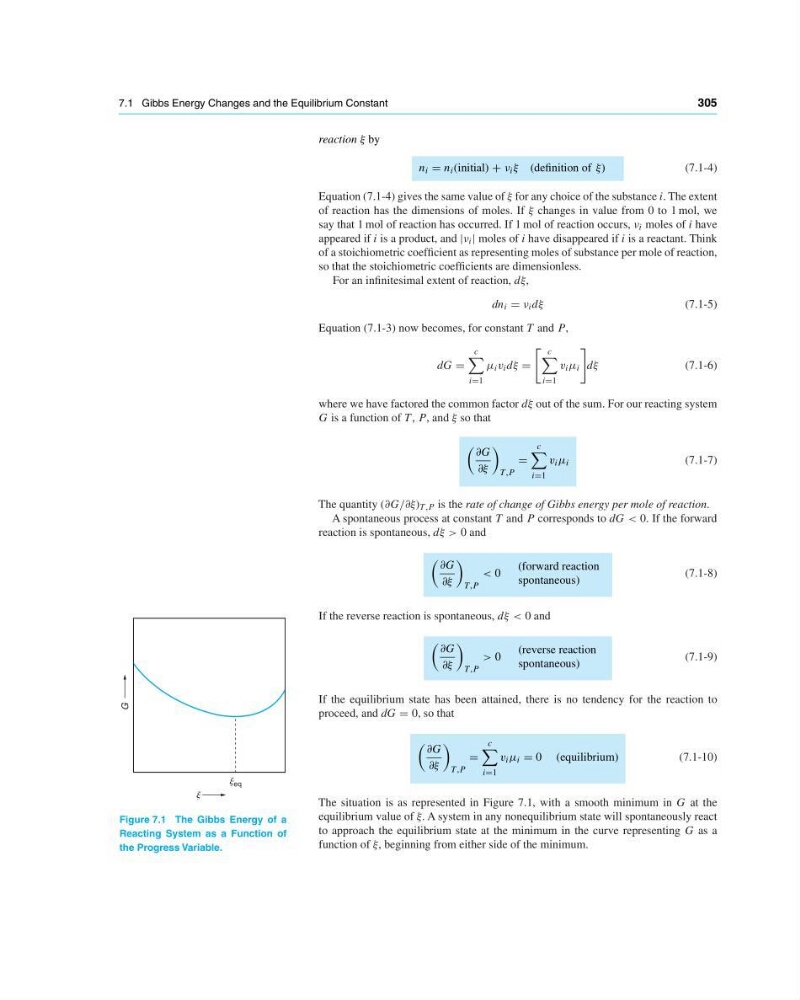
Figure 7.1 The Gibbs Energy of a
Reacting System as a Function of
the Progress Variable.
The situation is as represented in Figure 7.1, with a smooth minimum in G at the
equilibrium value of ξ. A system in any nonequilibrium state will spontaneously react
to approach the equilibrium state at the minimum in the curve representing G as a
function of ξ, beginning from either side of the minimum.
305
reaction ξ by
n i n i (initial) + ν i ξ (definition of ξ)
(7.1-4)
Equation (7.1-4) gives the same value of ξ for any choice of the substance i. The extent
of reaction has the dimensions of moles. If ξ changes in value from 0 to 1 mol, we
say that 1 mol of reaction has occurred. If 1 mol of reaction occurs, ν i moles of i have
appeared if i is a product, and |ν i | moles of i have disappeared if i is a reactant. Think
of a stoichiometric coefficient as representing moles of substance per mole of reaction,
so that the stoichiometric coefficients are dimensionless.
For an infinitesimal extent of reaction, dξ,
dn i ν i dξ
(7.1-5)
Equation (7.1-3) now becomes, for constant T and P,
dG
c
i1
µ i v i dξ
c
i1
v i µ i
dξ
(7.1-6)
where we have factored the common factor dξ out of the sum. For our reacting system
G is a function of T , P, and ξ so that
∂G
∂ξ
T ,P
c
i1
v i µ i
(7.1-7)
The quantity (∂G/∂ξ) T ,P is the rate of change of Gibbs energy per mole of reaction.
A spontaneous process at constant T and P corresponds to dG < 0. If the forward
reaction is spontaneous, dξ > 0 and
∂G
∂ξ
T ,P
< 0
(forward reaction
spontaneous)
(7.1-8)
If the reverse reaction is spontaneous, dξ < 0 and
∂G
∂ξ
T ,P
> 0
(reverse reaction
spontaneous)
(7.1-9)
If the equilibrium state has been attained, there is no tendency for the reaction to
proceed, and dG 0, so that
∂G
∂ξ
T ,P
c
i1
v i µ i 0 (equilibrium)
(7.1-10)
eq
G
Figure 7.1 The Gibbs Energy of a
Reacting System as a Function of
the Progress Variable.
The situation is as represented in Figure 7.1, with a smooth minimum in G at the
equilibrium value of ξ. A system in any nonequilibrium state will spontaneously react
to approach the equilibrium state at the minimum in the curve representing G as a
function of ξ, beginning from either side of the minimum.