

6.7 Colligative Properties
301
h. In an ideal solution, the mole fraction and the activity
coefficient of every component are equal.
i. If two substances form an ideal solution, they are
miscible in all proportions.
j. The mole fraction of naphthalene in a saturated solution
is the same in all solvents with which naphthalene
forms ideal solutions.
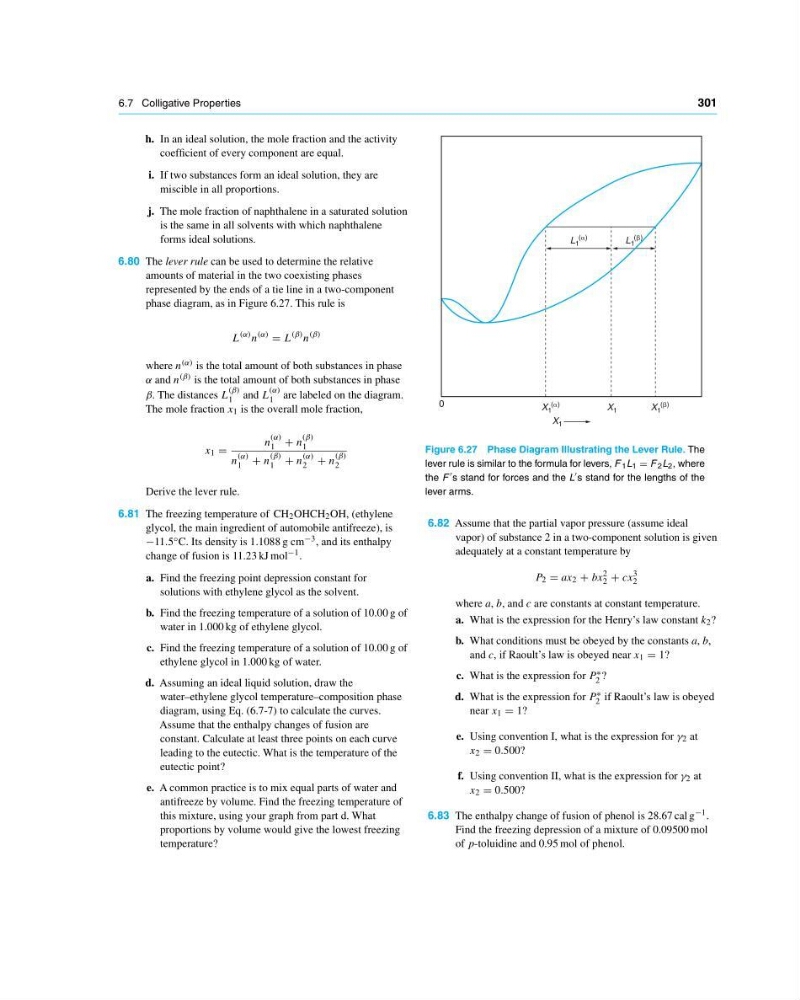
6.80 The lever rule can be used to determine the relative
amounts of material in the two coexisting phases
represented by the ends of a tie line in a two-component
phase diagram, as in Figure 6.27. This rule is
L
(α) n
(α)
L
(β) n
(β)
where n (α) is the total amount of both substances in phase
α and n (β) is the total amount of both substances in phase
β. The distances L
(β)
1 and L
(α)
1 are labeled on the diagram.
The mole fraction x 1 is the overall mole fraction,
x 1
n
(α)
1 + n
(β)
1
n
(α)
1 + n
(β)
1 + n
(α)
2 + n
(β)
2
Derive the lever rule.
6.81 The freezing temperature of CH 2 OHCH 2 OH, (ethylene
glycol, the main ingredient of automobile antifreeze), is
−11.5 ◦ C. Its density is 1.1088 g cm −3 , and its enthalpy
change of fusion is 11.23 kJ mol −1 .
a. Find the freezing point depression constant for
solutions with ethylene glycol as the solvent.
b. Find the freezing temperature of a solution of 10.00 g of
water in 1.000 kg of ethylene glycol.
c. Find the freezing temperature of a solution of 10.00 g of
ethylene glycol in 1.000 kg of water.
d. Assuming an ideal liquid solution, draw the
water–ethylene glycol temperature–composition phase
diagram, using Eq. (6.7-7) to calculate the curves.
Assume that the enthalpy changes of fusion are
constant. Calculate at least three points on each curve
leading to the eutectic. What is the temperature of the
eutectic point?
e. A common practice is to mix equal parts of water and
antifreeze by volume. Find the freezing temperature of
this mixture, using your graph from part d. What
proportions by volume would give the lowest freezing
temperature?
L 1
(␣)
L 1
()
0
X 1
(␣)
X 1
X 1
()
X 1
Figure 6.27 Phase Diagram Illustrating the Lever Rule. The
lever rule is similar to the formula for levers, F 1 L 1 F 2 L 2 , where
the F
s stand for forces and the L
s stand for the lengths of the
lever arms.
6.82 Assume that the partial vapor pressure (assume ideal
vapor) of substance 2 in a two-component solution is given
adequately at a constant temperature by
P 2 ax 2 + bx
2
2 + cx
3
2
where a, b, and c are constants at constant temperature.
a. What is the expression for the Henry’s law constant k 2 ?
b. What conditions must be obeyed by the constants a, b,
and c, if Raoult’s law is obeyed near x 1 1?
c. What is the expression for P ∗
2 ?
d. What is the expression for P ∗
2 if Raoult’s law is obeyed
near x 1 1?
e. Using convention I, what is the expression for γ 2 at
x 2 0.500?
f. Using convention II, what is the expression for γ 2 at
x 2 0.500?
6.83 The enthalpy change of fusion of phenol is 28.67 cal g −1 .
Find the freezing depression of a mixture of 0.09500 mol
of p-toluidine and 0.95 mol of phenol.
301
h. In an ideal solution, the mole fraction and the activity
coefficient of every component are equal.
i. If two substances form an ideal solution, they are
miscible in all proportions.
j. The mole fraction of naphthalene in a saturated solution
is the same in all solvents with which naphthalene
forms ideal solutions.
6.80 The lever rule can be used to determine the relative
amounts of material in the two coexisting phases
represented by the ends of a tie line in a two-component
phase diagram, as in Figure 6.27. This rule is
L
(α) n
(α)
L
(β) n
(β)
where n (α) is the total amount of both substances in phase
α and n (β) is the total amount of both substances in phase
β. The distances L
(β)
1 and L
(α)
1 are labeled on the diagram.
The mole fraction x 1 is the overall mole fraction,
x 1
n
(α)
1 + n
(β)
1
n
(α)
1 + n
(β)
1 + n
(α)
2 + n
(β)
2
Derive the lever rule.
6.81 The freezing temperature of CH 2 OHCH 2 OH, (ethylene
glycol, the main ingredient of automobile antifreeze), is
−11.5 ◦ C. Its density is 1.1088 g cm −3 , and its enthalpy
change of fusion is 11.23 kJ mol −1 .
a. Find the freezing point depression constant for
solutions with ethylene glycol as the solvent.
b. Find the freezing temperature of a solution of 10.00 g of
water in 1.000 kg of ethylene glycol.
c. Find the freezing temperature of a solution of 10.00 g of
ethylene glycol in 1.000 kg of water.
d. Assuming an ideal liquid solution, draw the
water–ethylene glycol temperature–composition phase
diagram, using Eq. (6.7-7) to calculate the curves.
Assume that the enthalpy changes of fusion are
constant. Calculate at least three points on each curve
leading to the eutectic. What is the temperature of the
eutectic point?
e. A common practice is to mix equal parts of water and
antifreeze by volume. Find the freezing temperature of
this mixture, using your graph from part d. What
proportions by volume would give the lowest freezing
temperature?
L 1
(␣)
L 1
()
0
X 1
(␣)
X 1
X 1
()
X 1
Figure 6.27 Phase Diagram Illustrating the Lever Rule. The
lever rule is similar to the formula for levers, F 1 L 1 F 2 L 2 , where
the F
s stand for forces and the L
s stand for the lengths of the
lever arms.
6.82 Assume that the partial vapor pressure (assume ideal
vapor) of substance 2 in a two-component solution is given
adequately at a constant temperature by
P 2 ax 2 + bx
2
2 + cx
3
2
where a, b, and c are constants at constant temperature.
a. What is the expression for the Henry’s law constant k 2 ?
b. What conditions must be obeyed by the constants a, b,
and c, if Raoult’s law is obeyed near x 1 1?
c. What is the expression for P ∗
2 ?
d. What is the expression for P ∗
2 if Raoult’s law is obeyed
near x 1 1?
e. Using convention I, what is the expression for γ 2 at
x 2 0.500?
f. Using convention II, what is the expression for γ 2 at
x 2 0.500?
6.83 The enthalpy change of fusion of phenol is 28.67 cal g −1 .
Find the freezing depression of a mixture of 0.09500 mol
of p-toluidine and 0.95 mol of phenol.