

1.2 Systems and States in Physical Chemistry
13
Hose
Valve
Part of
surroundings
Piston
Cylinder
External force exerted here
System
Constant-temperature bath
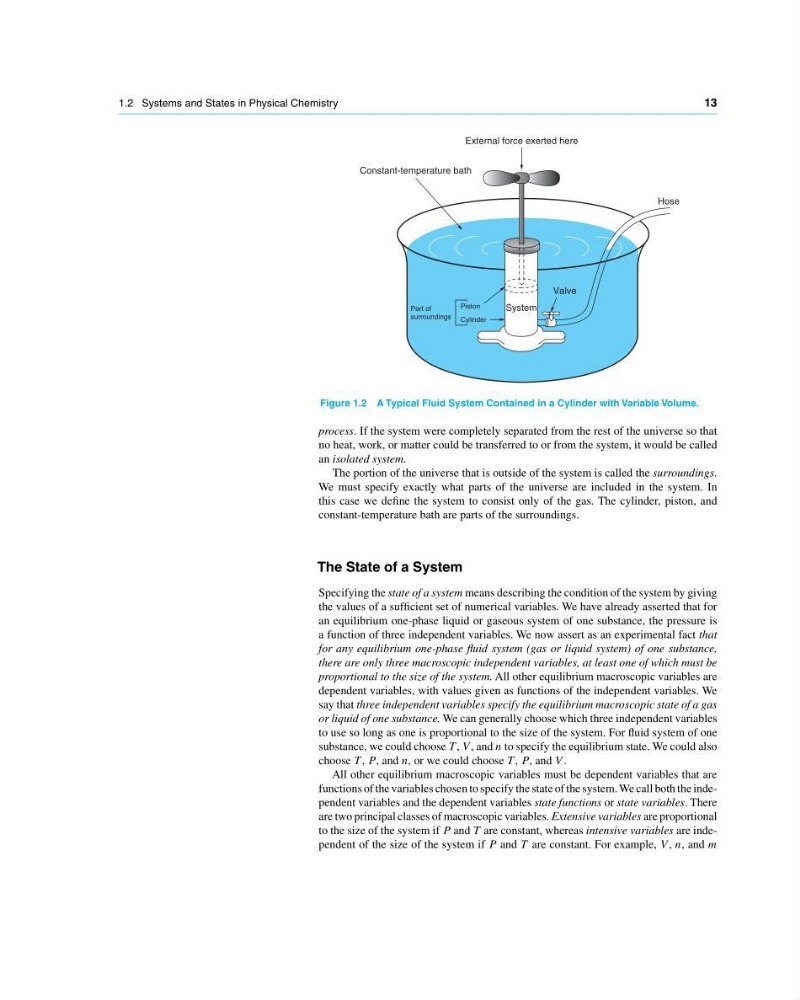
Figure 1.2 A Typical Fluid System Contained in a Cylinder with Variable Volume.
process. If the system were completely separated from the rest of the universe so that
no heat, work, or matter could be transferred to or from the system, it would be called
an isolated system.
The portion of the universe that is outside of the system is called the surroundings.
We must specify exactly what parts of the universe are included in the system. In
this case we define the system to consist only of the gas. The cylinder, piston, and
constant-temperature bath are parts of the surroundings.
The State of a System
Specifying the state of a system means describing the condition of the system by giving
the values of a sufficient set of numerical variables. We have already asserted that for
an equilibrium one-phase liquid or gaseous system of one substance, the pressure is
a function of three independent variables. We now assert as an experimental fact that
for any equilibrium one-phase fluid system (gas or liquid system) of one substance,
there are only three macroscopic independent variables, at least one of which must be
proportional to the size of the system. All other equilibrium macroscopic variables are
dependent variables, with values given as functions of the independent variables. We
say that three independent variables specify the equilibrium macroscopic state of a gas
or liquid of one substance. We can generally choose which three independent variables
to use so long as one is proportional to the size of the system. For fluid system of one
substance, we could choose T , V , and n to specify the equilibrium state. We could also
choose T , P, and n, or we could choose T , P, and V .
All other equilibrium macroscopic variables must be dependent variables that are
functions of the variables chosen to specify the state of the system. We call both the independent variables and the dependent variables state functions or state variables. There
are two principal classes of macroscopic variables. Extensive variables are proportional
to the size of the system if P and T are constant, whereas intensive variables are independent of the size of the system if P and T are constant. For example, V , n, and m
13
Hose
Valve
Part of
surroundings
Piston
Cylinder
External force exerted here
System
Constant-temperature bath
Figure 1.2 A Typical Fluid System Contained in a Cylinder with Variable Volume.
process. If the system were completely separated from the rest of the universe so that
no heat, work, or matter could be transferred to or from the system, it would be called
an isolated system.
The portion of the universe that is outside of the system is called the surroundings.
We must specify exactly what parts of the universe are included in the system. In
this case we define the system to consist only of the gas. The cylinder, piston, and
constant-temperature bath are parts of the surroundings.
The State of a System
Specifying the state of a system means describing the condition of the system by giving
the values of a sufficient set of numerical variables. We have already asserted that for
an equilibrium one-phase liquid or gaseous system of one substance, the pressure is
a function of three independent variables. We now assert as an experimental fact that
for any equilibrium one-phase fluid system (gas or liquid system) of one substance,
there are only three macroscopic independent variables, at least one of which must be
proportional to the size of the system. All other equilibrium macroscopic variables are
dependent variables, with values given as functions of the independent variables. We
say that three independent variables specify the equilibrium macroscopic state of a gas
or liquid of one substance. We can generally choose which three independent variables
to use so long as one is proportional to the size of the system. For fluid system of one
substance, we could choose T , V , and n to specify the equilibrium state. We could also
choose T , P, and n, or we could choose T , P, and V .
All other equilibrium macroscopic variables must be dependent variables that are
functions of the variables chosen to specify the state of the system. We call both the independent variables and the dependent variables state functions or state variables. There
are two principal classes of macroscopic variables. Extensive variables are proportional
to the size of the system if P and T are constant, whereas intensive variables are independent of the size of the system if P and T are constant. For example, V , n, and m