

6.7 Colligative Properties
299
Summary of the Chapter
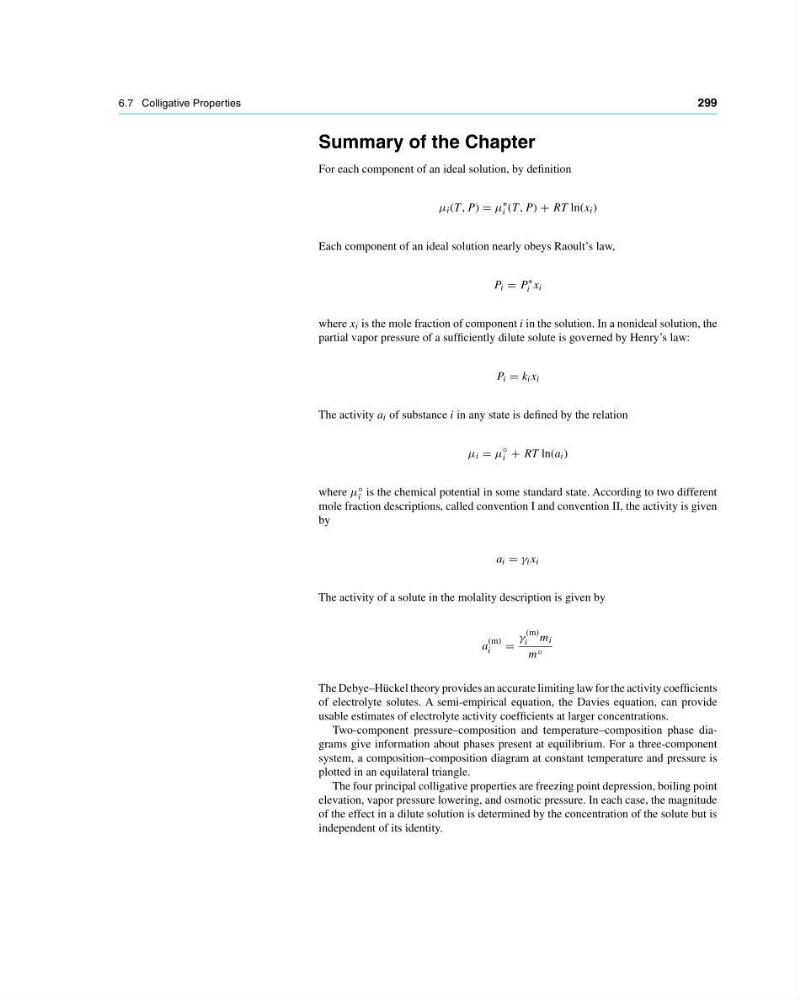
For each component of an ideal solution, by definition
µ i (T , P) µ
∗
i (T , P) + RT ln(x i )
Each component of an ideal solution nearly obeys Raoult’s law,
P i P
∗
i x i
where x i is the mole fraction of component i in the solution. In a nonideal solution, the
partial vapor pressure of a sufficiently dilute solute is governed by Henry’s law:
P i k i x i
The activity a i of substance i in any state is defined by the relation
µ i µ
◦
i + RT ln(a i )
where µ ◦
i is the chemical potential in some standard state. According to two different
mole fraction descriptions, called convention I and convention II, the activity is given
by
a i γ i x i
The activity of a solute in the molality description is given by
a
(m)
i
γ
(m)
i m i
m ◦
The Debye–Hückel theory provides an accurate limiting law for the activity coefficients
of electrolyte solutes. A semi-empirical equation, the Davies equation, can provide
usable estimates of electrolyte activity coefficients at larger concentrations.
Two-component pressure–composition and temperature–composition phase diagrams give information about phases present at equilibrium. For a three-component
system, a composition–composition diagram at constant temperature and pressure is
plotted in an equilateral triangle.
The four principal colligative properties are freezing point depression, boiling point
elevation, vapor pressure lowering, and osmotic pressure. In each case, the magnitude
of the effect in a dilute solution is determined by the concentration of the solute but is
independent of its identity.
299
Summary of the Chapter
For each component of an ideal solution, by definition
µ i (T , P) µ
∗
i (T , P) + RT ln(x i )
Each component of an ideal solution nearly obeys Raoult’s law,
P i P
∗
i x i
where x i is the mole fraction of component i in the solution. In a nonideal solution, the
partial vapor pressure of a sufficiently dilute solute is governed by Henry’s law:
P i k i x i
The activity a i of substance i in any state is defined by the relation
µ i µ
◦
i + RT ln(a i )
where µ ◦
i is the chemical potential in some standard state. According to two different
mole fraction descriptions, called convention I and convention II, the activity is given
by
a i γ i x i
The activity of a solute in the molality description is given by
a
(m)
i
γ
(m)
i m i
m ◦
The Debye–Hückel theory provides an accurate limiting law for the activity coefficients
of electrolyte solutes. A semi-empirical equation, the Davies equation, can provide
usable estimates of electrolyte activity coefficients at larger concentrations.
Two-component pressure–composition and temperature–composition phase diagrams give information about phases present at equilibrium. For a three-component
system, a composition–composition diagram at constant temperature and pressure is
plotted in an equilateral triangle.
The four principal colligative properties are freezing point depression, boiling point
elevation, vapor pressure lowering, and osmotic pressure. In each case, the magnitude
of the effect in a dilute solution is determined by the concentration of the solute but is
independent of its identity.