

296
6 The Thermodynamics of Solutions
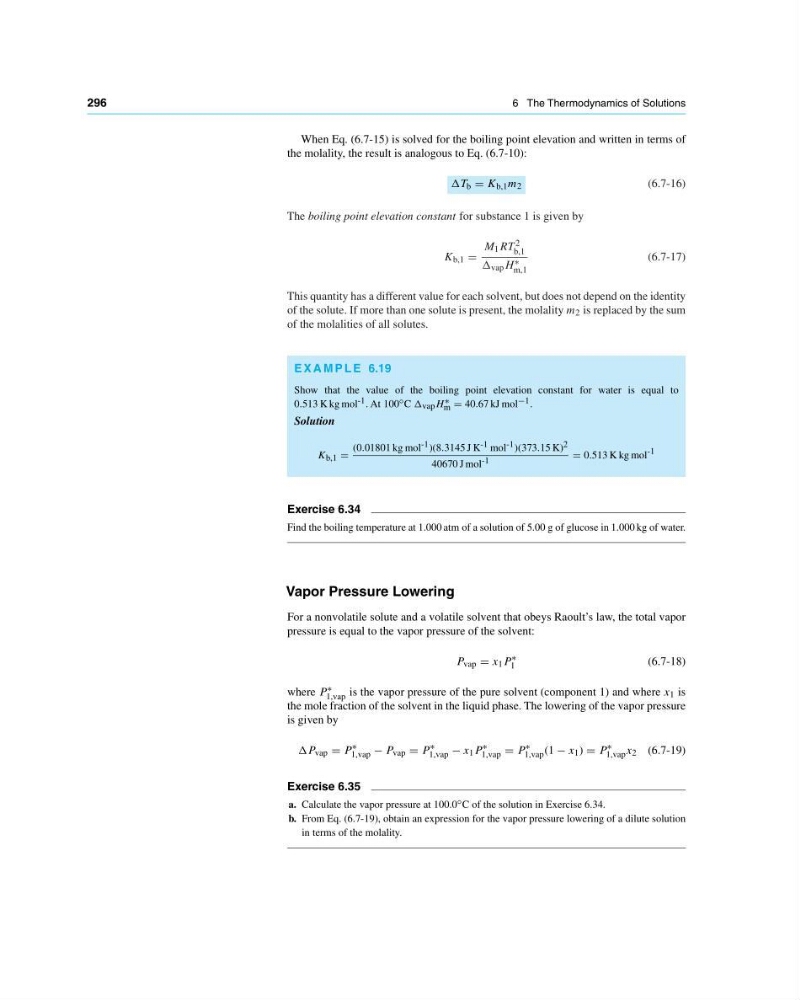
When Eq. (6.7-15) is solved for the boiling point elevation and written in terms of
the molality, the result is analogous to Eq. (6.7-10):
∆T b K b,1 m 2
(6.7-16)
The boiling point elevation constant for substance 1 is given by
K b,1
M 1 RT 2
b,1
∆ vap H ∗
m,1
(6.7-17)
This quantity has a different value for each solvent, but does not depend on the identity
of the solute. If more than one solute is present, the molality m 2 is replaced by the sum
of the molalities of all solutes.
E X A M P L E 6.19
Show that the value of the boiling point elevation constant for water is equal to
0.513 K kg mol -1 . At 100 ◦ C ∆ vap H ∗
m 40.67 kJ mol −1 .
Solution
K b,1
(0.01801 kg mol -1 )(8.3145 J K -1 mol -1 )(373.15 K) 2
40670 J mol -1
0.513 K kg mol -1
Exercise 6.34
Find the boiling temperature at 1.000 atm of a solution of 5.00 g of glucose in 1.000 kg of water.
Vapor Pressure Lowering
For a nonvolatile solute and a volatile solvent that obeys Raoult’s law, the total vapor
pressure is equal to the vapor pressure of the solvent:
P vap x 1 P
∗
1
(6.7-18)
where P ∗
1,vap is the vapor pressure of the pure solvent (component 1) and where x 1 is
the mole fraction of the solvent in the liquid phase. The lowering of the vapor pressure
is given by
∆P vap P
∗
1,vap − P vap P
∗
1,vap − x 1 P
∗
1,vap P
∗
1,vap (1 − x 1 ) P
∗
1,vap x 2 (6.7-19)
Exercise 6.35
a. Calculate the vapor pressure at 100.0 ◦ C of the solution in Exercise 6.34.
b. From Eq. (6.7-19), obtain an expression for the vapor pressure lowering of a dilute solution
in terms of the molality.
6 The Thermodynamics of Solutions
When Eq. (6.7-15) is solved for the boiling point elevation and written in terms of
the molality, the result is analogous to Eq. (6.7-10):
∆T b K b,1 m 2
(6.7-16)
The boiling point elevation constant for substance 1 is given by
K b,1
M 1 RT 2
b,1
∆ vap H ∗
m,1
(6.7-17)
This quantity has a different value for each solvent, but does not depend on the identity
of the solute. If more than one solute is present, the molality m 2 is replaced by the sum
of the molalities of all solutes.
E X A M P L E 6.19
Show that the value of the boiling point elevation constant for water is equal to
0.513 K kg mol -1 . At 100 ◦ C ∆ vap H ∗
m 40.67 kJ mol −1 .
Solution
K b,1
(0.01801 kg mol -1 )(8.3145 J K -1 mol -1 )(373.15 K) 2
40670 J mol -1
0.513 K kg mol -1
Exercise 6.34
Find the boiling temperature at 1.000 atm of a solution of 5.00 g of glucose in 1.000 kg of water.
Vapor Pressure Lowering
For a nonvolatile solute and a volatile solvent that obeys Raoult’s law, the total vapor
pressure is equal to the vapor pressure of the solvent:
P vap x 1 P
∗
1
(6.7-18)
where P ∗
1,vap is the vapor pressure of the pure solvent (component 1) and where x 1 is
the mole fraction of the solvent in the liquid phase. The lowering of the vapor pressure
is given by
∆P vap P
∗
1,vap − P vap P
∗
1,vap − x 1 P
∗
1,vap P
∗
1,vap (1 − x 1 ) P
∗
1,vap x 2 (6.7-19)
Exercise 6.35
a. Calculate the vapor pressure at 100.0 ◦ C of the solution in Exercise 6.34.
b. From Eq. (6.7-19), obtain an expression for the vapor pressure lowering of a dilute solution
in terms of the molality.