

6.4 The Activities of Nonvolatile Solutes
273
E X A M P L E 6.14
Calculate the value of γ ± for a 0.0100 mol kg −1 solution of NaCl in water at 298.15 K.
Assume that the distance of closest approach is 3.05 × 10 −10 m, which gives a value of βa
equal to 1.00 kg 1/2 mol −1/2 .
Solution
ln
γ ±
−
1.171 kg 1/2 mol −1/2
0.01 mol kg −1
1/2
1 +
1.00 kg 1/2 mol −1/2
0.01 mol kg −1
1/2 −0.1065
γ ± 0.899
The Debye–Hückel result has been shown experimentally to be an accurate limiting
law. That is, it becomes more nearly exact as the concentration approaches zero. In
practice, it is sufficiently accurate for ionic strengths up to 0.01 mol kg −1 , but is not
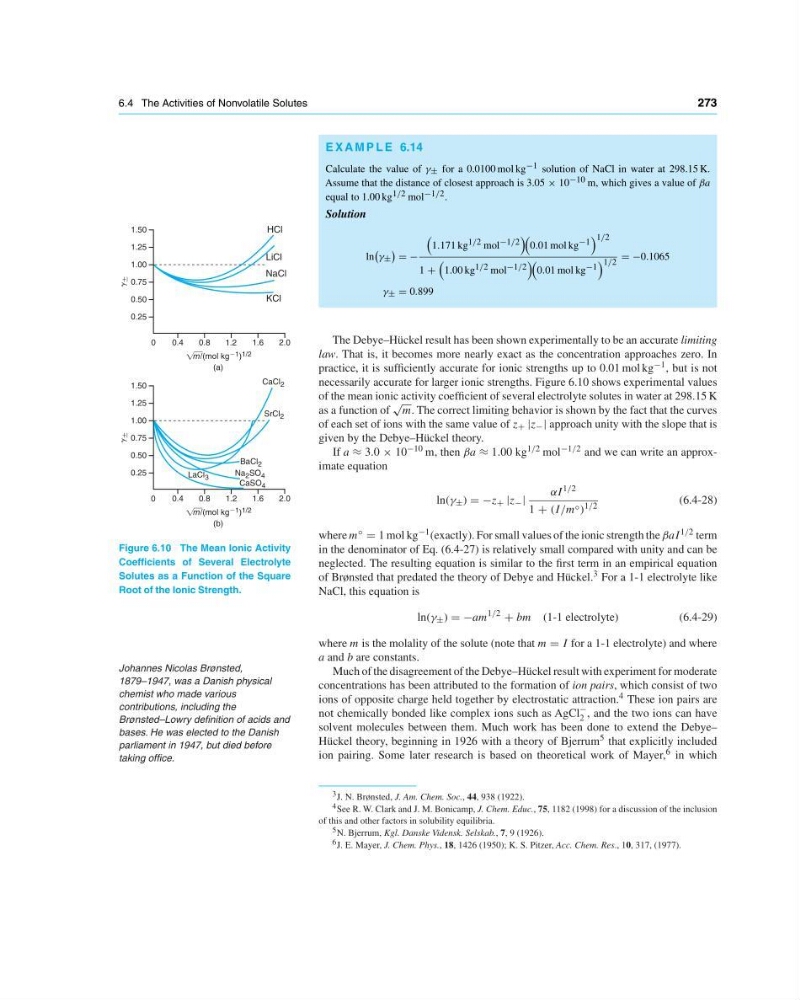
necessarily accurate for larger ionic strengths. Figure 6.10 shows experimental values
of the mean ionic activity coefficient of several electrolyte solutes in water at 298.15 K
as a function of
√
m. The correct limiting behavior is shown by the fact that the curves
of each set of ions with the same value of z + |z − | approach unity with the slope that is
given by the Debye–Hückel theory.
1.50
1.25
HCl
NaCl
KCl
CaSO 4
Na 2 SO 4
LaCl 3
BaCl 2
SrCl 2
CaCl 2
(a)
LiCl
1.00
0.75
0.50
0.25
0
0.4
0.8
1.2
1.6
2.0
␥
6
œw m /(mol kg 21 ) 1/2
(b)
œw m/(mol kg 21 ) 1/2
1.50
1.25
1.00
0.75
0.50
0.25
0
0.4
0.8
1.2
1.6
2.0
␥
6
Figure 6.10 The Mean Ionic Activity
Coefficients of Several Electrolyte
Solutes as a Function of the Square
Root of the Ionic Strength.
If a ≈ 3.0 × 10 −10 m, then βa ≈ 1.00 kg 1/2 mol −1/2 and we can write an approximate equation
ln(γ ± ) −z + |z − |
αI 1/2
1 + (I/m ◦ ) 1/2
(6.4-28)
where m ◦ 1 mol kg −1 (exactly). For small values of the ionic strength the βaI 1/2 term
in the denominator of Eq. (6.4-27) is relatively small compared with unity and can be
neglected. The resulting equation is similar to the first term in an empirical equation
of Brønsted that predated the theory of Debye and Hückel. 3 For a 1-1 electrolyte like
NaCl, this equation is
ln(γ ± ) −am
1/2
+ bm (1-1 electrolyte)
(6.4-29)
where m is the molality of the solute (note that m I for a 1-1 electrolyte) and where
a and b are constants.
Johannes Nicolas Brønsted,
1879–1947, was a Danish physical
chemist who made various
contributions, including the
Brønsted–Lowry definition of acids and
bases. He was elected to the Danish
parliament in 1947, but died before
taking office.
Much of the disagreement of the Debye–Hückel result with experiment for moderate
concentrations has been attributed to the formation of ion pairs, which consist of two
ions of opposite charge held together by electrostatic attraction. 4 These ion pairs are
not chemically bonded like complex ions such as AgCl
−
2 , and the two ions can have
solvent molecules between them. Much work has been done to extend the Debye–
Hückel theory, beginning in 1926 with a theory of Bjerrum 5 that explicitly included
ion pairing. Some later research is based on theoretical work of Mayer, 6 in which
3 J. N. Brønsted, J. Am. Chem. Soc., 44, 938 (1922).
4 See R. W. Clark and J. M. Bonicamp, J. Chem. Educ., 75, 1182 (1998) for a discussion of the inclusion
of this and other factors in solubility equilibria.
5 N. Bjerrum, Kgl. Danske Vidensk. Selskab., 7, 9 (1926).
6 J. E. Mayer, J. Chem. Phys., 18, 1426 (1950); K. S. Pitzer, Acc. Chem. Res., 10, 317, (1977).
273
E X A M P L E 6.14
Calculate the value of γ ± for a 0.0100 mol kg −1 solution of NaCl in water at 298.15 K.
Assume that the distance of closest approach is 3.05 × 10 −10 m, which gives a value of βa
equal to 1.00 kg 1/2 mol −1/2 .
Solution
ln
γ ±
−
1.171 kg 1/2 mol −1/2
0.01 mol kg −1
1/2
1 +
1.00 kg 1/2 mol −1/2
0.01 mol kg −1
1/2 −0.1065
γ ± 0.899
The Debye–Hückel result has been shown experimentally to be an accurate limiting
law. That is, it becomes more nearly exact as the concentration approaches zero. In
practice, it is sufficiently accurate for ionic strengths up to 0.01 mol kg −1 , but is not
necessarily accurate for larger ionic strengths. Figure 6.10 shows experimental values
of the mean ionic activity coefficient of several electrolyte solutes in water at 298.15 K
as a function of
√
m. The correct limiting behavior is shown by the fact that the curves
of each set of ions with the same value of z + |z − | approach unity with the slope that is
given by the Debye–Hückel theory.
1.50
1.25
HCl
NaCl
KCl
CaSO 4
Na 2 SO 4
LaCl 3
BaCl 2
SrCl 2
CaCl 2
(a)
LiCl
1.00
0.75
0.50
0.25
0
0.4
0.8
1.2
1.6
2.0
␥
6
œw m /(mol kg 21 ) 1/2
(b)
œw m/(mol kg 21 ) 1/2
1.50
1.25
1.00
0.75
0.50
0.25
0
0.4
0.8
1.2
1.6
2.0
␥
6
Figure 6.10 The Mean Ionic Activity
Coefficients of Several Electrolyte
Solutes as a Function of the Square
Root of the Ionic Strength.
If a ≈ 3.0 × 10 −10 m, then βa ≈ 1.00 kg 1/2 mol −1/2 and we can write an approximate equation
ln(γ ± ) −z + |z − |
αI 1/2
1 + (I/m ◦ ) 1/2
(6.4-28)
where m ◦ 1 mol kg −1 (exactly). For small values of the ionic strength the βaI 1/2 term
in the denominator of Eq. (6.4-27) is relatively small compared with unity and can be
neglected. The resulting equation is similar to the first term in an empirical equation
of Brønsted that predated the theory of Debye and Hückel. 3 For a 1-1 electrolyte like
NaCl, this equation is
ln(γ ± ) −am
1/2
+ bm (1-1 electrolyte)
(6.4-29)
where m is the molality of the solute (note that m I for a 1-1 electrolyte) and where
a and b are constants.
Johannes Nicolas Brønsted,
1879–1947, was a Danish physical
chemist who made various
contributions, including the
Brønsted–Lowry definition of acids and
bases. He was elected to the Danish
parliament in 1947, but died before
taking office.
Much of the disagreement of the Debye–Hückel result with experiment for moderate
concentrations has been attributed to the formation of ion pairs, which consist of two
ions of opposite charge held together by electrostatic attraction. 4 These ion pairs are
not chemically bonded like complex ions such as AgCl
−
2 , and the two ions can have
solvent molecules between them. Much work has been done to extend the Debye–
Hückel theory, beginning in 1926 with a theory of Bjerrum 5 that explicitly included
ion pairing. Some later research is based on theoretical work of Mayer, 6 in which
3 J. N. Brønsted, J. Am. Chem. Soc., 44, 938 (1922).
4 See R. W. Clark and J. M. Bonicamp, J. Chem. Educ., 75, 1182 (1998) for a discussion of the inclusion
of this and other factors in solubility equilibria.
5 N. Bjerrum, Kgl. Danske Vidensk. Selskab., 7, 9 (1926).
6 J. E. Mayer, J. Chem. Phys., 18, 1426 (1950); K. S. Pitzer, Acc. Chem. Res., 10, 317, (1977).