

6.3 Activity and Activity Coefficients
265
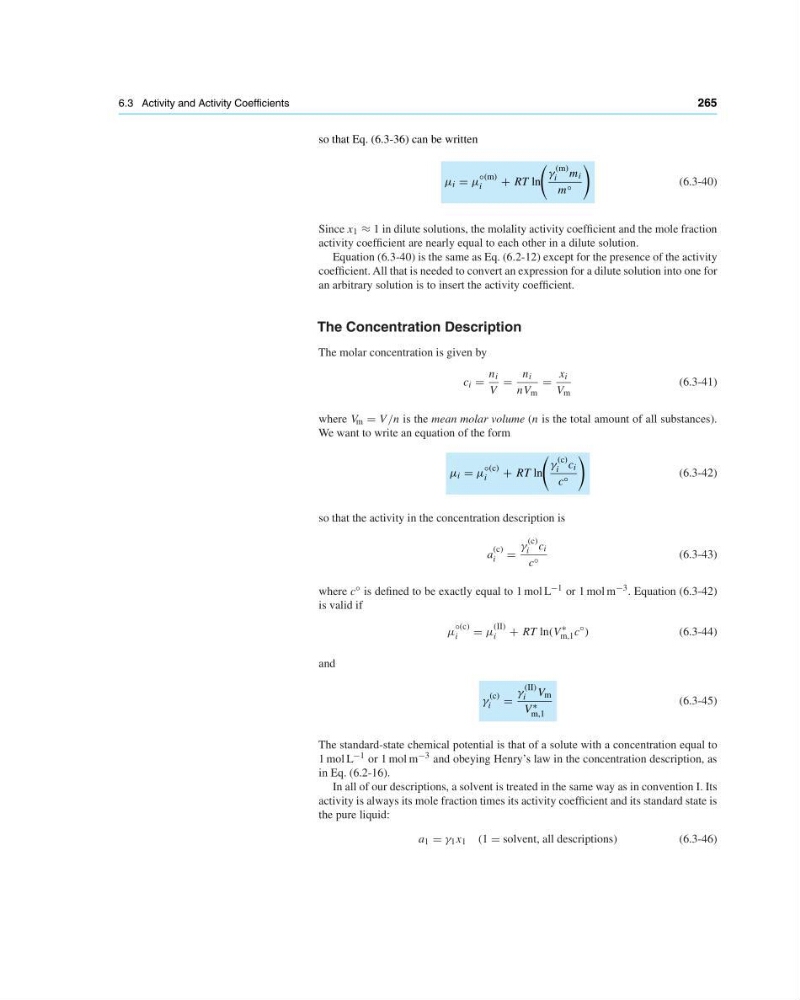
so that Eq. (6.3-36) can be written
µ i µ
◦(m)
i
+ RT ln
γ
(m)
i m i
m ◦
(6.3-40)
Since x 1 ≈ 1 in dilute solutions, the molality activity coefficient and the mole fraction
activity coefficient are nearly equal to each other in a dilute solution.
Equation (6.3-40) is the same as Eq. (6.2-12) except for the presence of the activity
coefficient. All that is needed to convert an expression for a dilute solution into one for
an arbitrary solution is to insert the activity coefficient.
The Concentration Description
The molar concentration is given by
c i
n i
V
n i
nV m
x i
V m
(6.3-41)
where V m V /n is the mean molar volume (n is the total amount of all substances).
We want to write an equation of the form
µ i µ
◦(c)
i
+ RT ln
γ
(c)
i c i
c ◦
(6.3-42)
so that the activity in the concentration description is
a
(c)
i
γ
(c)
i c i
c ◦
(6.3-43)
where c ◦ is defined to be exactly equal to 1 mol L −1 or 1 mol m −3 . Equation (6.3-42)
is valid if
µ
◦(c)
i
µ
(II)
i + RT ln(V
∗
m,1 c
◦ )
(6.3-44)
and
γ
(c)
i
γ
(II)
i V m
V ∗
m,1
(6.3-45)
The standard-state chemical potential is that of a solute with a concentration equal to
1 mol L −1 or 1 mol m −3 and obeying Henry’s law in the concentration description, as
in Eq. (6.2-16).
In all of our descriptions, a solvent is treated in the same way as in convention I. Its
activity is always its mole fraction times its activity coefficient and its standard state is
the pure liquid:
a 1 γ 1 x 1 (1 solvent, all descriptions)
(6.3-46)
265
so that Eq. (6.3-36) can be written
µ i µ
◦(m)
i
+ RT ln
γ
(m)
i m i
m ◦
(6.3-40)
Since x 1 ≈ 1 in dilute solutions, the molality activity coefficient and the mole fraction
activity coefficient are nearly equal to each other in a dilute solution.
Equation (6.3-40) is the same as Eq. (6.2-12) except for the presence of the activity
coefficient. All that is needed to convert an expression for a dilute solution into one for
an arbitrary solution is to insert the activity coefficient.
The Concentration Description
The molar concentration is given by
c i
n i
V
n i
nV m
x i
V m
(6.3-41)
where V m V /n is the mean molar volume (n is the total amount of all substances).
We want to write an equation of the form
µ i µ
◦(c)
i
+ RT ln
γ
(c)
i c i
c ◦
(6.3-42)
so that the activity in the concentration description is
a
(c)
i
γ
(c)
i c i
c ◦
(6.3-43)
where c ◦ is defined to be exactly equal to 1 mol L −1 or 1 mol m −3 . Equation (6.3-42)
is valid if
µ
◦(c)
i
µ
(II)
i + RT ln(V
∗
m,1 c
◦ )
(6.3-44)
and
γ
(c)
i
γ
(II)
i V m
V ∗
m,1
(6.3-45)
The standard-state chemical potential is that of a solute with a concentration equal to
1 mol L −1 or 1 mol m −3 and obeying Henry’s law in the concentration description, as
in Eq. (6.2-16).
In all of our descriptions, a solvent is treated in the same way as in convention I. Its
activity is always its mole fraction times its activity coefficient and its standard state is
the pure liquid:
a 1 γ 1 x 1 (1 solvent, all descriptions)
(6.3-46)