

6.2 Henry’s Law and Dilute Nonelectrolyte Solutions
249
0
0
100
200
P/torr
(12x 2 )P 2 * 5 x 1 P 1 *
(Raoult s law)
x 2 P 2 *
300
400
P 1 *
P 1
k 2 x 2
P 2
P 2 *
x 2
k 2
P 5 P 1 1 P 2
0.2
0.4
0.6
0.8
1
(Henry s law)
(Raoult s law)
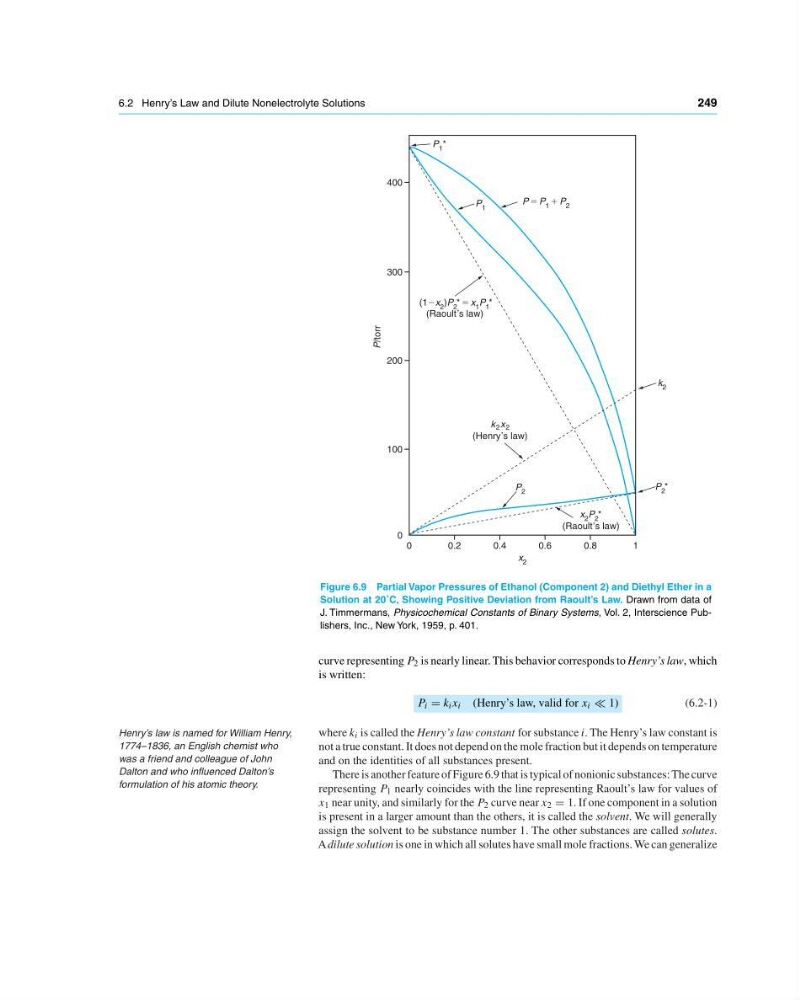
Figure 6.9 Partial Vapor Pressures of Ethanol (Component 2) and Diethyl Ether in a
Solution at 20˚C, Showing Positive Deviation from Raoult’s Law. Drawn from data of
J. Timmermans, Physicochemical Constants of Binary Systems, Vol. 2, Interscience Publishers, Inc., New York, 1959, p. 401.
curve representing P 2 is nearly linear. This behavior corresponds to Henry’s law, which
is written:
P i k i x i (Henry’s law, valid for x i 1)
(6.2-1)
where k i is called the Henry’s law constant for substance i. The Henry’s law constant is
not a true constant. It does not depend on the mole fraction but it depends on temperature
and on the identities of all substances present.
Henry’s law is named for William Henry,
1774–1836, an English chemist who
was a friend and colleague of John
Dalton and who influenced Dalton’s
formulation of his atomic theory.
There is another feature of Figure 6.9 that is typical of nonionic substances: The curve
representing P 1 nearly coincides with the line representing Raoult’s law for values of
x 1 near unity, and similarly for the P 2 curve near x 2 1. If one component in a solution
is present in a larger amount than the others, it is called the solvent. We will generally
assign the solvent to be substance number 1. The other substances are called solutes.
A dilute solution is one in which all solutes have small mole fractions. We can generalize
249
0
0
100
200
P/torr
(12x 2 )P 2 * 5 x 1 P 1 *
(Raoult s law)
x 2 P 2 *
300
400
P 1 *
P 1
k 2 x 2
P 2
P 2 *
x 2
k 2
P 5 P 1 1 P 2
0.2
0.4
0.6
0.8
1
(Henry s law)
(Raoult s law)
Figure 6.9 Partial Vapor Pressures of Ethanol (Component 2) and Diethyl Ether in a
Solution at 20˚C, Showing Positive Deviation from Raoult’s Law. Drawn from data of
J. Timmermans, Physicochemical Constants of Binary Systems, Vol. 2, Interscience Publishers, Inc., New York, 1959, p. 401.
curve representing P 2 is nearly linear. This behavior corresponds to Henry’s law, which
is written:
P i k i x i (Henry’s law, valid for x i 1)
(6.2-1)
where k i is called the Henry’s law constant for substance i. The Henry’s law constant is
not a true constant. It does not depend on the mole fraction but it depends on temperature
and on the identities of all substances present.
Henry’s law is named for William Henry,
1774–1836, an English chemist who
was a friend and colleague of John
Dalton and who influenced Dalton’s
formulation of his atomic theory.
There is another feature of Figure 6.9 that is typical of nonionic substances: The curve
representing P 1 nearly coincides with the line representing Raoult’s law for values of
x 1 near unity, and similarly for the P 2 curve near x 2 1. If one component in a solution
is present in a larger amount than the others, it is called the solvent. We will generally
assign the solvent to be substance number 1. The other substances are called solutes.
A dilute solution is one in which all solutes have small mole fractions. We can generalize