

6.1 Ideal Solutions
239
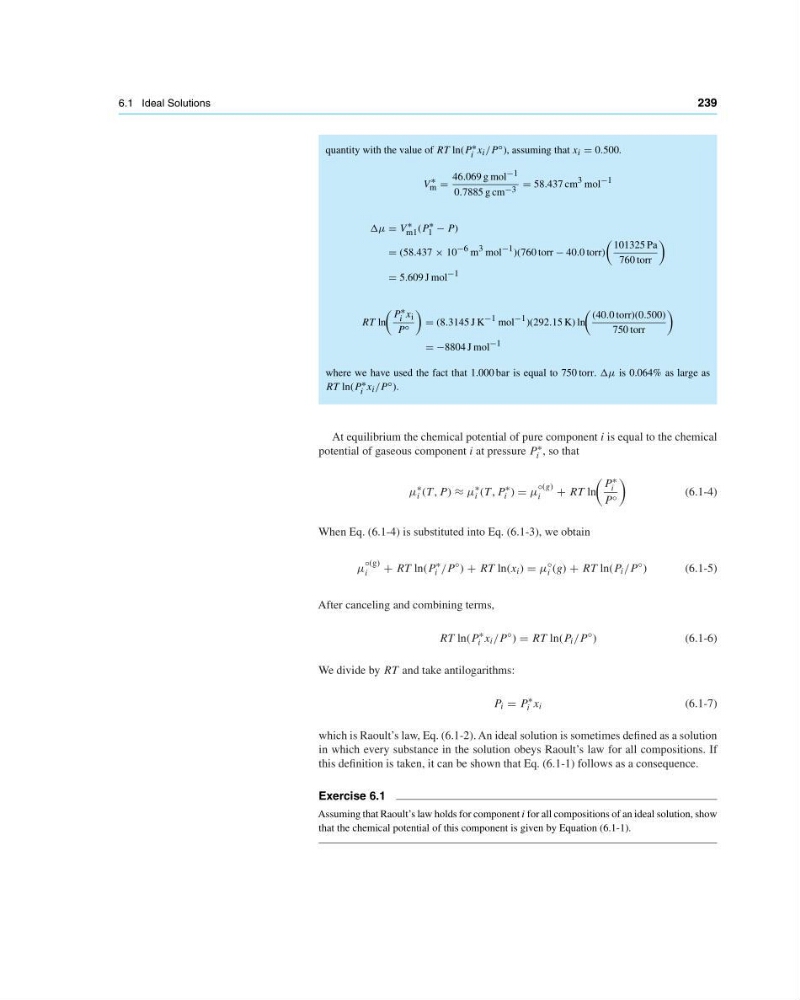
quantity with the value of RT ln(P ∗
i x i /P ◦ ), assuming that x i 0.500.
V ∗
m
46.069 g mol −1
0.7885 g cm −3 58.437 cm 3 mol −1
∆µ V ∗
m1 (P ∗
1 − P)
(58.437 × 10 −6 m 3 mol −1 )(760 torr − 40.0 torr)
101325 Pa
760 torr
5.609 J mol −1
RT ln
P ∗
i x i
P ◦
(8.3145 J K −1 mol −1 )(292.15 K) ln
(40.0 torr)(0.500)
750 torr
−8804 J mol −1
where we have used the fact that 1.000 bar is equal to 750 torr. ∆µ is 0.064% as large as
RT ln(P ∗
i x i /P ◦ ).
At equilibrium the chemical potential of pure component i is equal to the chemical
potential of gaseous component i at pressure P ∗
i , so that
µ
∗
i (T , P) ≈ µ
∗
i (T , P
∗
i ) µ
◦(g)
i
+ RT ln
P ∗
i
P ◦
(6.1-4)
When Eq. (6.1-4) is substituted into Eq. (6.1-3), we obtain
µ
◦(g)
i
+ RT ln(P
∗
i /P
◦ ) + RT ln(x i ) µ
◦
i (g) + RT ln(P i /P
◦ )
(6.1-5)
After canceling and combining terms,
RT ln(P
∗
i x i /P
◦ ) RT ln(P i /P
◦ )
(6.1-6)
We divide by RT and take antilogarithms:
P i P
∗
i x i
(6.1-7)
which is Raoult’s law, Eq. (6.1-2). An ideal solution is sometimes defined as a solution
in which every substance in the solution obeys Raoult’s law for all compositions. If
this definition is taken, it can be shown that Eq. (6.1-1) follows as a consequence.
Exercise 6.1
Assuming that Raoult’s law holds for component i for all compositions of an ideal solution, show
that the chemical potential of this component is given by Equation (6.1-1).
239
quantity with the value of RT ln(P ∗
i x i /P ◦ ), assuming that x i 0.500.
V ∗
m
46.069 g mol −1
0.7885 g cm −3 58.437 cm 3 mol −1
∆µ V ∗
m1 (P ∗
1 − P)
(58.437 × 10 −6 m 3 mol −1 )(760 torr − 40.0 torr)
101325 Pa
760 torr
5.609 J mol −1
RT ln
P ∗
i x i
P ◦
(8.3145 J K −1 mol −1 )(292.15 K) ln
(40.0 torr)(0.500)
750 torr
−8804 J mol −1
where we have used the fact that 1.000 bar is equal to 750 torr. ∆µ is 0.064% as large as
RT ln(P ∗
i x i /P ◦ ).
At equilibrium the chemical potential of pure component i is equal to the chemical
potential of gaseous component i at pressure P ∗
i , so that
µ
∗
i (T , P) ≈ µ
∗
i (T , P
∗
i ) µ
◦(g)
i
+ RT ln
P ∗
i
P ◦
(6.1-4)
When Eq. (6.1-4) is substituted into Eq. (6.1-3), we obtain
µ
◦(g)
i
+ RT ln(P
∗
i /P
◦ ) + RT ln(x i ) µ
◦
i (g) + RT ln(P i /P
◦ )
(6.1-5)
After canceling and combining terms,
RT ln(P
∗
i x i /P
◦ ) RT ln(P i /P
◦ )
(6.1-6)
We divide by RT and take antilogarithms:
P i P
∗
i x i
(6.1-7)
which is Raoult’s law, Eq. (6.1-2). An ideal solution is sometimes defined as a solution
in which every substance in the solution obeys Raoult’s law for all compositions. If
this definition is taken, it can be shown that Eq. (6.1-1) follows as a consequence.
Exercise 6.1
Assuming that Raoult’s law holds for component i for all compositions of an ideal solution, show
that the chemical potential of this component is given by Equation (6.1-1).