

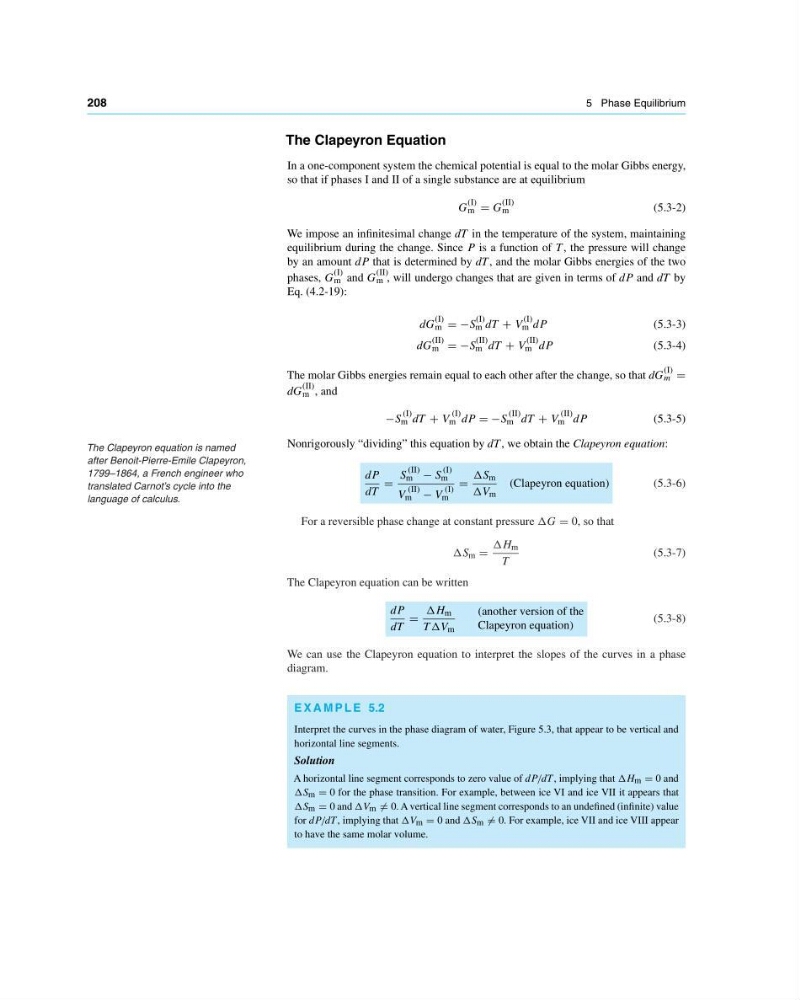
208
5 Phase Equilibrium
The Clapeyron Equation
In a one-component system the chemical potential is equal to the molar Gibbs energy,
so that if phases I and II of a single substance are at equilibrium
G
(I)
m G
(II)
m
(5.3-2)
We impose an infinitesimal change dT in the temperature of the system, maintaining
equilibrium during the change. Since P is a function of T , the pressure will change
by an amount dP that is determined by dT , and the molar Gibbs energies of the two
phases, G
(I)
m and G
(II)
m , will undergo changes that are given in terms of dP and dT by
Eq. (4.2-19):
dG
(I)
m −S
(I)
m dT + V
(I)
m dP
(5.3-3)
dG
(II)
m −S
(II)
m dT + V
(II)
m dP
(5.3-4)
The molar Gibbs energies remain equal to each other after the change, so that dG
(I)
m
dG
(II)
m , and
−S
(I)
m dT + V
(I)
m dP −S
(II)
m dT + V
(II)
m dP
(5.3-5)
Nonrigorously “dividing” this equation by dT , we obtain the Clapeyron equation:
dP
dT
S
(II)
m − S
(I)
m
V
(II)
m − V
(I)
m
∆S m
∆V m
(Clapeyron equation)
(5.3-6)
The Clapeyron equation is named
after Benoit-Pierre-Emile Clapeyron,
1799–1864, a French engineer who
translated Carnot’s cycle into the
language of calculus.
For a reversible phase change at constant pressure ∆G 0, so that
∆S m
∆H m
T
(5.3-7)
The Clapeyron equation can be written
dP
dT
∆H m
T ∆V m
(another version of the
Clapeyron equation)
(5.3-8)
We can use the Clapeyron equation to interpret the slopes of the curves in a phase
diagram.
E X A M P L E 5.2
Interpret the curves in the phase diagram of water, Figure 5.3, that appear to be vertical and
horizontal line segments.
Solution
A horizontal line segment corresponds to zero value of dP/dT , implying that ∆H m 0 and
∆S m 0 for the phase transition. For example, between ice VI and ice VII it appears that
∆S m 0 and ∆V m 0. A vertical line segment corresponds to an undefined (infinite) value
for dP/dT , implying that ∆V m 0 and ∆S m 0. For example, ice VII and ice VIII appear
to have the same molar volume.
5 Phase Equilibrium
The Clapeyron Equation
In a one-component system the chemical potential is equal to the molar Gibbs energy,
so that if phases I and II of a single substance are at equilibrium
G
(I)
m G
(II)
m
(5.3-2)
We impose an infinitesimal change dT in the temperature of the system, maintaining
equilibrium during the change. Since P is a function of T , the pressure will change
by an amount dP that is determined by dT , and the molar Gibbs energies of the two
phases, G
(I)
m and G
(II)
m , will undergo changes that are given in terms of dP and dT by
Eq. (4.2-19):
dG
(I)
m −S
(I)
m dT + V
(I)
m dP
(5.3-3)
dG
(II)
m −S
(II)
m dT + V
(II)
m dP
(5.3-4)
The molar Gibbs energies remain equal to each other after the change, so that dG
(I)
m
dG
(II)
m , and
−S
(I)
m dT + V
(I)
m dP −S
(II)
m dT + V
(II)
m dP
(5.3-5)
Nonrigorously “dividing” this equation by dT , we obtain the Clapeyron equation:
dP
dT
S
(II)
m − S
(I)
m
V
(II)
m − V
(I)
m
∆S m
∆V m
(Clapeyron equation)
(5.3-6)
The Clapeyron equation is named
after Benoit-Pierre-Emile Clapeyron,
1799–1864, a French engineer who
translated Carnot’s cycle into the
language of calculus.
For a reversible phase change at constant pressure ∆G 0, so that
∆S m
∆H m
T
(5.3-7)
The Clapeyron equation can be written
dP
dT
∆H m
T ∆V m
(another version of the
Clapeyron equation)
(5.3-8)
We can use the Clapeyron equation to interpret the slopes of the curves in a phase
diagram.
E X A M P L E 5.2
Interpret the curves in the phase diagram of water, Figure 5.3, that appear to be vertical and
horizontal line segments.
Solution
A horizontal line segment corresponds to zero value of dP/dT , implying that ∆H m 0 and
∆S m 0 for the phase transition. For example, between ice VI and ice VII it appears that
∆S m 0 and ∆V m 0. A vertical line segment corresponds to an undefined (infinite) value
for dP/dT , implying that ∆V m 0 and ∆S m 0. For example, ice VII and ice VIII appear
to have the same molar volume.