

186
4 The Thermodynamics of Real Systems
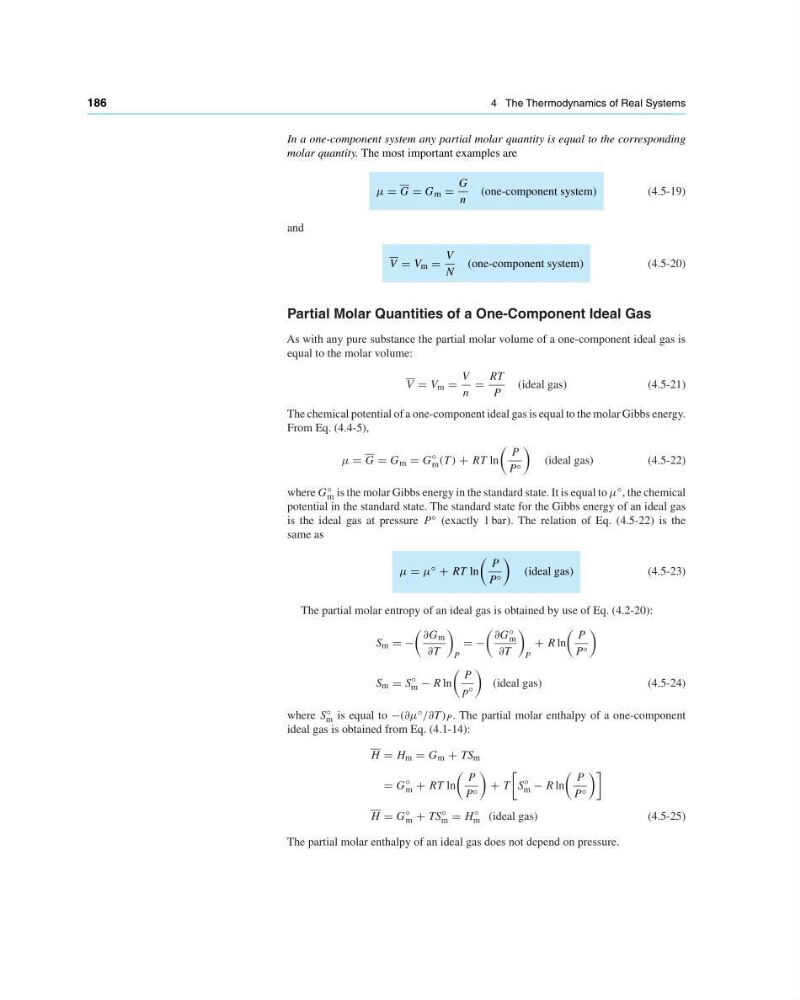
In a one-component system any partial molar quantity is equal to the corresponding
molar quantity. The most important examples are
µ G G m
G
n
(one-component system)
(4.5-19)
and
V V m
V
N
(one-component system)
(4.5-20)
Partial Molar Quantities of a One-Component Ideal Gas
As with any pure substance the partial molar volume of a one-component ideal gas is
equal to the molar volume:
V V m
V
n
RT
P
(ideal gas)
(4.5-21)
The chemical potential of a one-component ideal gas is equal to the molar Gibbs energy.
From Eq. (4.4-5),
µ G G m G
◦
m (T ) + RT ln
P
P ◦
(ideal gas)
(4.5-22)
where G ◦
m is the molar Gibbs energy in the standard state. It is equal to µ ◦ , the chemical
potential in the standard state. The standard state for the Gibbs energy of an ideal gas
is the ideal gas at pressure P ◦ (exactly 1 bar). The relation of Eq. (4.5-22) is the
same as
µ µ ◦ + RT ln
P
P ◦
(ideal gas)
(4.5-23)
The partial molar entropy of an ideal gas is obtained by use of Eq. (4.2-20):
S m −
∂G m
∂T
P
−
∂G ◦
m
∂T
P
+ R ln
P
P ◦
S m S
◦
m − R ln
P
p ◦
(ideal gas)
(4.5-24)
where S ◦
m is equal to −(∂µ ◦ /∂T ) P . The partial molar enthalpy of a one-component
ideal gas is obtained from Eq. (4.1-14):
H H m G m + TS m
G
◦
m + RT ln
P
P ◦
+ T
S
◦
m − R ln
P
P ◦
H G
◦
m + TS
◦
m H
◦
m (ideal gas)
(4.5-25)
The partial molar enthalpy of an ideal gas does not depend on pressure.
4 The Thermodynamics of Real Systems
In a one-component system any partial molar quantity is equal to the corresponding
molar quantity. The most important examples are
µ G G m
G
n
(one-component system)
(4.5-19)
and
V V m
V
N
(one-component system)
(4.5-20)
Partial Molar Quantities of a One-Component Ideal Gas
As with any pure substance the partial molar volume of a one-component ideal gas is
equal to the molar volume:
V V m
V
n
RT
P
(ideal gas)
(4.5-21)
The chemical potential of a one-component ideal gas is equal to the molar Gibbs energy.
From Eq. (4.4-5),
µ G G m G
◦
m (T ) + RT ln
P
P ◦
(ideal gas)
(4.5-22)
where G ◦
m is the molar Gibbs energy in the standard state. It is equal to µ ◦ , the chemical
potential in the standard state. The standard state for the Gibbs energy of an ideal gas
is the ideal gas at pressure P ◦ (exactly 1 bar). The relation of Eq. (4.5-22) is the
same as
µ µ ◦ + RT ln
P
P ◦
(ideal gas)
(4.5-23)
The partial molar entropy of an ideal gas is obtained by use of Eq. (4.2-20):
S m −
∂G m
∂T
P
−
∂G ◦
m
∂T
P
+ R ln
P
P ◦
S m S
◦
m − R ln
P
p ◦
(ideal gas)
(4.5-24)
where S ◦
m is equal to −(∂µ ◦ /∂T ) P . The partial molar enthalpy of a one-component
ideal gas is obtained from Eq. (4.1-14):
H H m G m + TS m
G
◦
m + RT ln
P
P ◦
+ T
S
◦
m − R ln
P
P ◦
H G
◦
m + TS
◦
m H
◦
m (ideal gas)
(4.5-25)
The partial molar enthalpy of an ideal gas does not depend on pressure.