

4.4 Gibbs Energy Calculations
179
We cannot use this relation, because a constant can be added to the value of the entropy
without any physical effect. The assignment of “absolute” entropies is based on a
conventional assignment of zero entropy for elements at 0 K and does not provide
unique values of entropies. Adding a constant to S would change the value of the
integrand in Eq. (4.4-16), changing the value of the integral.
The most we can do is to consider an isothermal process that can be carried out
once at temperature T 1 and a fixed pressure P and again at temperature T 2 and pressure
P. We write Eq. (4.4-16) once for the initial state and once for the final state. The
difference of these equations gives
∆G(T 2 , P) − ∆G(T 1 , P) −
T 2
T 1
∆S(T , P)dT (closed system)
(4.4-17)
where ∆G(T , P) and ∆S(T , P) pertain to a process at a constant temperature T and
a constant pressure P. Equation (4.4-17) does not mean that we are considering a
nonisothermal process. It gives the difference between ∆G for an isothermal process
carried out at T 2 and ∆G for the same isothermal process carried out at T 1 .
If ∆S is nearly independent of temperature between T 1 and T 2 , Eq. (4.4-17) becomes
∆G(T 2 , P) − ∆G(T 1 , P) ≈ −∆S(T 2 − T 1 ) (∆S independent of temperature)
(4.4-18)
This equation should be a usable approximation if the difference between T 2 and T 1 is
not very large. An alternate to Eq. (4.4-17) is known as the Gibbs–Helmholtz equation:
∆G(T 2 , P)
T 2
−
∆G(T 1 , P)
T 1
−
T 2
T 1
∆H(T , P)
T 2
dT
(4.4-19)
If ∆H is nearly independent of temperature,
∆G(T 2 , P)
T 2
−
∆G(T 1 , P)
T 1
∆H
1
T 2
−
1
T 1
(4.4-20)
Thermodynamics applies equally to chemical reactions and to physical processes such
as fusion or vaporization. We can apply Eqs. (4.4-17) and (4.4-19) to physical processes
as well as to chemical reactions.
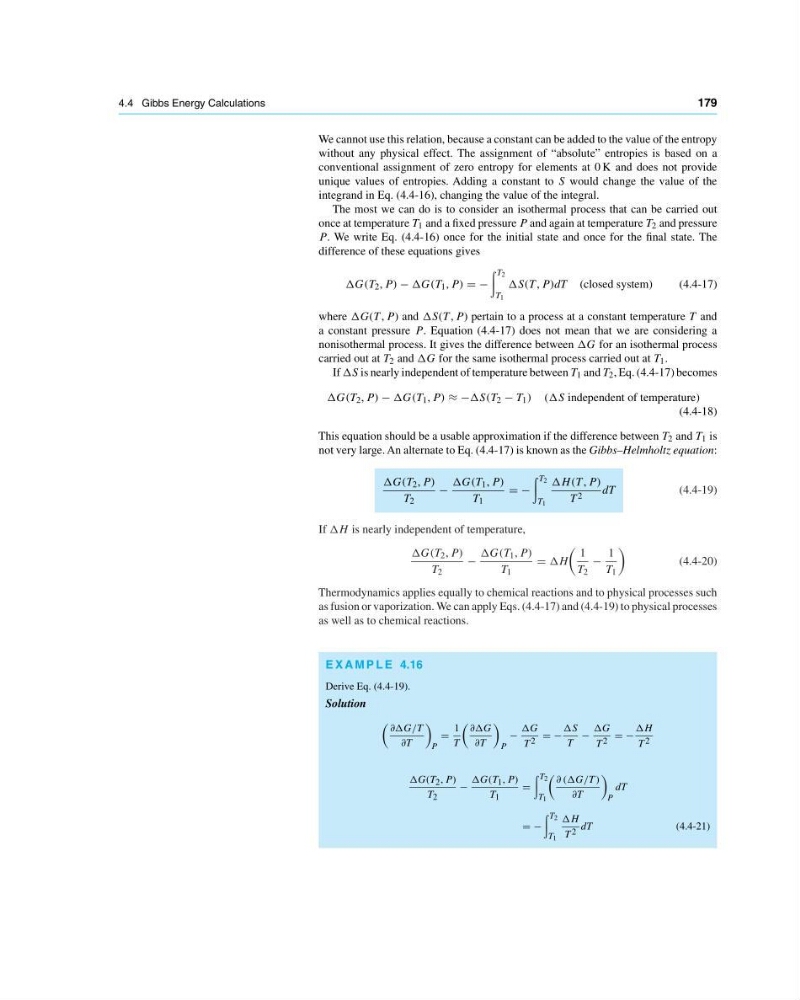
E X A M P L E 4.16
Derive Eq. (4.4-19).
Solution
∂∆G/T
∂T
P
1
T
∂∆G
∂T
P
−
∆G
T 2 −
∆S
T
−
∆G
T 2 −
∆H
T 2
∆G(T 2 , P)
T 2
−
∆G(T 1 , P)
T 1
T 2
T 1
∂ (∆G/T )
∂T
P
dT
−
T 2
T 1
∆H
T 2 dT
(4.4-21)
179
We cannot use this relation, because a constant can be added to the value of the entropy
without any physical effect. The assignment of “absolute” entropies is based on a
conventional assignment of zero entropy for elements at 0 K and does not provide
unique values of entropies. Adding a constant to S would change the value of the
integrand in Eq. (4.4-16), changing the value of the integral.
The most we can do is to consider an isothermal process that can be carried out
once at temperature T 1 and a fixed pressure P and again at temperature T 2 and pressure
P. We write Eq. (4.4-16) once for the initial state and once for the final state. The
difference of these equations gives
∆G(T 2 , P) − ∆G(T 1 , P) −
T 2
T 1
∆S(T , P)dT (closed system)
(4.4-17)
where ∆G(T , P) and ∆S(T , P) pertain to a process at a constant temperature T and
a constant pressure P. Equation (4.4-17) does not mean that we are considering a
nonisothermal process. It gives the difference between ∆G for an isothermal process
carried out at T 2 and ∆G for the same isothermal process carried out at T 1 .
If ∆S is nearly independent of temperature between T 1 and T 2 , Eq. (4.4-17) becomes
∆G(T 2 , P) − ∆G(T 1 , P) ≈ −∆S(T 2 − T 1 ) (∆S independent of temperature)
(4.4-18)
This equation should be a usable approximation if the difference between T 2 and T 1 is
not very large. An alternate to Eq. (4.4-17) is known as the Gibbs–Helmholtz equation:
∆G(T 2 , P)
T 2
−
∆G(T 1 , P)
T 1
−
T 2
T 1
∆H(T , P)
T 2
dT
(4.4-19)
If ∆H is nearly independent of temperature,
∆G(T 2 , P)
T 2
−
∆G(T 1 , P)
T 1
∆H
1
T 2
−
1
T 1
(4.4-20)
Thermodynamics applies equally to chemical reactions and to physical processes such
as fusion or vaporization. We can apply Eqs. (4.4-17) and (4.4-19) to physical processes
as well as to chemical reactions.
E X A M P L E 4.16
Derive Eq. (4.4-19).
Solution
∂∆G/T
∂T
P
1
T
∂∆G
∂T
P
−
∆G
T 2 −
∆S
T
−
∆G
T 2 −
∆H
T 2
∆G(T 2 , P)
T 2
−
∆G(T 1 , P)
T 1
T 2
T 1
∂ (∆G/T )
∂T
P
dT
−
T 2
T 1
∆H
T 2 dT
(4.4-21)