

4.4 Gibbs Energy Calculations
177
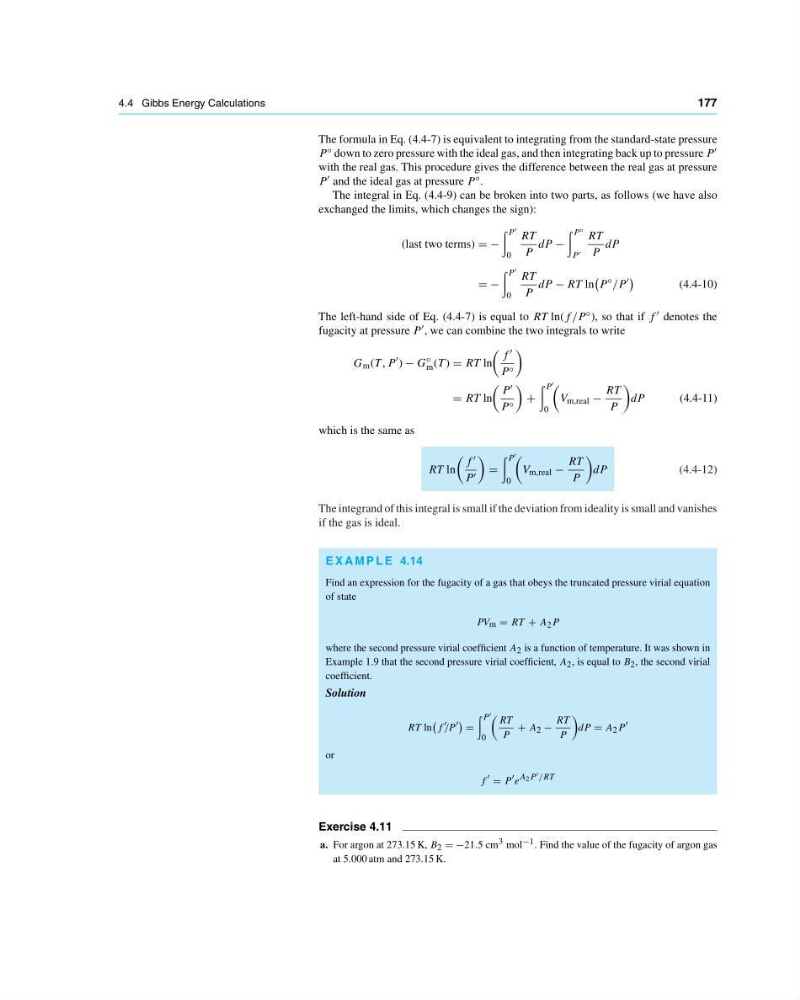
The formula in Eq. (4.4-7) is equivalent to integrating from the standard-state pressure
P ◦ down to zero pressure with the ideal gas, and then integrating back up to pressure P
with the real gas. This procedure gives the difference between the real gas at pressure
P and the ideal gas at pressure P ◦ .
The integral in Eq. (4.4-9) can be broken into two parts, as follows (we have also
exchanged the limits, which changes the sign):
(last two terms) −
P
0
RT
P
dP −
P ◦
P
RT
P
dP
−
P
0
RT
P
dP − RT ln
P
◦ /P
(4.4-10)
The left-hand side of Eq. (4.4-7) is equal to RT ln(f /P ◦ ), so that if f denotes the
fugacity at pressure P , we can combine the two integrals to write
G m (T , P
) − G
◦
m (T ) RT ln
f
P ◦
RT ln
P
P ◦
+
P
0
V m,real −
RT
P
dP
(4.4-11)
which is the same as
RT ln
f
P
P
0
V m,real −
RT
P
dP
(4.4-12)
The integrand of this integral is small if the deviation from ideality is small and vanishes
if the gas is ideal.
E X A M P L E 4.14
Find an expression for the fugacity of a gas that obeys the truncated pressure virial equation
of state
PV m RT + A 2 P
where the second pressure virial coefficient A 2 is a function of temperature. It was shown in
Example 1.9 that the second pressure virial coefficient, A 2 , is equal to B 2 , the second virial
coefficient.
Solution
RT ln
f /P
P
0
RT
P
+ A 2 −
RT
P
dP A 2 P
or
f P e A 2 P /RT
Exercise 4.11
a. For argon at 273.15 K, B 2 −21.5 cm 3 mol −1 . Find the value of the fugacity of argon gas
at 5.000 atm and 273.15 K.
177
The formula in Eq. (4.4-7) is equivalent to integrating from the standard-state pressure
P ◦ down to zero pressure with the ideal gas, and then integrating back up to pressure P
with the real gas. This procedure gives the difference between the real gas at pressure
P and the ideal gas at pressure P ◦ .
The integral in Eq. (4.4-9) can be broken into two parts, as follows (we have also
exchanged the limits, which changes the sign):
(last two terms) −
P
0
RT
P
dP −
P ◦
P
RT
P
dP
−
P
0
RT
P
dP − RT ln
P
◦ /P
(4.4-10)
The left-hand side of Eq. (4.4-7) is equal to RT ln(f /P ◦ ), so that if f denotes the
fugacity at pressure P , we can combine the two integrals to write
G m (T , P
) − G
◦
m (T ) RT ln
f
P ◦
RT ln
P
P ◦
+
P
0
V m,real −
RT
P
dP
(4.4-11)
which is the same as
RT ln
f
P
P
0
V m,real −
RT
P
dP
(4.4-12)
The integrand of this integral is small if the deviation from ideality is small and vanishes
if the gas is ideal.
E X A M P L E 4.14
Find an expression for the fugacity of a gas that obeys the truncated pressure virial equation
of state
PV m RT + A 2 P
where the second pressure virial coefficient A 2 is a function of temperature. It was shown in
Example 1.9 that the second pressure virial coefficient, A 2 , is equal to B 2 , the second virial
coefficient.
Solution
RT ln
f /P
P
0
RT
P
+ A 2 −
RT
P
dP A 2 P
or
f P e A 2 P /RT
Exercise 4.11
a. For argon at 273.15 K, B 2 −21.5 cm 3 mol −1 . Find the value of the fugacity of argon gas
at 5.000 atm and 273.15 K.