

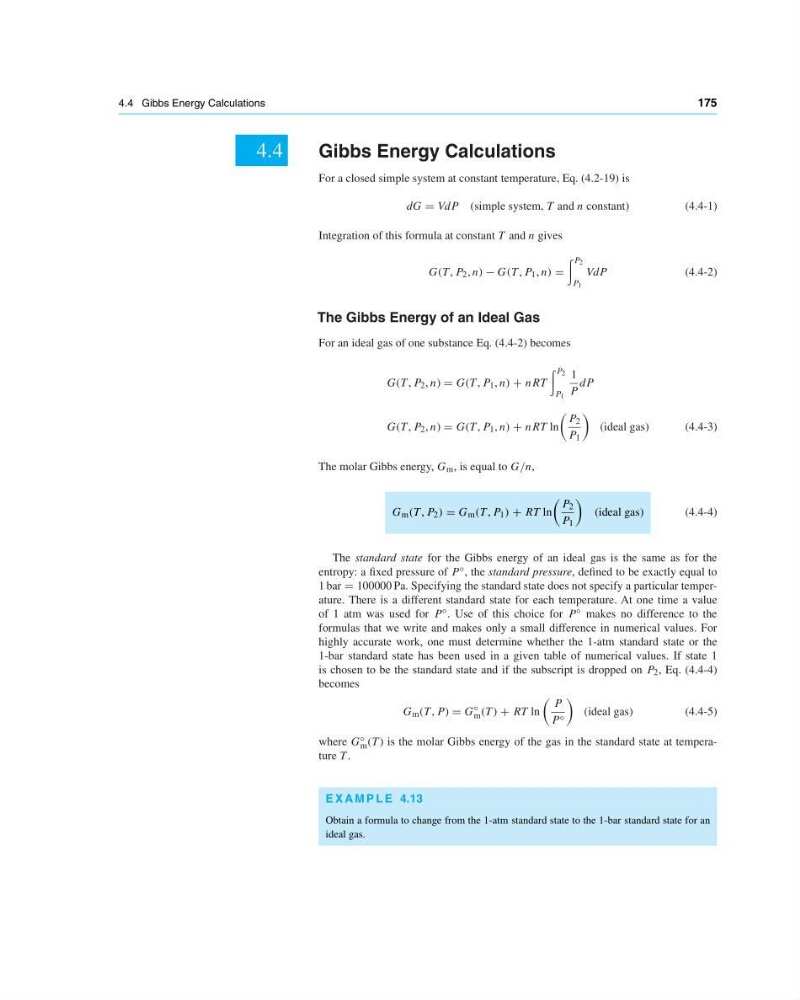
4.4 Gibbs Energy Calculations
175
4.4
Gibbs Energy Calculations
For a closed simple system at constant temperature, Eq. (4.2-19) is
dG VdP (simple system, T and n constant)
(4.4-1)
Integration of this formula at constant T and n gives
G(T , P 2 , n) − G(T , P 1 , n)
P 2
P 1
VdP
(4.4-2)
The Gibbs Energy of an Ideal Gas
For an ideal gas of one substance Eq. (4.4-2) becomes
G(T , P 2 , n) G(T , P 1 , n) + nRT
P 2
P 1
1
P
dP
G(T , P 2 , n) G(T , P 1 , n) + nRT ln
P 2
P 1
(ideal gas)
(4.4-3)
The molar Gibbs energy, G m , is equal to G/n,
G m (T , P 2 ) G m (T , P 1 ) + RT ln
P 2
P 1
(ideal gas)
(4.4-4)
The standard state for the Gibbs energy of an ideal gas is the same as for the
entropy: a fixed pressure of P ◦ , the standard pressure, defined to be exactly equal to
1 bar 100000 Pa. Specifying the standard state does not specify a particular temperature. There is a different standard state for each temperature. At one time a value
of 1 atm was used for P ◦ . Use of this choice for P ◦ makes no difference to the
formulas that we write and makes only a small difference in numerical values. For
highly accurate work, one must determine whether the 1-atm standard state or the
1-bar standard state has been used in a given table of numerical values. If state 1
is chosen to be the standard state and if the subscript is dropped on P 2 , Eq. (4.4-4)
becomes
G m (T , P) G
◦
m (T ) + RT ln
P
P ◦
(ideal gas)
(4.4-5)
where G ◦
m (T ) is the molar Gibbs energy of the gas in the standard state at temperature T .
E X A M P L E 4.13
Obtain a formula to change from the 1-atm standard state to the 1-bar standard state for an
ideal gas.
175
4.4
Gibbs Energy Calculations
For a closed simple system at constant temperature, Eq. (4.2-19) is
dG VdP (simple system, T and n constant)
(4.4-1)
Integration of this formula at constant T and n gives
G(T , P 2 , n) − G(T , P 1 , n)
P 2
P 1
VdP
(4.4-2)
The Gibbs Energy of an Ideal Gas
For an ideal gas of one substance Eq. (4.4-2) becomes
G(T , P 2 , n) G(T , P 1 , n) + nRT
P 2
P 1
1
P
dP
G(T , P 2 , n) G(T , P 1 , n) + nRT ln
P 2
P 1
(ideal gas)
(4.4-3)
The molar Gibbs energy, G m , is equal to G/n,
G m (T , P 2 ) G m (T , P 1 ) + RT ln
P 2
P 1
(ideal gas)
(4.4-4)
The standard state for the Gibbs energy of an ideal gas is the same as for the
entropy: a fixed pressure of P ◦ , the standard pressure, defined to be exactly equal to
1 bar 100000 Pa. Specifying the standard state does not specify a particular temperature. There is a different standard state for each temperature. At one time a value
of 1 atm was used for P ◦ . Use of this choice for P ◦ makes no difference to the
formulas that we write and makes only a small difference in numerical values. For
highly accurate work, one must determine whether the 1-atm standard state or the
1-bar standard state has been used in a given table of numerical values. If state 1
is chosen to be the standard state and if the subscript is dropped on P 2 , Eq. (4.4-4)
becomes
G m (T , P) G
◦
m (T ) + RT ln
P
P ◦
(ideal gas)
(4.4-5)
where G ◦
m (T ) is the molar Gibbs energy of the gas in the standard state at temperature T .
E X A M P L E 4.13
Obtain a formula to change from the 1-atm standard state to the 1-bar standard state for an
ideal gas.