

4.3 Additional Useful Thermodynamic Identities
171
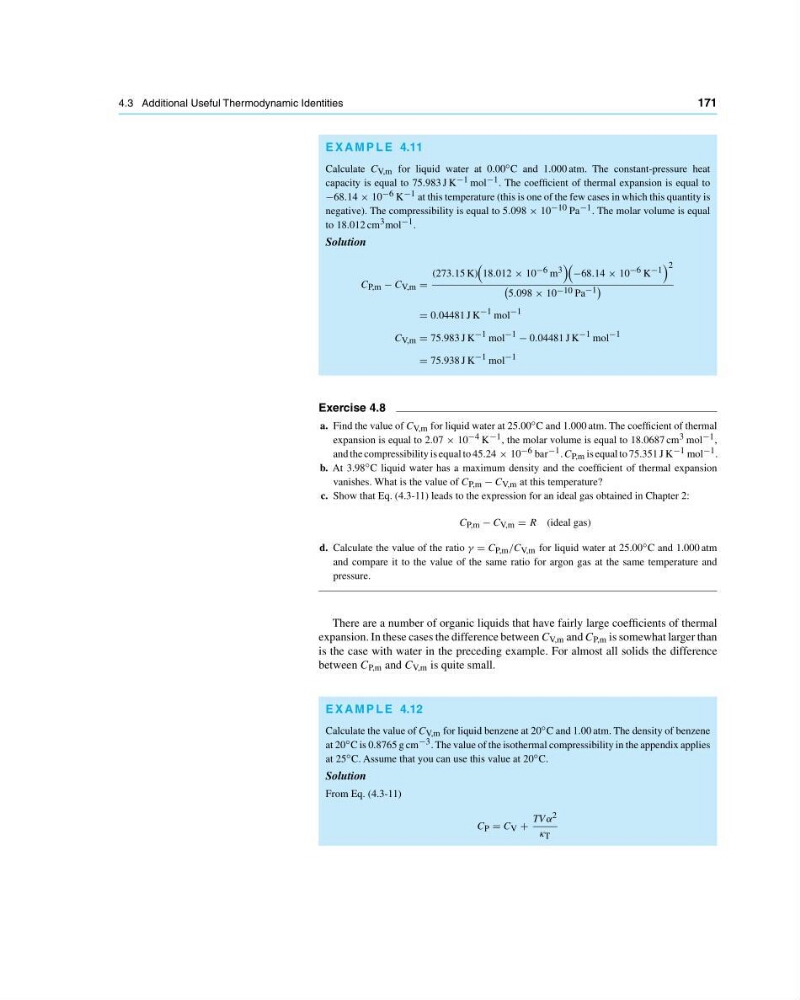
E X A M P L E 4.11
Calculate C V,m for liquid water at 0.00 ◦ C and 1.000 atm. The constant-pressure heat
capacity is equal to 75.983 J K −1 mol −1 . The coefficient of thermal expansion is equal to
−68.14 × 10 −6 K −1 at this temperature (this is one of the few cases in which this quantity is
negative). The compressibility is equal to 5.098 × 10 −10 Pa −1 . The molar volume is equal
to 18.012 cm 3 mol −1 .
Solution
C P,m − C V,m
(273.15 K)
18.012 × 10 −6 m 3
−68.14 × 10 −6 K −1
2
5.098 × 10 −10 Pa −1
0.04481 J K −1 mol −1
C V,m 75.983 J K −1 mol −1 − 0.04481 J K −1 mol −1
75.938 J K −1 mol −1
Exercise 4.8
a. Find the value of C V,m for liquid water at 25.00 ◦ C and 1.000 atm. The coefficient of thermal
expansion is equal to 2.07 × 10 −4 K −1 , the molar volume is equal to 18.0687 cm 3 mol −1 ,
and the compressibility is equal to 45.24 × 10 −6 bar −1 . C P,m is equal to 75.351 J K −1 mol −1 .
b. At 3.98 ◦ C liquid water has a maximum density and the coefficient of thermal expansion
vanishes. What is the value of C P,m − C V,m at this temperature?
c. Show that Eq. (4.3-11) leads to the expression for an ideal gas obtained in Chapter 2:
C P,m − C V,m R (ideal gas)
d. Calculate the value of the ratio γ C P,m /C V,m for liquid water at 25.00 ◦ C and 1.000 atm
and compare it to the value of the same ratio for argon gas at the same temperature and
pressure.
There are a number of organic liquids that have fairly large coefficients of thermal
expansion. In these cases the difference between C V,m and C P,m is somewhat larger than
is the case with water in the preceding example. For almost all solids the difference
between C P,m and C V,m is quite small.
E X A M P L E 4.12
Calculate the value of C V,m for liquid benzene at 20 ◦ C and 1.00 atm. The density of benzene
at 20 ◦ C is 0.8765 g cm −3 . The value of the isothermal compressibility in the appendix applies
at 25 ◦ C. Assume that you can use this value at 20 ◦ C.
Solution
From Eq. (4.3-11)
C P C V +
TV α 2
κ T
171
E X A M P L E 4.11
Calculate C V,m for liquid water at 0.00 ◦ C and 1.000 atm. The constant-pressure heat
capacity is equal to 75.983 J K −1 mol −1 . The coefficient of thermal expansion is equal to
−68.14 × 10 −6 K −1 at this temperature (this is one of the few cases in which this quantity is
negative). The compressibility is equal to 5.098 × 10 −10 Pa −1 . The molar volume is equal
to 18.012 cm 3 mol −1 .
Solution
C P,m − C V,m
(273.15 K)
18.012 × 10 −6 m 3
−68.14 × 10 −6 K −1
2
5.098 × 10 −10 Pa −1
0.04481 J K −1 mol −1
C V,m 75.983 J K −1 mol −1 − 0.04481 J K −1 mol −1
75.938 J K −1 mol −1
Exercise 4.8
a. Find the value of C V,m for liquid water at 25.00 ◦ C and 1.000 atm. The coefficient of thermal
expansion is equal to 2.07 × 10 −4 K −1 , the molar volume is equal to 18.0687 cm 3 mol −1 ,
and the compressibility is equal to 45.24 × 10 −6 bar −1 . C P,m is equal to 75.351 J K −1 mol −1 .
b. At 3.98 ◦ C liquid water has a maximum density and the coefficient of thermal expansion
vanishes. What is the value of C P,m − C V,m at this temperature?
c. Show that Eq. (4.3-11) leads to the expression for an ideal gas obtained in Chapter 2:
C P,m − C V,m R (ideal gas)
d. Calculate the value of the ratio γ C P,m /C V,m for liquid water at 25.00 ◦ C and 1.000 atm
and compare it to the value of the same ratio for argon gas at the same temperature and
pressure.
There are a number of organic liquids that have fairly large coefficients of thermal
expansion. In these cases the difference between C V,m and C P,m is somewhat larger than
is the case with water in the preceding example. For almost all solids the difference
between C P,m and C V,m is quite small.
E X A M P L E 4.12
Calculate the value of C V,m for liquid benzene at 20 ◦ C and 1.00 atm. The density of benzene
at 20 ◦ C is 0.8765 g cm −3 . The value of the isothermal compressibility in the appendix applies
at 25 ◦ C. Assume that you can use this value at 20 ◦ C.
Solution
From Eq. (4.3-11)
C P C V +
TV α 2
κ T