

4.3 Additional Useful Thermodynamic Identities
169
∂U
∂V
T ,n
T
α
κ T
− P
(4.3-5)
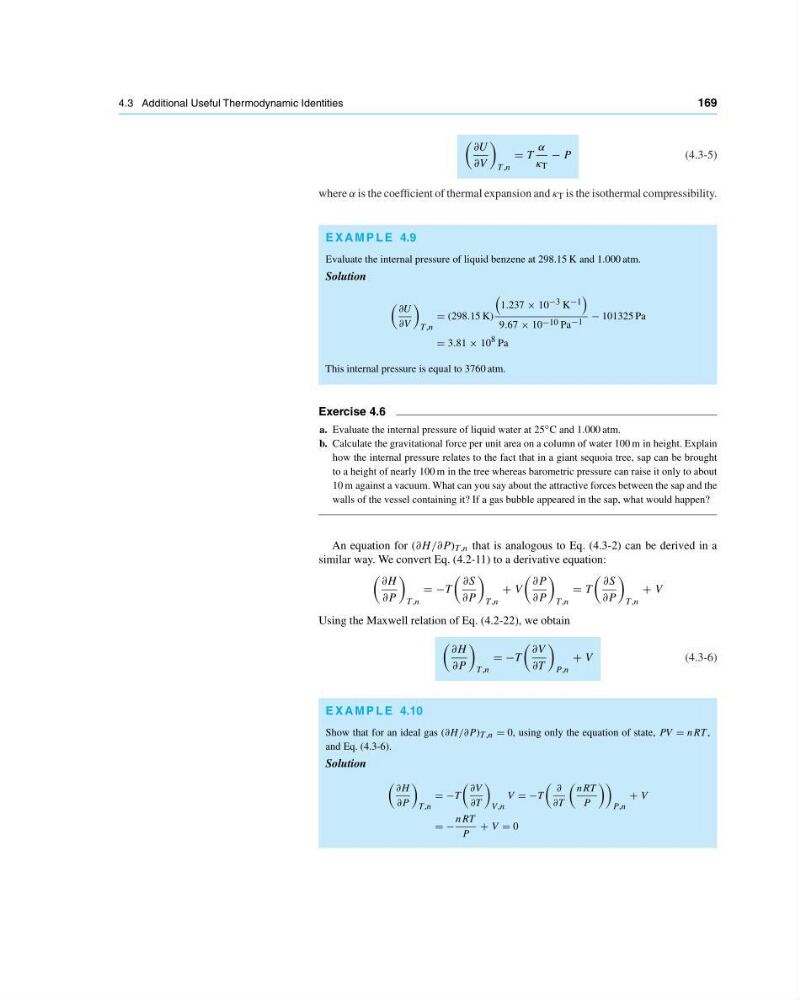
where α is the coefficient of thermal expansion and κ T is the isothermal compressibility.
E X A M P L E 4.9
Evaluate the internal pressure of liquid benzene at 298.15 K and 1.000 atm.
Solution
∂U
∂V
T ,n
(298.15 K)
1.237 × 10 −3 K −1
9.67 × 10 −10 Pa −1 − 101325 Pa
3.81 × 10 8 Pa
This internal pressure is equal to 3760 atm.
Exercise 4.6
a. Evaluate the internal pressure of liquid water at 25 ◦ C and 1.000 atm.
b. Calculate the gravitational force per unit area on a column of water 100 m in height. Explain
how the internal pressure relates to the fact that in a giant sequoia tree, sap can be brought
to a height of nearly 100 m in the tree whereas barometric pressure can raise it only to about
10 m against a vacuum. What can you say about the attractive forces between the sap and the
walls of the vessel containing it? If a gas bubble appeared in the sap, what would happen?
An equation for (∂H/∂P) T ,n that is analogous to Eq. (4.3-2) can be derived in a
similar way. We convert Eq. (4.2-11) to a derivative equation:
∂H
∂P
T ,n
−T
∂S
∂P
T ,n
+ V
∂P
∂P
T ,n
T
∂S
∂P
T ,n
+ V
Using the Maxwell relation of Eq. (4.2-22), we obtain
∂H
∂P
T ,n
−T
∂V
∂T
P,n
+ V
(4.3-6)
E X A M P L E 4.10
Show that for an ideal gas (∂H/∂P) T ,n 0, using only the equation of state, PV nRT ,
and Eq. (4.3-6).
Solution
∂H
∂P
T ,n
−T
∂V
∂T
V ,n
V −T
∂
∂T
nRT
P
P,n
+ V
−
nRT
P
+ V 0
169
∂U
∂V
T ,n
T
α
κ T
− P
(4.3-5)
where α is the coefficient of thermal expansion and κ T is the isothermal compressibility.
E X A M P L E 4.9
Evaluate the internal pressure of liquid benzene at 298.15 K and 1.000 atm.
Solution
∂U
∂V
T ,n
(298.15 K)
1.237 × 10 −3 K −1
9.67 × 10 −10 Pa −1 − 101325 Pa
3.81 × 10 8 Pa
This internal pressure is equal to 3760 atm.
Exercise 4.6
a. Evaluate the internal pressure of liquid water at 25 ◦ C and 1.000 atm.
b. Calculate the gravitational force per unit area on a column of water 100 m in height. Explain
how the internal pressure relates to the fact that in a giant sequoia tree, sap can be brought
to a height of nearly 100 m in the tree whereas barometric pressure can raise it only to about
10 m against a vacuum. What can you say about the attractive forces between the sap and the
walls of the vessel containing it? If a gas bubble appeared in the sap, what would happen?
An equation for (∂H/∂P) T ,n that is analogous to Eq. (4.3-2) can be derived in a
similar way. We convert Eq. (4.2-11) to a derivative equation:
∂H
∂P
T ,n
−T
∂S
∂P
T ,n
+ V
∂P
∂P
T ,n
T
∂S
∂P
T ,n
+ V
Using the Maxwell relation of Eq. (4.2-22), we obtain
∂H
∂P
T ,n
−T
∂V
∂T
P,n
+ V
(4.3-6)
E X A M P L E 4.10
Show that for an ideal gas (∂H/∂P) T ,n 0, using only the equation of state, PV nRT ,
and Eq. (4.3-6).
Solution
∂H
∂P
T ,n
−T
∂V
∂T
V ,n
V −T
∂
∂T
nRT
P
P,n
+ V
−
nRT
P
+ V 0