

4.2 Fundamental Relations for Closed Simple Systems
165
b.
∆S
P 2
P 1
∂S
∂P
T ,n
dP −
P 2
P 1
∂V
∂T
P,n
dP −
P 2
P 1
V αdP
−
P 2
P 1
V (T 1 , P 1 )[1 + κ T (P − P 1 )] αdP
−V (T 1 , P 1 )
P 2
P 1
[1 − κ T (P − P 1 )] αdP
−V (T 1 , P 1 )α(P 2 − P 1 ) − V (T 1 , P 1 )κ T α
1
2
(P − P 1 ) 2
c.
∆S −(18.0 × 10 −6 m 3 )(2.07 × 10 −4 K −1 )(99.00 atm)(101325 Pa atm −1 )
+ (18.0 × 10 −6 m 3 )(4.57 × 10 −10 Pa −1 )(2.07 × 10 −4 K −1 )
×
1
2
(99.00 atm)(101325 Pa atm −1 ) 2
−0.0374 J K −1 + 0.000086 J K −1 −0.0373 J K −1
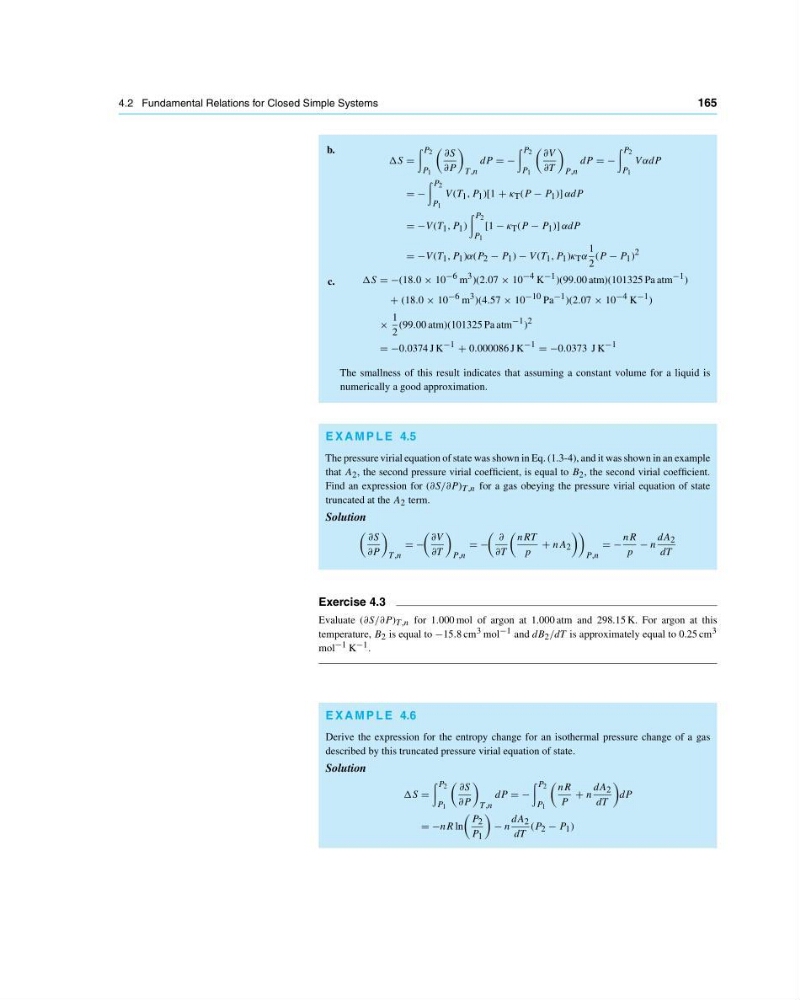
The smallness of this result indicates that assuming a constant volume for a liquid is
numerically a good approximation.
E X A M P L E 4.5
The pressure virial equation of state was shown in Eq. (1.3-4), and it was shown in an example
that A 2 , the second pressure virial coefficient, is equal to B 2 , the second virial coefficient.
Find an expression for (∂S/∂P) T ,n for a gas obeying the pressure virial equation of state
truncated at the A 2 term.
Solution
∂S
∂P
T ,n
−
∂V
∂T
P,n
−
∂
∂T
nRT
p
+ nA 2
P,n
−
nR
p
− n
dA 2
dT
Exercise 4.3
Evaluate (∂S/∂P) T ,n for 1.000 mol of argon at 1.000 atm and 298.15 K. For argon at this
temperature, B 2 is equal to −15.8 cm 3 mol −1 and dB 2 /dT is approximately equal to 0.25 cm 3
mol −1 K −1 .
E X A M P L E 4.6
Derive the expression for the entropy change for an isothermal pressure change of a gas
described by this truncated pressure virial equation of state.
Solution
∆S
P 2
P 1
∂S
∂P
T ,n
dP −
P 2
P 1
nR
P
+ n
dA 2
dT
dP
−nR ln
P 2
P 1
− n
dA 2
dT
(P 2 − P 1 )
165
b.
∆S
P 2
P 1
∂S
∂P
T ,n
dP −
P 2
P 1
∂V
∂T
P,n
dP −
P 2
P 1
V αdP
−
P 2
P 1
V (T 1 , P 1 )[1 + κ T (P − P 1 )] αdP
−V (T 1 , P 1 )
P 2
P 1
[1 − κ T (P − P 1 )] αdP
−V (T 1 , P 1 )α(P 2 − P 1 ) − V (T 1 , P 1 )κ T α
1
2
(P − P 1 ) 2
c.
∆S −(18.0 × 10 −6 m 3 )(2.07 × 10 −4 K −1 )(99.00 atm)(101325 Pa atm −1 )
+ (18.0 × 10 −6 m 3 )(4.57 × 10 −10 Pa −1 )(2.07 × 10 −4 K −1 )
×
1
2
(99.00 atm)(101325 Pa atm −1 ) 2
−0.0374 J K −1 + 0.000086 J K −1 −0.0373 J K −1
The smallness of this result indicates that assuming a constant volume for a liquid is
numerically a good approximation.
E X A M P L E 4.5
The pressure virial equation of state was shown in Eq. (1.3-4), and it was shown in an example
that A 2 , the second pressure virial coefficient, is equal to B 2 , the second virial coefficient.
Find an expression for (∂S/∂P) T ,n for a gas obeying the pressure virial equation of state
truncated at the A 2 term.
Solution
∂S
∂P
T ,n
−
∂V
∂T
P,n
−
∂
∂T
nRT
p
+ nA 2
P,n
−
nR
p
− n
dA 2
dT
Exercise 4.3
Evaluate (∂S/∂P) T ,n for 1.000 mol of argon at 1.000 atm and 298.15 K. For argon at this
temperature, B 2 is equal to −15.8 cm 3 mol −1 and dB 2 /dT is approximately equal to 0.25 cm 3
mol −1 K −1 .
E X A M P L E 4.6
Derive the expression for the entropy change for an isothermal pressure change of a gas
described by this truncated pressure virial equation of state.
Solution
∆S
P 2
P 1
∂S
∂P
T ,n
dP −
P 2
P 1
nR
P
+ n
dA 2
dT
dP
−nR ln
P 2
P 1
− n
dA 2
dT
(P 2 − P 1 )