

4.2 Fundamental Relations for Closed Simple Systems
163
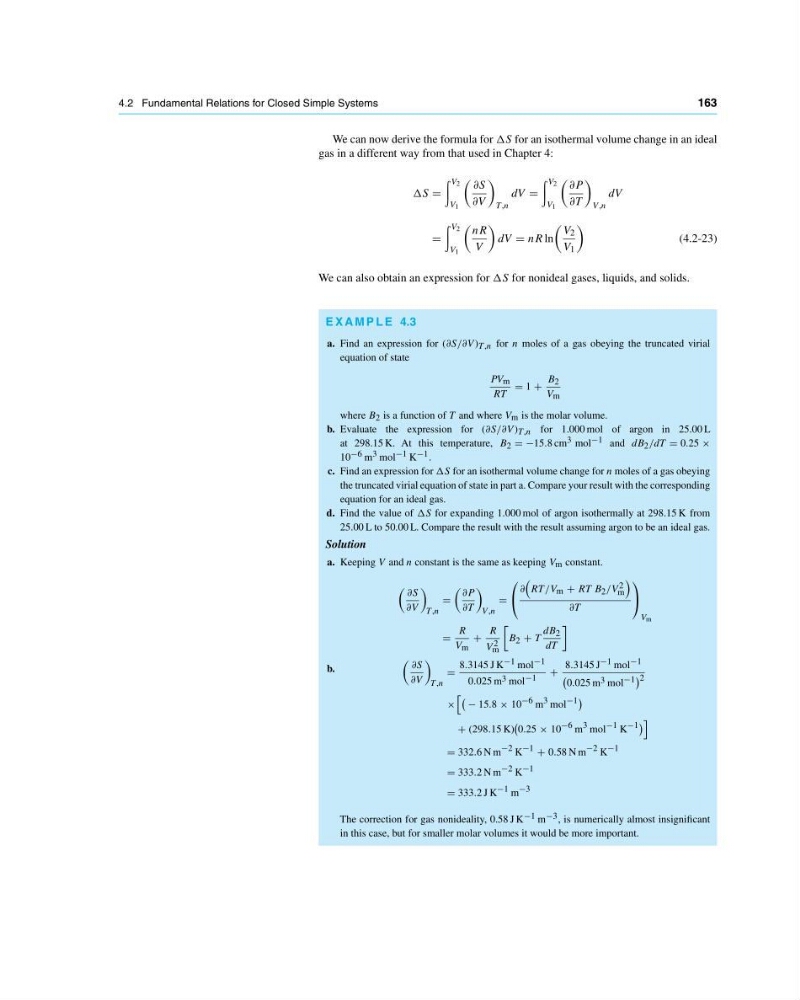
We can now derive the formula for ∆S for an isothermal volume change in an ideal
gas in a different way from that used in Chapter 4:
∆S
V 2
V 1
∂S
∂V
T ,n
dV
V 2
V 1
∂P
∂T
V ,n
dV
V 2
V 1
nR
V
dV nR ln
V 2
V 1
(4.2-23)
We can also obtain an expression for ∆S for nonideal gases, liquids, and solids.
E X A M P L E 4.3
a. Find an expression for (∂S/∂V ) T ,n for n moles of a gas obeying the truncated virial
equation of state
PV m
RT
1 +
B 2
V m
where B 2 is a function of T and where V m is the molar volume.
b. Evaluate the expression for (∂S/∂V ) T ,n for 1.000 mol of argon in 25.00 L
at 298.15 K. At this temperature, B 2 −15.8 cm 3 mol −1 and dB 2 /dT 0.25 ×
10 −6 m 3 mol −1 K −1 .
c. Find an expression for ∆S for an isothermal volume change for n moles of a gas obeying
the truncated virial equation of state in part a. Compare your result with the corresponding
equation for an ideal gas.
d. Find the value of ∆S for expanding 1.000 mol of argon isothermally at 298.15 K from
25.00 L to 50.00 L. Compare the result with the result assuming argon to be an ideal gas.
Solution
a. Keeping V and n constant is the same as keeping V m constant.
∂S
∂V
T ,n
∂P
∂T
V ,n
⎛
⎝
∂
RT /V m + RT B 2 /V 2
m
∂T
⎞
⎠
V m
R
V m
+
R
V 2
m
B 2 + T
dB 2
dT
b.
∂S
∂V
T ,n
8.3145 J K −1 mol −1
0.025 m 3 mol −1 +
8.3145 J −1 mol −1
0.025 m 3 mol −1 2
×
− 15.8 × 10 −6 m 3 mol −1
+ (298.15 K)
0.25 × 10 −6 m 3 mol −1 K −1
332.6 N m −2 K −1 + 0.58 N m −2 K −1
333.2 N m −2 K −1
333.2 J K −1 m −3
The correction for gas nonideality, 0.58 J K −1 m −3 , is numerically almost insignificant
in this case, but for smaller molar volumes it would be more important.
163
We can now derive the formula for ∆S for an isothermal volume change in an ideal
gas in a different way from that used in Chapter 4:
∆S
V 2
V 1
∂S
∂V
T ,n
dV
V 2
V 1
∂P
∂T
V ,n
dV
V 2
V 1
nR
V
dV nR ln
V 2
V 1
(4.2-23)
We can also obtain an expression for ∆S for nonideal gases, liquids, and solids.
E X A M P L E 4.3
a. Find an expression for (∂S/∂V ) T ,n for n moles of a gas obeying the truncated virial
equation of state
PV m
RT
1 +
B 2
V m
where B 2 is a function of T and where V m is the molar volume.
b. Evaluate the expression for (∂S/∂V ) T ,n for 1.000 mol of argon in 25.00 L
at 298.15 K. At this temperature, B 2 −15.8 cm 3 mol −1 and dB 2 /dT 0.25 ×
10 −6 m 3 mol −1 K −1 .
c. Find an expression for ∆S for an isothermal volume change for n moles of a gas obeying
the truncated virial equation of state in part a. Compare your result with the corresponding
equation for an ideal gas.
d. Find the value of ∆S for expanding 1.000 mol of argon isothermally at 298.15 K from
25.00 L to 50.00 L. Compare the result with the result assuming argon to be an ideal gas.
Solution
a. Keeping V and n constant is the same as keeping V m constant.
∂S
∂V
T ,n
∂P
∂T
V ,n
⎛
⎝
∂
RT /V m + RT B 2 /V 2
m
∂T
⎞
⎠
V m
R
V m
+
R
V 2
m
B 2 + T
dB 2
dT
b.
∂S
∂V
T ,n
8.3145 J K −1 mol −1
0.025 m 3 mol −1 +
8.3145 J −1 mol −1
0.025 m 3 mol −1 2
×
− 15.8 × 10 −6 m 3 mol −1
+ (298.15 K)
0.25 × 10 −6 m 3 mol −1 K −1
332.6 N m −2 K −1 + 0.58 N m −2 K −1
333.2 N m −2 K −1
333.2 J K −1 m −3
The correction for gas nonideality, 0.58 J K −1 m −3 , is numerically almost insignificant
in this case, but for smaller molar volumes it would be more important.