

4.1 Criteria for Spontaneous Processes and for Equilibrium: The Gibbs and Helmholtz Energies
155
The Equilibrium State of a Closed Simple System
For a system to be at macroscopic equilibrium, every process must have proceeded to the
state at which the appropriate criterion for spontaneity has been satisfied. For example,
when a closed simple system at constant temperature and pressure reaches equilibrium,
the Gibbs energy must have reached the minimum value possible at that pressure and
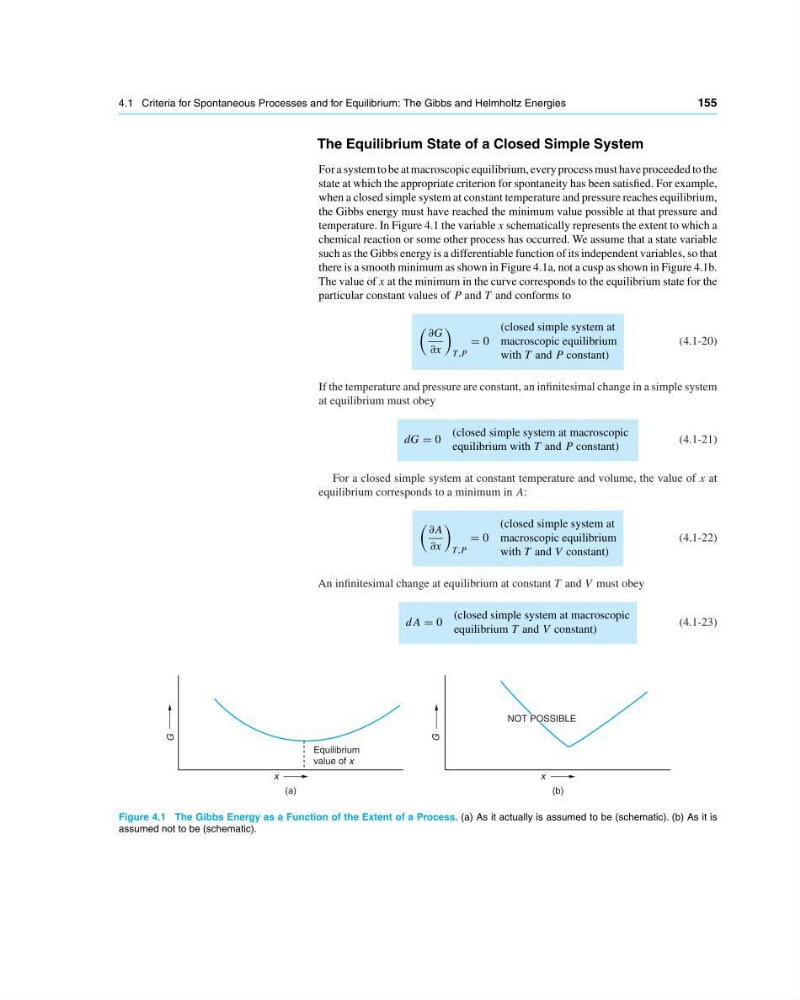
temperature. In Figure 4.1 the variable x schematically represents the extent to which a
chemical reaction or some other process has occurred. We assume that a state variable
such as the Gibbs energy is a differentiable function of its independent variables, so that
there is a smooth minimum as shown in Figure 4.1a, not a cusp as shown in Figure 4.1b.
The value of x at the minimum in the curve corresponds to the equilibrium state for the
particular constant values of P and T and conforms to
∂G
∂x
T ,P
0
(closed simple system at
macroscopic equilibrium
with T and P constant)
(4.1-20)
If the temperature and pressure are constant, an infinitesimal change in a simple system
at equilibrium must obey
dG 0
(closed simple system at macroscopic
equilibrium with T and P constant)
(4.1-21)
For a closed simple system at constant temperature and volume, the value of x at
equilibrium corresponds to a minimum in A:
∂A
∂x
T ,P
0
(closed simple system at
macroscopic equilibrium
with T and V constant)
(4.1-22)
An infinitesimal change at equilibrium at constant T and V must obey
dA 0
(closed simple system at macroscopic
equilibrium T and V constant)
(4.1-23)
(a)
(b)
NOT POSSIBLE
Equilibrium
value of x
G
G
x
x
Figure 4.1 The Gibbs Energy as a Function of the Extent of a Process. (a) As it actually is assumed to be (schematic). (b) As it is
assumed not to be (schematic).
155
The Equilibrium State of a Closed Simple System
For a system to be at macroscopic equilibrium, every process must have proceeded to the
state at which the appropriate criterion for spontaneity has been satisfied. For example,
when a closed simple system at constant temperature and pressure reaches equilibrium,
the Gibbs energy must have reached the minimum value possible at that pressure and
temperature. In Figure 4.1 the variable x schematically represents the extent to which a
chemical reaction or some other process has occurred. We assume that a state variable
such as the Gibbs energy is a differentiable function of its independent variables, so that
there is a smooth minimum as shown in Figure 4.1a, not a cusp as shown in Figure 4.1b.
The value of x at the minimum in the curve corresponds to the equilibrium state for the
particular constant values of P and T and conforms to
∂G
∂x
T ,P
0
(closed simple system at
macroscopic equilibrium
with T and P constant)
(4.1-20)
If the temperature and pressure are constant, an infinitesimal change in a simple system
at equilibrium must obey
dG 0
(closed simple system at macroscopic
equilibrium with T and P constant)
(4.1-21)
For a closed simple system at constant temperature and volume, the value of x at
equilibrium corresponds to a minimum in A:
∂A
∂x
T ,P
0
(closed simple system at
macroscopic equilibrium
with T and V constant)
(4.1-22)
An infinitesimal change at equilibrium at constant T and V must obey
dA 0
(closed simple system at macroscopic
equilibrium T and V constant)
(4.1-23)
(a)
(b)
NOT POSSIBLE
Equilibrium
value of x
G
G
x
x
Figure 4.1 The Gibbs Energy as a Function of the Extent of a Process. (a) As it actually is assumed to be (schematic). (b) As it is
assumed not to be (schematic).