

3.5 The Third Law of Thermodynamics and Absolute Entropies
147
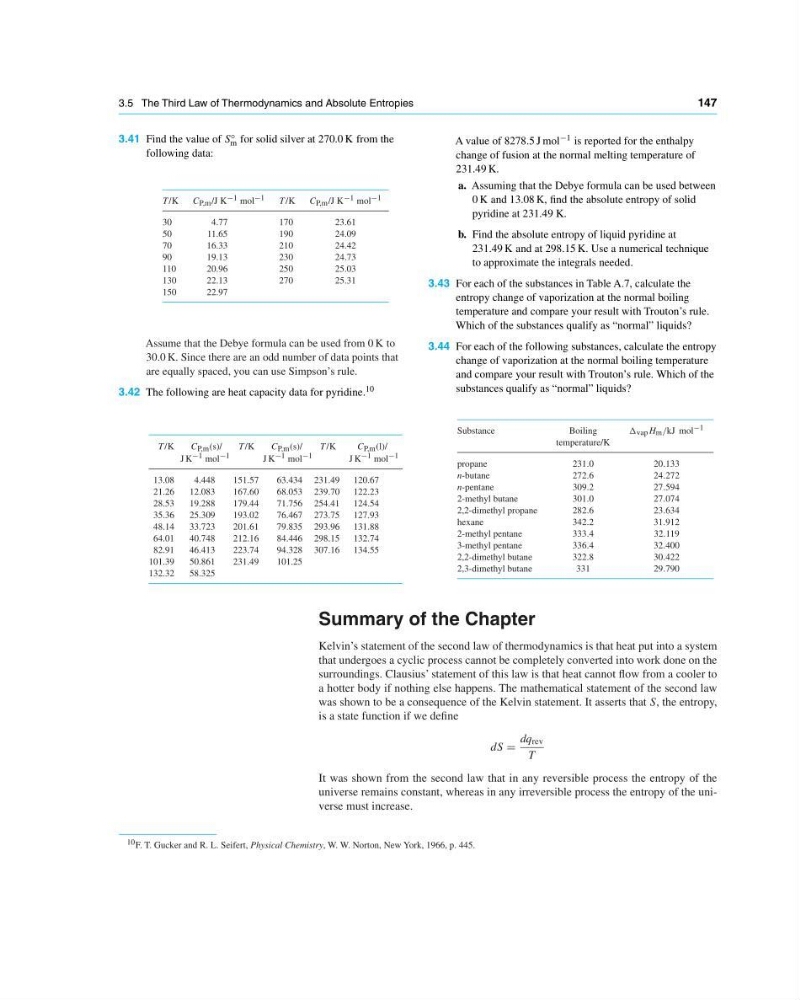
3.41 Find the value of S ◦
m for solid silver at 270.0 K from the
following data:
T /K
C P,m /J K −1 mol −1
T /K
C P,m /J K −1 mol −1
30
4.77
170
23.61
50
11.65
190
24.09
70
16.33
210
24.42
90
19.13
230
24.73
110
20.96
250
25.03
130
22.13
270
25.31
150
22.97
Assume that the Debye formula can be used from 0 K to
30.0 K. Since there are an odd number of data points that
are equally spaced, you can use Simpson’s rule.
3.42 The following are heat capacity data for pyridine. 10
T /K
C P,m (s)/
T /K
C P,m (s)/
T /K
C P,m (l)/
J K −1 mol −1
J K −1 mol −1
J K −1 mol −1
13.08
4.448
151.57
63.434 231.49 120.67
21.26
12.083
167.60
68.053 239.70 122.23
28.53
19.288
179.44
71.756 254.41 124.54
35.36
25.309
193.02
76.467 273.75 127.93
48.14
33.723
201.61
79.835 293.96 131.88
64.01
40.748
212.16
84.446 298.15 132.74
82.91
46.413
223.74
94.328 307.16 134.55
101.39
50.861
231.49
101.25
132.32
58.325
A value of 8278.5 J mol −1 is reported for the enthalpy
change of fusion at the normal melting temperature of
231.49 K.
a. Assuming that the Debye formula can be used between
0 K and 13.08 K, find the absolute entropy of solid
pyridine at 231.49 K.
b. Find the absolute entropy of liquid pyridine at
231.49 K and at 298.15 K. Use a numerical technique
to approximate the integrals needed.
3.43 For each of the substances in Table A.7, calculate the
entropy change of vaporization at the normal boiling
temperature and compare your result with Trouton’s rule.
Which of the substances qualify as “normal” liquids?
3.44 For each of the following substances, calculate the entropy
change of vaporization at the normal boiling temperature
and compare your result with Trouton’s rule. Which of the
substances qualify as “normal” liquids?
Substance
Boiling
∆ vap H m /kJ mol −1
temperature/K
propane
231.0
2 0 .133
n-butane
272.6
2 4 .272
n-pentane
309.2
2 7 .594
2-methyl butane
301.0
2 7 .074
2,2-dimethyl propane
282.6
2 3 .634
hexane
342.2
3 1 .912
2-methyl pentane
333.4
3 2 .119
3-methyl pentane
336.4
3 2 .400
2,2-dimethyl butane
322.8
3 0 .422
2,3-dimethyl butane
331
29.790
Summary of the Chapter
Kelvin’s statement of the second law of thermodynamics is that heat put into a system
that undergoes a cyclic process cannot be completely converted into work done on the
surroundings. Clausius’ statement of this law is that heat cannot flow from a cooler to
a hotter body if nothing else happens. The mathematical statement of the second law
was shown to be a consequence of the Kelvin statement. It asserts that S, the entropy,
is a state function if we define
dS
dq rev
T
It was shown from the second law that in any reversible process the entropy of the
universe remains constant, whereas in any irreversible process the entropy of the universe must increase.
10 F. T. Gucker and R. L. Seifert, Physical Chemistry, W. W. Norton, New York, 1966, p. 445.
147
3.41 Find the value of S ◦
m for solid silver at 270.0 K from the
following data:
T /K
C P,m /J K −1 mol −1
T /K
C P,m /J K −1 mol −1
30
4.77
170
23.61
50
11.65
190
24.09
70
16.33
210
24.42
90
19.13
230
24.73
110
20.96
250
25.03
130
22.13
270
25.31
150
22.97
Assume that the Debye formula can be used from 0 K to
30.0 K. Since there are an odd number of data points that
are equally spaced, you can use Simpson’s rule.
3.42 The following are heat capacity data for pyridine. 10
T /K
C P,m (s)/
T /K
C P,m (s)/
T /K
C P,m (l)/
J K −1 mol −1
J K −1 mol −1
J K −1 mol −1
13.08
4.448
151.57
63.434 231.49 120.67
21.26
12.083
167.60
68.053 239.70 122.23
28.53
19.288
179.44
71.756 254.41 124.54
35.36
25.309
193.02
76.467 273.75 127.93
48.14
33.723
201.61
79.835 293.96 131.88
64.01
40.748
212.16
84.446 298.15 132.74
82.91
46.413
223.74
94.328 307.16 134.55
101.39
50.861
231.49
101.25
132.32
58.325
A value of 8278.5 J mol −1 is reported for the enthalpy
change of fusion at the normal melting temperature of
231.49 K.
a. Assuming that the Debye formula can be used between
0 K and 13.08 K, find the absolute entropy of solid
pyridine at 231.49 K.
b. Find the absolute entropy of liquid pyridine at
231.49 K and at 298.15 K. Use a numerical technique
to approximate the integrals needed.
3.43 For each of the substances in Table A.7, calculate the
entropy change of vaporization at the normal boiling
temperature and compare your result with Trouton’s rule.
Which of the substances qualify as “normal” liquids?
3.44 For each of the following substances, calculate the entropy
change of vaporization at the normal boiling temperature
and compare your result with Trouton’s rule. Which of the
substances qualify as “normal” liquids?
Substance
Boiling
∆ vap H m /kJ mol −1
temperature/K
propane
231.0
2 0 .133
n-butane
272.6
2 4 .272
n-pentane
309.2
2 7 .594
2-methyl butane
301.0
2 7 .074
2,2-dimethyl propane
282.6
2 3 .634
hexane
342.2
3 1 .912
2-methyl pentane
333.4
3 2 .119
3-methyl pentane
336.4
3 2 .400
2,2-dimethyl butane
322.8
3 0 .422
2,3-dimethyl butane
331
29.790
Summary of the Chapter
Kelvin’s statement of the second law of thermodynamics is that heat put into a system
that undergoes a cyclic process cannot be completely converted into work done on the
surroundings. Clausius’ statement of this law is that heat cannot flow from a cooler to
a hotter body if nothing else happens. The mathematical statement of the second law
was shown to be a consequence of the Kelvin statement. It asserts that S, the entropy,
is a state function if we define
dS
dq rev
T
It was shown from the second law that in any reversible process the entropy of the
universe remains constant, whereas in any irreversible process the entropy of the universe must increase.
10 F. T. Gucker and R. L. Seifert, Physical Chemistry, W. W. Norton, New York, 1966, p. 445.