

3.5 The Third Law of Thermodynamics and Absolute Entropies
141
for low temperatures, an approximate theory of Debye 6 can be used in lieu of data.
According to this theory, the vibrations of a crystal of a monatomic substance produce
a contribution to C V at low temperatures that is proportional to T 3 . An approximate
theory for the motion of mobile electrons in metals gives a contribution proportional
to T , 7 so that for sufficiently low temperature
C V,m aT 3 + bT (valid at low temperature)
(3.5-3)
where a and b are parameters that can be determined from experimental data. For
electrical insulators the parameter b is equal to zero. Equation (3.5-3) is quite reliable
up to temperatures of about 15 K. Above this temperature data are usually available.
Since the difference between C P and C V is numerically small for solids, Eq. (3.5-3) is
usually used for C P as well as for C V .
Peter J. W. Debye, 1884–1966, was a
Dutch-American physicist and chemist
who received the Nobel Prize in
chemistry in 1936 for his work on the
dipole moments of molecules and who
made numerous other important
contributions.
Exercise 3.17
a. Show that if Eq. (3.5-3) is valid between zero temperature and some temperature T 1 and if
b 0, the value of the molar entropy at T 1 is given by
S m (T 1 )
aT 3
1
3
C V,m (T 1 )
3
(3.5-4)
b. Find the expression for S m (T 1 ) if b is not equal to zero.
If a phase transition occurs between zero temperature and the temperature of interest,
Eq. (3.5-2) must be modified to include the entropy change of the phase transition. If
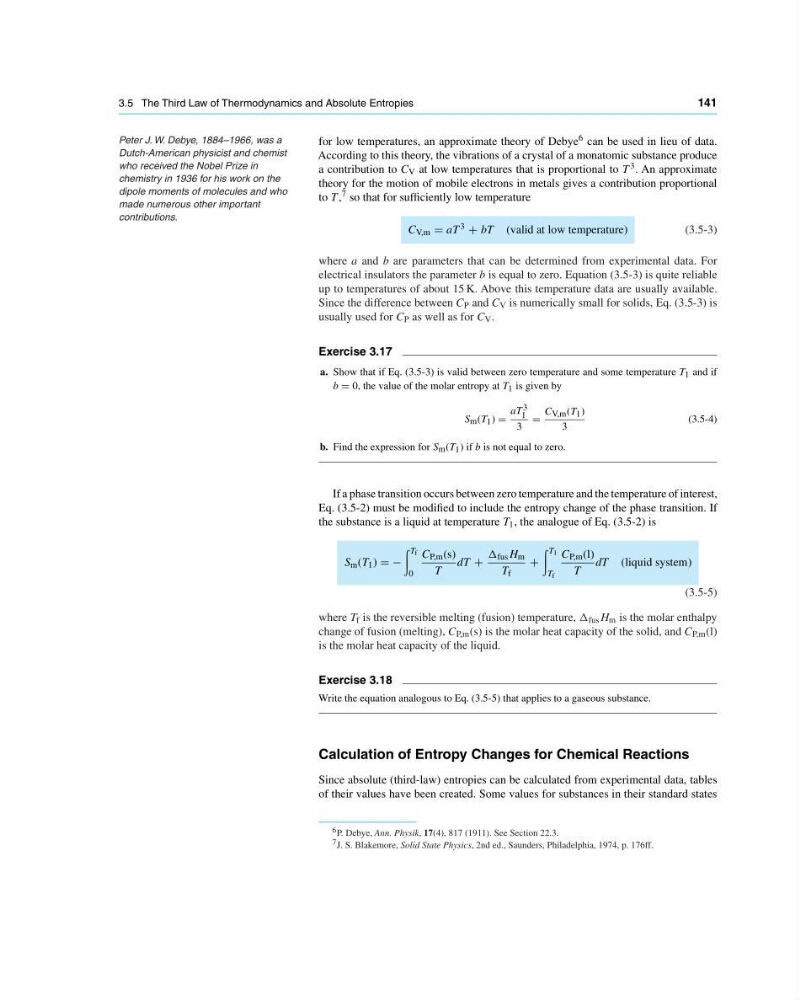
the substance is a liquid at temperature T 1 , the analogue of Eq. (3.5-2) is
S m (T 1 ) −
T f
0
C P,m (s)
T
dT +
∆ fus H m
T f
+
T 1
T f
C P,m (l)
T
dT (liquid system)
(3.5-5)
where T f is the reversible melting (fusion) temperature, ∆ fus H m is the molar enthalpy
change of fusion (melting), C P,m (s) is the molar heat capacity of the solid, and C P,m (l)
is the molar heat capacity of the liquid.
Exercise 3.18
Write the equation analogous to Eq. (3.5-5) that applies to a gaseous substance.
Calculation of Entropy Changes for Chemical Reactions
Since absolute (third-law) entropies can be calculated from experimental data, tables
of their values have been created. Some values for substances in their standard states
6 P. Debye, Ann. Physik, 17(4), 817 (1911). See Section 22.3.
7 J. S. Blakemore, Solid State Physics, 2nd ed., Saunders, Philadelphia, 1974, p. 176ff.
141
for low temperatures, an approximate theory of Debye 6 can be used in lieu of data.
According to this theory, the vibrations of a crystal of a monatomic substance produce
a contribution to C V at low temperatures that is proportional to T 3 . An approximate
theory for the motion of mobile electrons in metals gives a contribution proportional
to T , 7 so that for sufficiently low temperature
C V,m aT 3 + bT (valid at low temperature)
(3.5-3)
where a and b are parameters that can be determined from experimental data. For
electrical insulators the parameter b is equal to zero. Equation (3.5-3) is quite reliable
up to temperatures of about 15 K. Above this temperature data are usually available.
Since the difference between C P and C V is numerically small for solids, Eq. (3.5-3) is
usually used for C P as well as for C V .
Peter J. W. Debye, 1884–1966, was a
Dutch-American physicist and chemist
who received the Nobel Prize in
chemistry in 1936 for his work on the
dipole moments of molecules and who
made numerous other important
contributions.
Exercise 3.17
a. Show that if Eq. (3.5-3) is valid between zero temperature and some temperature T 1 and if
b 0, the value of the molar entropy at T 1 is given by
S m (T 1 )
aT 3
1
3
C V,m (T 1 )
3
(3.5-4)
b. Find the expression for S m (T 1 ) if b is not equal to zero.
If a phase transition occurs between zero temperature and the temperature of interest,
Eq. (3.5-2) must be modified to include the entropy change of the phase transition. If
the substance is a liquid at temperature T 1 , the analogue of Eq. (3.5-2) is
S m (T 1 ) −
T f
0
C P,m (s)
T
dT +
∆ fus H m
T f
+
T 1
T f
C P,m (l)
T
dT (liquid system)
(3.5-5)
where T f is the reversible melting (fusion) temperature, ∆ fus H m is the molar enthalpy
change of fusion (melting), C P,m (s) is the molar heat capacity of the solid, and C P,m (l)
is the molar heat capacity of the liquid.
Exercise 3.18
Write the equation analogous to Eq. (3.5-5) that applies to a gaseous substance.
Calculation of Entropy Changes for Chemical Reactions
Since absolute (third-law) entropies can be calculated from experimental data, tables
of their values have been created. Some values for substances in their standard states
6 P. Debye, Ann. Physik, 17(4), 817 (1911). See Section 22.3.
7 J. S. Blakemore, Solid State Physics, 2nd ed., Saunders, Philadelphia, 1974, p. 176ff.