

136
3 The Second and Third Laws of Thermodynamics: Entropy
The Statistical Entropy and the Thermodynamic Entropy
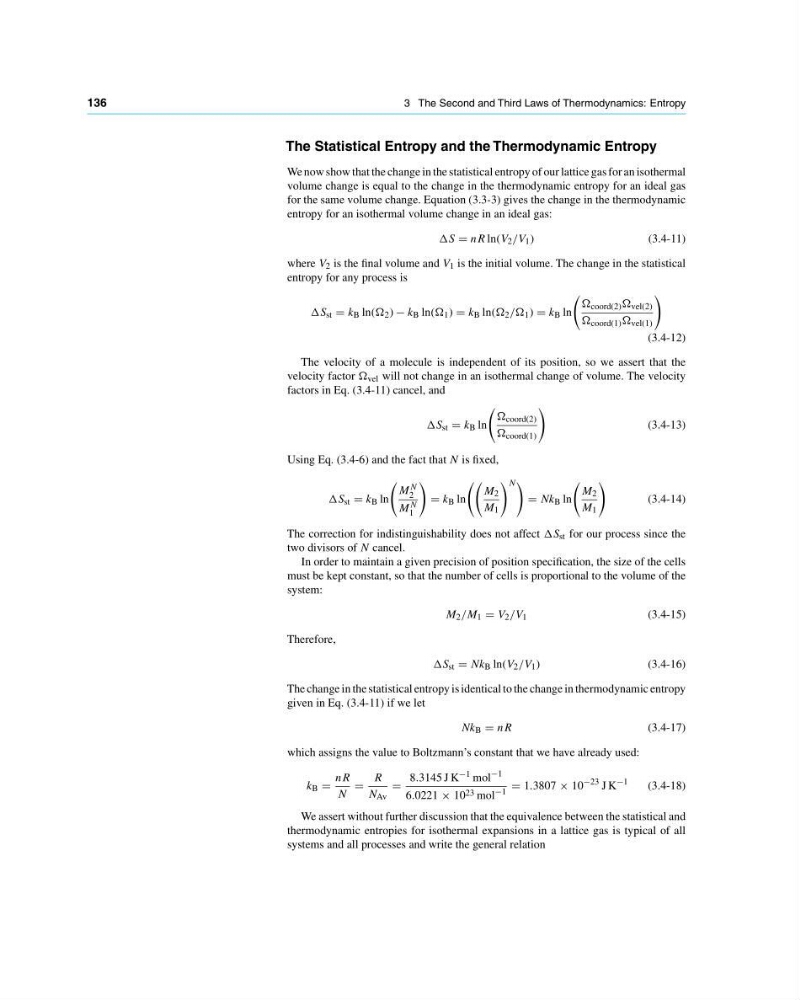
We now show that the change in the statistical entropy of our lattice gas for an isothermal
volume change is equal to the change in the thermodynamic entropy for an ideal gas
for the same volume change. Equation (3.3-3) gives the change in the thermodynamic
entropy for an isothermal volume change in an ideal gas:
∆S nR ln(V 2 /V 1 )
(3.4-11)
where V 2 is the final volume and V 1 is the initial volume. The change in the statistical
entropy for any process is
∆S st k B ln(Ω 2 ) − k B ln(Ω 1 ) k B ln(Ω 2 /Ω 1 ) k B ln
Ω coord(2) Ω vel(2)
Ω coord(1) Ω vel(1)
(3.4-12)
The velocity of a molecule is independent of its position, so we assert that the
velocity factor Ω vel will not change in an isothermal change of volume. The velocity
factors in Eq. (3.4-11) cancel, and
∆S st k B ln
Ω coord(2)
Ω coord(1)
(3.4-13)
Using Eq. (3.4-6) and the fact that N is fixed,
∆S st k B ln
M N
2
M N
1
k B ln
M 2
M 1
N
Nk B ln
M 2
M 1
(3.4-14)
The correction for indistinguishability does not affect ∆S st for our process since the
two divisors of N cancel.
In order to maintain a given precision of position specification, the size of the cells
must be kept constant, so that the number of cells is proportional to the volume of the
system:
M 2 /M 1 V 2 /V 1
(3.4-15)
Therefore,
∆S st Nk B ln(V 2 /V 1 )
(3.4-16)
The change in the statistical entropy is identical to the change in thermodynamic entropy
given in Eq. (3.4-11) if we let
Nk B nR
(3.4-17)
which assigns the value to Boltzmann’s constant that we have already used:
k B
nR
N
R
N Av
8.3145 J K −1 mol
−1
6.0221 × 10 23 mol
−1
1.3807 × 10
−23 J K
−1
(3.4-18)
We assert without further discussion that the equivalence between the statistical and
thermodynamic entropies for isothermal expansions in a lattice gas is typical of all
systems and all processes and write the general relation
3 The Second and Third Laws of Thermodynamics: Entropy
The Statistical Entropy and the Thermodynamic Entropy
We now show that the change in the statistical entropy of our lattice gas for an isothermal
volume change is equal to the change in the thermodynamic entropy for an ideal gas
for the same volume change. Equation (3.3-3) gives the change in the thermodynamic
entropy for an isothermal volume change in an ideal gas:
∆S nR ln(V 2 /V 1 )
(3.4-11)
where V 2 is the final volume and V 1 is the initial volume. The change in the statistical
entropy for any process is
∆S st k B ln(Ω 2 ) − k B ln(Ω 1 ) k B ln(Ω 2 /Ω 1 ) k B ln
Ω coord(2) Ω vel(2)
Ω coord(1) Ω vel(1)
(3.4-12)
The velocity of a molecule is independent of its position, so we assert that the
velocity factor Ω vel will not change in an isothermal change of volume. The velocity
factors in Eq. (3.4-11) cancel, and
∆S st k B ln
Ω coord(2)
Ω coord(1)
(3.4-13)
Using Eq. (3.4-6) and the fact that N is fixed,
∆S st k B ln
M N
2
M N
1
k B ln
M 2
M 1
N
Nk B ln
M 2
M 1
(3.4-14)
The correction for indistinguishability does not affect ∆S st for our process since the
two divisors of N cancel.
In order to maintain a given precision of position specification, the size of the cells
must be kept constant, so that the number of cells is proportional to the volume of the
system:
M 2 /M 1 V 2 /V 1
(3.4-15)
Therefore,
∆S st Nk B ln(V 2 /V 1 )
(3.4-16)
The change in the statistical entropy is identical to the change in thermodynamic entropy
given in Eq. (3.4-11) if we let
Nk B nR
(3.4-17)
which assigns the value to Boltzmann’s constant that we have already used:
k B
nR
N
R
N Av
8.3145 J K −1 mol
−1
6.0221 × 10 23 mol
−1
1.3807 × 10
−23 J K
−1
(3.4-18)
We assert without further discussion that the equivalence between the statistical and
thermodynamic entropies for isothermal expansions in a lattice gas is typical of all
systems and all processes and write the general relation