

3.3 The Calculation of Entropy Changes
125
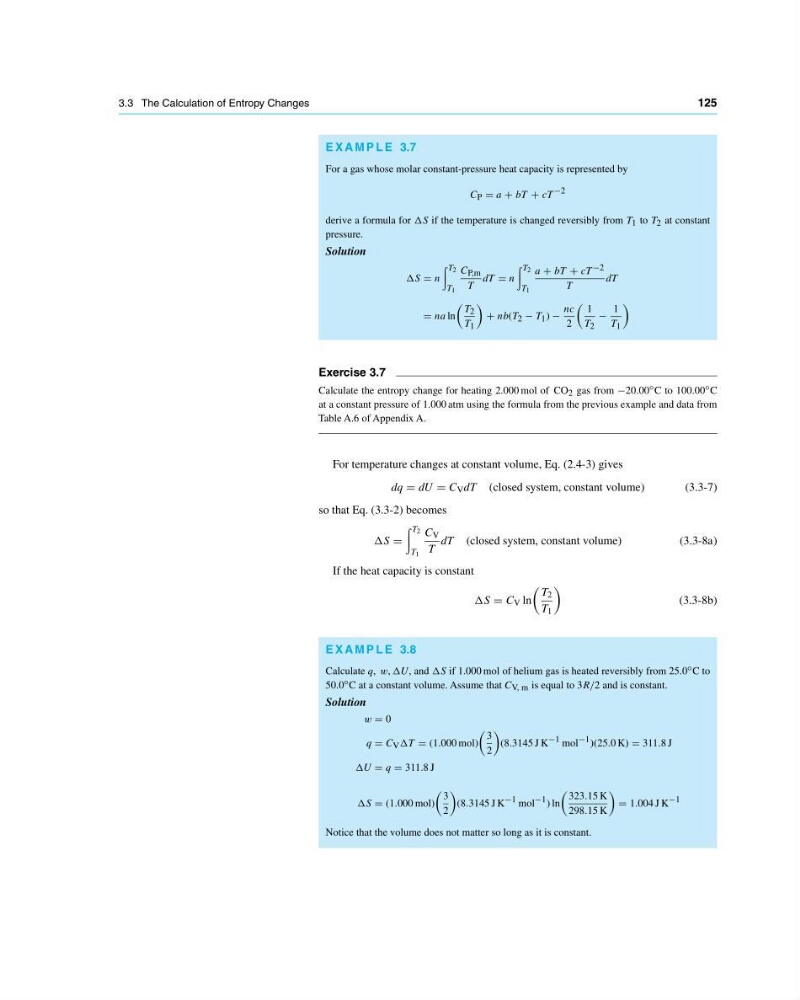
E X A M P L E 3.7
For a gas whose molar constant-pressure heat capacity is represented by
C P a + bT + cT −2
derive a formula for ∆S if the temperature is changed reversibly from T 1 to T 2 at constant
pressure.
Solution
∆S n
T 2
T 1
C P,m
T
dT n
T 2
T 1
a + bT + cT −2
T
dT
na ln
T 2
T 1
+ nb(T 2 − T 1 ) −
nc
2
1
T 2
−
1
T 1
Exercise 3.7
Calculate the entropy change for heating 2.000 mol of CO 2 gas from −20.00 ◦ C to 100.00 ◦ C
at a constant pressure of 1.000 atm using the formula from the previous example and data from
Table A.6 of Appendix A.
For temperature changes at constant volume, Eq. (2.4-3) gives
dq dU C V dT (closed system, constant volume)
(3.3-7)
so that Eq. (3.3-2) becomes
∆S
T 2
T 1
C V
T
dT (closed system, constant volume)
(3.3-8a)
If the heat capacity is constant
∆S C V ln
T 2
T 1
(3.3-8b)
E X A M P L E 3.8
Calculate q, w, ∆U, and ∆S if 1.000 mol of helium gas is heated reversibly from 25.0 ◦ C to
50.0 ◦ C at a constant volume. Assume that C V, m is equal to 3R/2 and is constant.
Solution
w 0
q C V ∆T (1.000 mol)
3
2
(8.3145 J K −1 mol −1 )(25.0 K) 311.8 J
∆U q 311.8 J
∆S (1.000 mol)
3
2
(8.3145 J K −1 mol −1 ) ln
323.15 K
298.15 K
1.004 J K −1
Notice that the volume does not matter so long as it is constant.
125
E X A M P L E 3.7
For a gas whose molar constant-pressure heat capacity is represented by
C P a + bT + cT −2
derive a formula for ∆S if the temperature is changed reversibly from T 1 to T 2 at constant
pressure.
Solution
∆S n
T 2
T 1
C P,m
T
dT n
T 2
T 1
a + bT + cT −2
T
dT
na ln
T 2
T 1
+ nb(T 2 − T 1 ) −
nc
2
1
T 2
−
1
T 1
Exercise 3.7
Calculate the entropy change for heating 2.000 mol of CO 2 gas from −20.00 ◦ C to 100.00 ◦ C
at a constant pressure of 1.000 atm using the formula from the previous example and data from
Table A.6 of Appendix A.
For temperature changes at constant volume, Eq. (2.4-3) gives
dq dU C V dT (closed system, constant volume)
(3.3-7)
so that Eq. (3.3-2) becomes
∆S
T 2
T 1
C V
T
dT (closed system, constant volume)
(3.3-8a)
If the heat capacity is constant
∆S C V ln
T 2
T 1
(3.3-8b)
E X A M P L E 3.8
Calculate q, w, ∆U, and ∆S if 1.000 mol of helium gas is heated reversibly from 25.0 ◦ C to
50.0 ◦ C at a constant volume. Assume that C V, m is equal to 3R/2 and is constant.
Solution
w 0
q C V ∆T (1.000 mol)
3
2
(8.3145 J K −1 mol −1 )(25.0 K) 311.8 J
∆U q 311.8 J
∆S (1.000 mol)
3
2
(8.3145 J K −1 mol −1 ) ln
323.15 K
298.15 K
1.004 J K −1
Notice that the volume does not matter so long as it is constant.