

122
3 The Second and Third Laws of Thermodynamics: Entropy
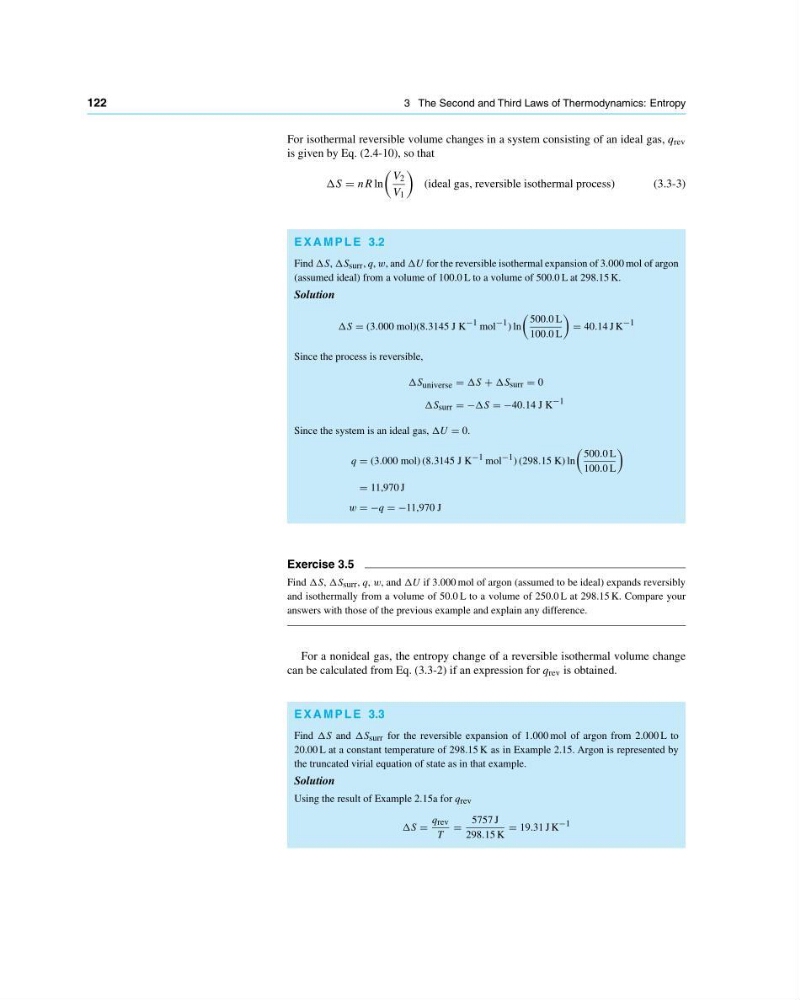
For isothermal reversible volume changes in a system consisting of an ideal gas, q rev
is given by Eq. (2.4-10), so that
∆S nR ln
V 2
V 1
(ideal gas, reversible isothermal process)
(3.3-3)
E X A M P L E 3.2
Find ∆S, ∆S surr , q, w, and ∆U for the reversible isothermal expansion of 3.000 mol of argon
(assumed ideal) from a volume of 100.0 L to a volume of 500.0 L at 298.15 K.
Solution
∆S (3.000 mol)(8.3145 J K −1 mol −1 ) ln
500.0 L
100.0 L
40.14 J K −1
Since the process is reversible,
∆S universe ∆S + ∆S surr 0
∆S surr −∆S −40.14 J K −1
Since the system is an ideal gas, ∆U 0.
q (3.000 mol) (8.3145 J K −1 mol −1 ) (298.15 K) ln
500.0 L
100.0 L
11,970 J
w −q −11,970 J
Exercise 3.5
Find ∆S, ∆S surr , q, w, and ∆U if 3.000 mol of argon (assumed to be ideal) expands reversibly
and isothermally from a volume of 50.0 L to a volume of 250.0 L at 298.15 K. Compare your
answers with those of the previous example and explain any difference.
For a nonideal gas, the entropy change of a reversible isothermal volume change
can be calculated from Eq. (3.3-2) if an expression for q rev is obtained.
E X A M P L E 3.3
Find ∆S and ∆S surr for the reversible expansion of 1.000 mol of argon from 2.000 L to
20.00 L at a constant temperature of 298.15 K as in Example 2.15. Argon is represented by
the truncated virial equation of state as in that example.
Solution
Using the result of Example 2.15a for q rev
∆S
q rev
T
5757 J
298.15 K
19.31 J K −1
3 The Second and Third Laws of Thermodynamics: Entropy
For isothermal reversible volume changes in a system consisting of an ideal gas, q rev
is given by Eq. (2.4-10), so that
∆S nR ln
V 2
V 1
(ideal gas, reversible isothermal process)
(3.3-3)
E X A M P L E 3.2
Find ∆S, ∆S surr , q, w, and ∆U for the reversible isothermal expansion of 3.000 mol of argon
(assumed ideal) from a volume of 100.0 L to a volume of 500.0 L at 298.15 K.
Solution
∆S (3.000 mol)(8.3145 J K −1 mol −1 ) ln
500.0 L
100.0 L
40.14 J K −1
Since the process is reversible,
∆S universe ∆S + ∆S surr 0
∆S surr −∆S −40.14 J K −1
Since the system is an ideal gas, ∆U 0.
q (3.000 mol) (8.3145 J K −1 mol −1 ) (298.15 K) ln
500.0 L
100.0 L
11,970 J
w −q −11,970 J
Exercise 3.5
Find ∆S, ∆S surr , q, w, and ∆U if 3.000 mol of argon (assumed to be ideal) expands reversibly
and isothermally from a volume of 50.0 L to a volume of 250.0 L at 298.15 K. Compare your
answers with those of the previous example and explain any difference.
For a nonideal gas, the entropy change of a reversible isothermal volume change
can be calculated from Eq. (3.3-2) if an expression for q rev is obtained.
E X A M P L E 3.3
Find ∆S and ∆S surr for the reversible expansion of 1.000 mol of argon from 2.000 L to
20.00 L at a constant temperature of 298.15 K as in Example 2.15. Argon is represented by
the truncated virial equation of state as in that example.
Solution
Using the result of Example 2.15a for q rev
∆S
q rev
T
5757 J
298.15 K
19.31 J K −1