

3.1 The Second Law of Thermodynamics and the Carnot Heat Engine
111
announced after the other laws. The order of announcement was as follows: the second
law, followed by the first law, the third law, and the zeroth law. The name “zeroth law”
was coined by Ralph H. Fowler.
Ralph H. Fowler, 1889–1945, was a
prominent professor of physics at
Cambridge University.
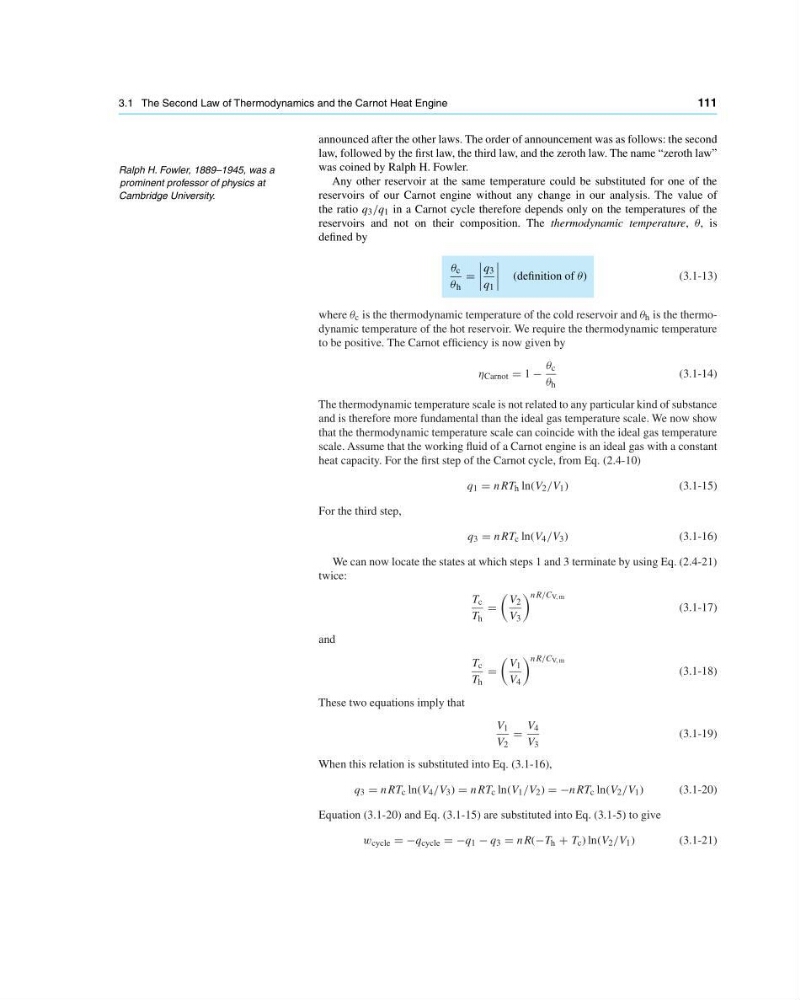
Any other reservoir at the same temperature could be substituted for one of the
reservoirs of our Carnot engine without any change in our analysis. The value of
the ratio q 3 /q 1 in a Carnot cycle therefore depends only on the temperatures of the
reservoirs and not on their composition. The thermodynamic temperature, θ, is
defined by
θ c
θ h
q 3
q 1
(definition of θ)
(3.1-13)
where θ c is the thermodynamic temperature of the cold reservoir and θ h is the thermodynamic temperature of the hot reservoir. We require the thermodynamic temperature
to be positive. The Carnot efficiency is now given by
η Carnot 1 −
θ c
θ h
(3.1-14)
The thermodynamic temperature scale is not related to any particular kind of substance
and is therefore more fundamental than the ideal gas temperature scale. We now show
that the thermodynamic temperature scale can coincide with the ideal gas temperature
scale. Assume that the working fluid of a Carnot engine is an ideal gas with a constant
heat capacity. For the first step of the Carnot cycle, from Eq. (2.4-10)
q 1 nRT h ln(V 2 /V 1 )
(3.1-15)
For the third step,
q 3 nRT c ln(V 4 /V 3 )
(3.1-16)
We can now locate the states at which steps 1 and 3 terminate by using Eq. (2.4-21)
twice:
T c
T h
V 2
V 3
nR/C V, m
(3.1-17)
and
T c
T h
V 1
V 4
nR/C V, m
(3.1-18)
These two equations imply that
V 1
V 2
V 4
V 3
(3.1-19)
When this relation is substituted into Eq. (3.1-16),
q 3 nRT c ln(V 4 /V 3 ) nRT c ln(V 1 /V 2 ) −nRT c ln(V 2 /V 1 )
(3.1-20)
Equation (3.1-20) and Eq. (3.1-15) are substituted into Eq. (3.1-5) to give
w cycle −q cycle −q 1 − q 3 nR(−T h + T c ) ln(V 2 /V 1 )
(3.1-21)
111
announced after the other laws. The order of announcement was as follows: the second
law, followed by the first law, the third law, and the zeroth law. The name “zeroth law”
was coined by Ralph H. Fowler.
Ralph H. Fowler, 1889–1945, was a
prominent professor of physics at
Cambridge University.
Any other reservoir at the same temperature could be substituted for one of the
reservoirs of our Carnot engine without any change in our analysis. The value of
the ratio q 3 /q 1 in a Carnot cycle therefore depends only on the temperatures of the
reservoirs and not on their composition. The thermodynamic temperature, θ, is
defined by
θ c
θ h
q 3
q 1
(definition of θ)
(3.1-13)
where θ c is the thermodynamic temperature of the cold reservoir and θ h is the thermodynamic temperature of the hot reservoir. We require the thermodynamic temperature
to be positive. The Carnot efficiency is now given by
η Carnot 1 −
θ c
θ h
(3.1-14)
The thermodynamic temperature scale is not related to any particular kind of substance
and is therefore more fundamental than the ideal gas temperature scale. We now show
that the thermodynamic temperature scale can coincide with the ideal gas temperature
scale. Assume that the working fluid of a Carnot engine is an ideal gas with a constant
heat capacity. For the first step of the Carnot cycle, from Eq. (2.4-10)
q 1 nRT h ln(V 2 /V 1 )
(3.1-15)
For the third step,
q 3 nRT c ln(V 4 /V 3 )
(3.1-16)
We can now locate the states at which steps 1 and 3 terminate by using Eq. (2.4-21)
twice:
T c
T h
V 2
V 3
nR/C V, m
(3.1-17)
and
T c
T h
V 1
V 4
nR/C V, m
(3.1-18)
These two equations imply that
V 1
V 2
V 4
V 3
(3.1-19)
When this relation is substituted into Eq. (3.1-16),
q 3 nRT c ln(V 4 /V 3 ) nRT c ln(V 1 /V 2 ) −nRT c ln(V 2 /V 1 )
(3.1-20)
Equation (3.1-20) and Eq. (3.1-15) are substituted into Eq. (3.1-5) to give
w cycle −q cycle −q 1 − q 3 nR(−T h + T c ) ln(V 2 /V 1 )
(3.1-21)