

100
2 Work, Heat, and Energy: The First Law of Thermodynamics
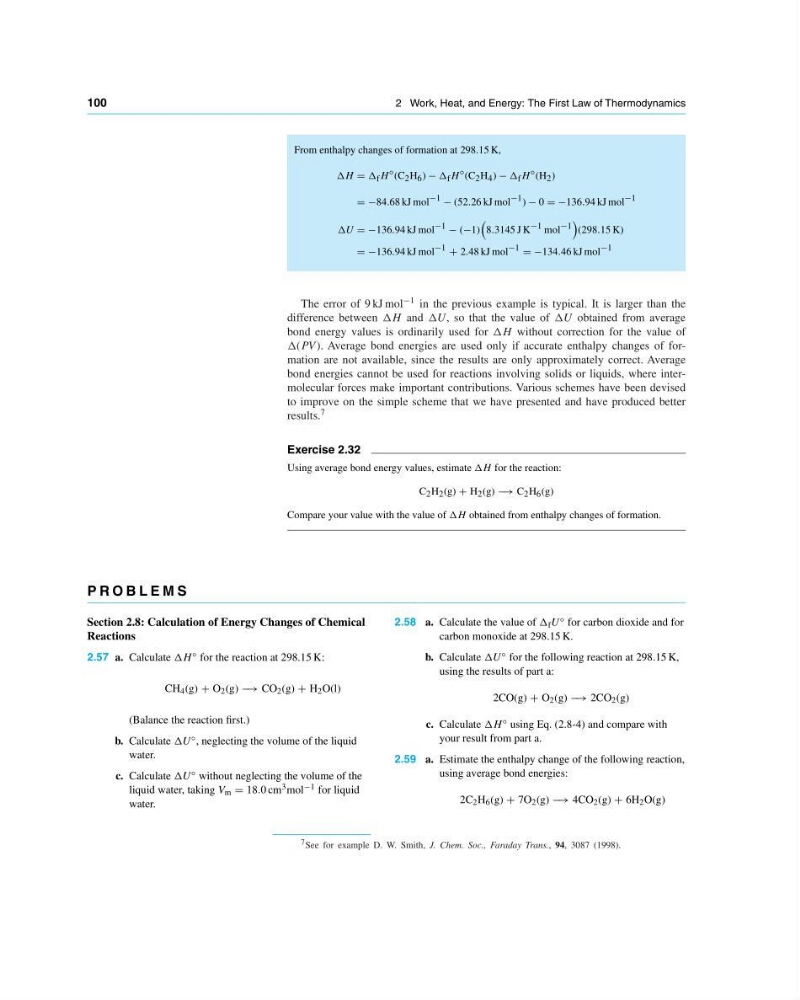
From enthalpy changes of formation at 298.15 K,
∆H ∆ f H ◦ (C 2 H 6 ) − ∆ f H ◦ (C 2 H 4 ) − ∆ f H ◦ (H 2 )
−84.68 kJ mol −1 − (52.26 kJ mol −1 ) − 0 −136.94 kJ mol −1
∆U −136.94 kJ mol −1 − (−1)
8.3145 J K −1 mol −1
(298.15 K)
−136.94 kJ mol −1 + 2.48 kJ mol −1 −134.46 kJ mol −1
The error of 9 kJ mol −1 in the previous example is typical. It is larger than the
difference between ∆H and ∆U, so that the value of ∆U obtained from average
bond energy values is ordinarily used for ∆H without correction for the value of
∆(PV ). Average bond energies are used only if accurate enthalpy changes of formation are not available, since the results are only approximately correct. Average
bond energies cannot be used for reactions involving solids or liquids, where intermolecular forces make important contributions. Various schemes have been devised
to improve on the simple scheme that we have presented and have produced better
results. 7
Exercise 2.32
Using average bond energy values, estimate ∆H for the reaction:
C 2 H 2 (g) + H 2 (g) − → C 2 H 6 (g)
Compare your value with the value of ∆H obtained from enthalpy changes of formation.
P R O B L E M S
Section 2.8: Calculation of Energy Changes of Chemical
Reactions
2.57 a. Calculate ∆H ◦ for the reaction at 298.15 K:
CH 4 (g) + O 2 (g) − → CO 2 (g) + H 2 O(l)
(Balance the reaction first.)
b. Calculate ∆U ◦ , neglecting the volume of the liquid
water.
c. Calculate ∆U ◦ without neglecting the volume of the
liquid water, taking V m 18.0 cm 3 mol −1 for liquid
water.
2.58 a. Calculate the value of ∆ f U ◦ for carbon dioxide and for
carbon monoxide at 298.15 K.
b. Calculate ∆U ◦ for the following reaction at 298.15 K,
using the results of part a:
2CO(g) + O 2 (g) − → 2CO 2 (g)
c. Calculate ∆H ◦ using Eq. (2.8-4) and compare with
your result from part a.
2.59 a. Estimate the enthalpy change of the following reaction,
using average bond energies:
2C 2 H 6 (g) + 7O 2 (g) − → 4CO 2 (g) + 6H 2 O(g)
7 See for example D. W. Smith, J. Chem. Soc., Faraday Trans., 94, 3087 (1998).
2 Work, Heat, and Energy: The First Law of Thermodynamics
From enthalpy changes of formation at 298.15 K,
∆H ∆ f H ◦ (C 2 H 6 ) − ∆ f H ◦ (C 2 H 4 ) − ∆ f H ◦ (H 2 )
−84.68 kJ mol −1 − (52.26 kJ mol −1 ) − 0 −136.94 kJ mol −1
∆U −136.94 kJ mol −1 − (−1)
8.3145 J K −1 mol −1
(298.15 K)
−136.94 kJ mol −1 + 2.48 kJ mol −1 −134.46 kJ mol −1
The error of 9 kJ mol −1 in the previous example is typical. It is larger than the
difference between ∆H and ∆U, so that the value of ∆U obtained from average
bond energy values is ordinarily used for ∆H without correction for the value of
∆(PV ). Average bond energies are used only if accurate enthalpy changes of formation are not available, since the results are only approximately correct. Average
bond energies cannot be used for reactions involving solids or liquids, where intermolecular forces make important contributions. Various schemes have been devised
to improve on the simple scheme that we have presented and have produced better
results. 7
Exercise 2.32
Using average bond energy values, estimate ∆H for the reaction:
C 2 H 2 (g) + H 2 (g) − → C 2 H 6 (g)
Compare your value with the value of ∆H obtained from enthalpy changes of formation.
P R O B L E M S
Section 2.8: Calculation of Energy Changes of Chemical
Reactions
2.57 a. Calculate ∆H ◦ for the reaction at 298.15 K:
CH 4 (g) + O 2 (g) − → CO 2 (g) + H 2 O(l)
(Balance the reaction first.)
b. Calculate ∆U ◦ , neglecting the volume of the liquid
water.
c. Calculate ∆U ◦ without neglecting the volume of the
liquid water, taking V m 18.0 cm 3 mol −1 for liquid
water.
2.58 a. Calculate the value of ∆ f U ◦ for carbon dioxide and for
carbon monoxide at 298.15 K.
b. Calculate ∆U ◦ for the following reaction at 298.15 K,
using the results of part a:
2CO(g) + O 2 (g) − → 2CO 2 (g)
c. Calculate ∆H ◦ using Eq. (2.8-4) and compare with
your result from part a.
2.59 a. Estimate the enthalpy change of the following reaction,
using average bond energies:
2C 2 H 6 (g) + 7O 2 (g) − → 4CO 2 (g) + 6H 2 O(g)
7 See for example D. W. Smith, J. Chem. Soc., Faraday Trans., 94, 3087 (1998).