

90
2 Work, Heat, and Energy: The First Law of Thermodynamics
Process 2: Isothermal reaction at temperature T 2
Process 1: Isothermal reaction at temperature T 1
Reactants
T
T 1
T 2
Products
Process 3: Temperature change of
reactants from T
2
to T
1
Process 4: Temperature change of
products from T
1 to T
2
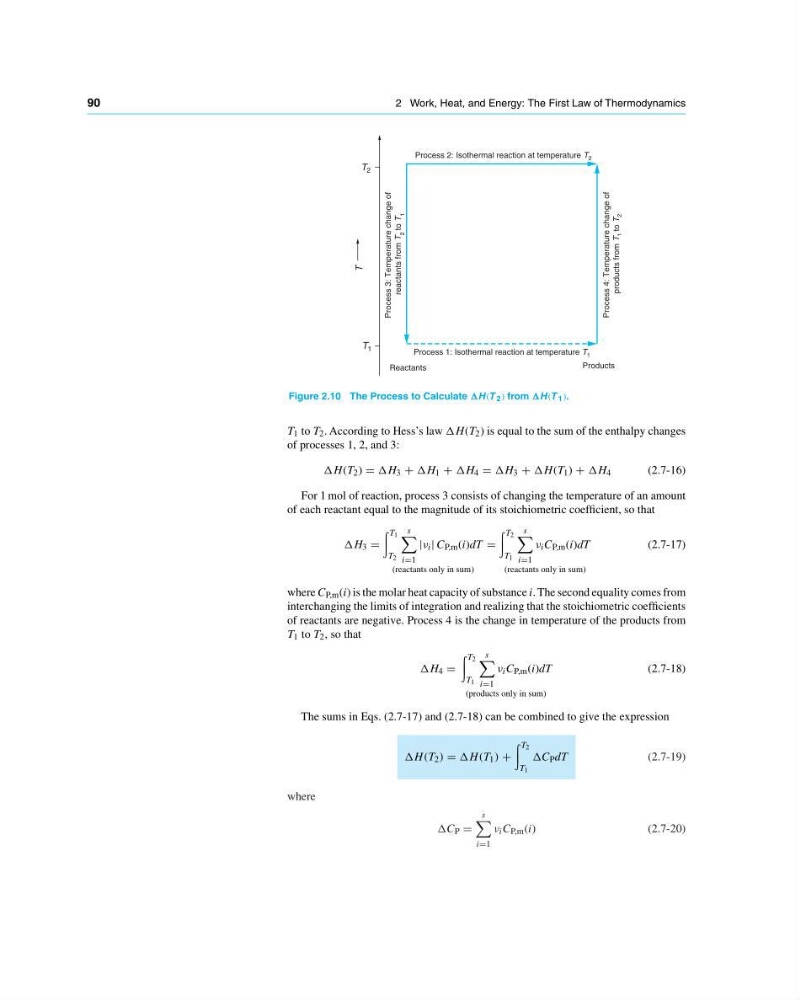
Figure 2.10 The Process to Calculate ∆H (T 2 ) from ∆H (T 1 ).
T 1 to T 2 . According to Hess’s law ∆H(T 2 ) is equal to the sum of the enthalpy changes
of processes 1, 2, and 3:
∆H(T 2 ) ∆H 3 + ∆H 1 + ∆H 4 ∆H 3 + ∆H(T 1 ) + ∆H 4
(2.7-16)
For 1 mol of reaction, process 3 consists of changing the temperature of an amount
of each reactant equal to the magnitude of its stoichiometric coefficient, so that
∆H 3
T 1
T 2
s
i1
|ν i | C P,m (i)dT
(reactants only in sum)
T 2
T 1
s
i1
ν i C P,m (i)dT
(reactants only in sum)
(2.7-17)
where C P,m (i) is the molar heat capacity of substance i. The second equality comes from
interchanging the limits of integration and realizing that the stoichiometric coefficients
of reactants are negative. Process 4 is the change in temperature of the products from
T 1 to T 2 , so that
∆H 4
T 2
T 1
s
i1
ν i C P,m (i)dT
(products only in sum)
(2.7-18)
The sums in Eqs. (2.7-17) and (2.7-18) can be combined to give the expression
∆H(T 2 ) ∆H(T 1 ) +
T 2
T 1
∆C P dT
(2.7-19)
where
∆C P
s
i1
ν i C P,m (i)
(2.7-20)
2 Work, Heat, and Energy: The First Law of Thermodynamics
Process 2: Isothermal reaction at temperature T 2
Process 1: Isothermal reaction at temperature T 1
Reactants
T
T 1
T 2
Products
Process 3: Temperature change of
reactants from T
2
to T
1
Process 4: Temperature change of
products from T
1 to T
2
Figure 2.10 The Process to Calculate ∆H (T 2 ) from ∆H (T 1 ).
T 1 to T 2 . According to Hess’s law ∆H(T 2 ) is equal to the sum of the enthalpy changes
of processes 1, 2, and 3:
∆H(T 2 ) ∆H 3 + ∆H 1 + ∆H 4 ∆H 3 + ∆H(T 1 ) + ∆H 4
(2.7-16)
For 1 mol of reaction, process 3 consists of changing the temperature of an amount
of each reactant equal to the magnitude of its stoichiometric coefficient, so that
∆H 3
T 1
T 2
s
i1
|ν i | C P,m (i)dT
(reactants only in sum)
T 2
T 1
s
i1
ν i C P,m (i)dT
(reactants only in sum)
(2.7-17)
where C P,m (i) is the molar heat capacity of substance i. The second equality comes from
interchanging the limits of integration and realizing that the stoichiometric coefficients
of reactants are negative. Process 4 is the change in temperature of the products from
T 1 to T 2 , so that
∆H 4
T 2
T 1
s
i1
ν i C P,m (i)dT
(products only in sum)
(2.7-18)
The sums in Eqs. (2.7-17) and (2.7-18) can be combined to give the expression
∆H(T 2 ) ∆H(T 1 ) +
T 2
T 1
∆C P dT
(2.7-19)
where
∆C P
s
i1
ν i C P,m (i)
(2.7-20)